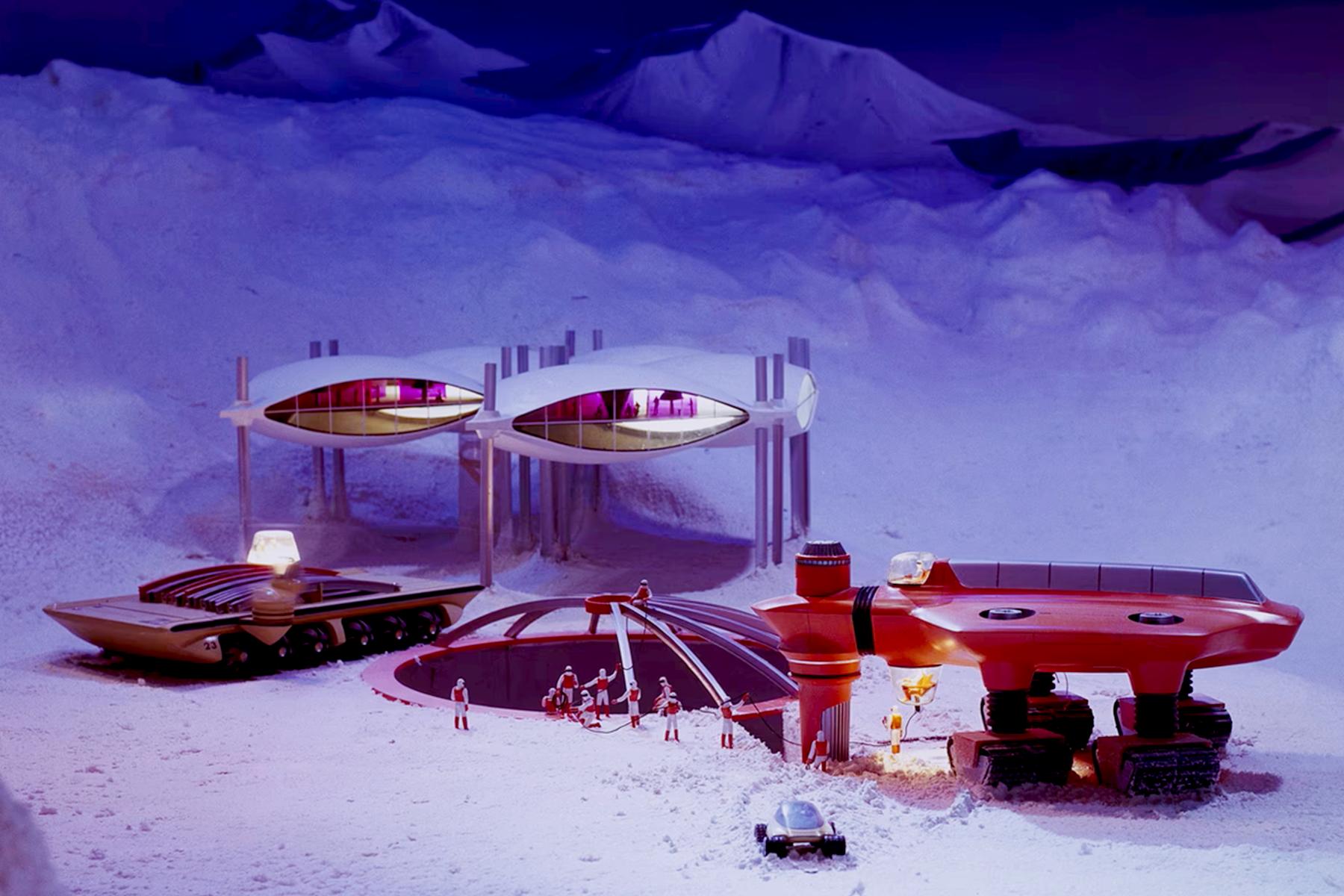
AP Photo, "A model of a deep hole cut into Antarctic ice, leading to a weather station, where technicians can prepare forecasts embracing whole continents, part of GM's Futurama exhibit at the World's Fair." Sourced Via.
I don’t know if kids still make dioramas in primary school. And sure, dust tends to settle on the unchanging dioramas fixed behind glass at natural history museums. This physical format—the very appeal of which lies in its tangibility—might be presumed obsolete, outdone and eclipsed by ever-advancing digital software.
As the reigning figurehead of early photography, Louis Daugerre is less often remembered for his invention of the diorama. A decade before debuting his namesake photographic technique in 1837, the Parisian multihyphenate paired up with painter Charles Marie Bouton to develop the diorama: a lifesize optical-mechanical spectacle. An accomplished set designer, Daguerre leveraged his expertise in staging enclosed worlds toward this fundamentally theatrical format. With the prototype debuted in Paris in 1822, the inventors sought not simply to reproduce reality, but to engineer an immersive visual experience capable of sustaining illusion as a self-contained spectacle. This early model invited urban audiences into highly specialized cylindrical theaters, where transparent canvases were animated by elaborate lighting systems to simulate atmospheric shifts. This novelty demanded the accompanying linguistic invention of “diorama,” a term derived from Greek roots meaning “to see through.”
The diorama soon spread across Europe as an experiential format characterized by a two-dimensional background and a three-dimensional foreground: a monumental hyperrealistic painting accompanied by props like foliage and rocks. These commercial attractions presented scenes ranging from historical events to pastoral landscapes. Dioramas catered to escapist fantasies amid rapid industrialization, with vignettes of distant lands inviting audiences to witness colonial expansion by proxy. By the end of the nineteenth century, the diorama oscillated between entertainment and education, serving not only as a spectacle of mass amusement but also as a site of knowledge production. In particular, the habitat diorama gained popularity in museums as a pedagogical tool shaped by imperial logics. As the lifesize spectacles spread throughout Europe and beyond, so too did smaller portable dioramas billed as miniature theaters.
In an era of Enlightenment-induced interest in perception itself, the diorama emerged alongside “eye machines” like the magic lantern, the peepshow, the zoetrope, and the panorama, all optical devices designed to augment perception and produce immersive environments. Together, these technologies participated in the historicization of vision at the dawn of modern visual culture, advancing a model of the spectator as a centralized subject, a master of the visual field. Through this carefully controlled form of spectatorship, realism depends upon the viewer accepting an illusion while remaining conscious of its mediation.
From its inception, the diorama has hovered between scientific authority and theatrical illusion, empirical display and popular entertainment. As a commercial format associated with technical skill, the diorama has long been marginalized from narratives of high artistic innovation. In recent decades, however, the diorama has proven ripe for artistic intervention precisely because it occupies unstable ontological territory, suspended between object and image, material construction and virtual projection, theatrical artifice and mimetic reliability.
Artists like Robert Gober and Olivia Erlanger—each through recent solo exhibitions in New York—make the case for the enduring relevance of the two-centuries-old format. The diorama, for these artists, manifests as a spatial logic at the very core of modern ocularcentrism. Whether as subject or format, the diorama is primed to probe the mechanisms through which representation is negotiated and reality itself is mediated. Some artists recall the institutional legacy of lifesize museum displays; others embrace the DIY-sensibility of miniature models. The diorama—as a spectacle of entertainment, a visual technology, an ideological instrument, and an artistic format—opens up both epistemological and ontological questions extending beyond this particular medium.
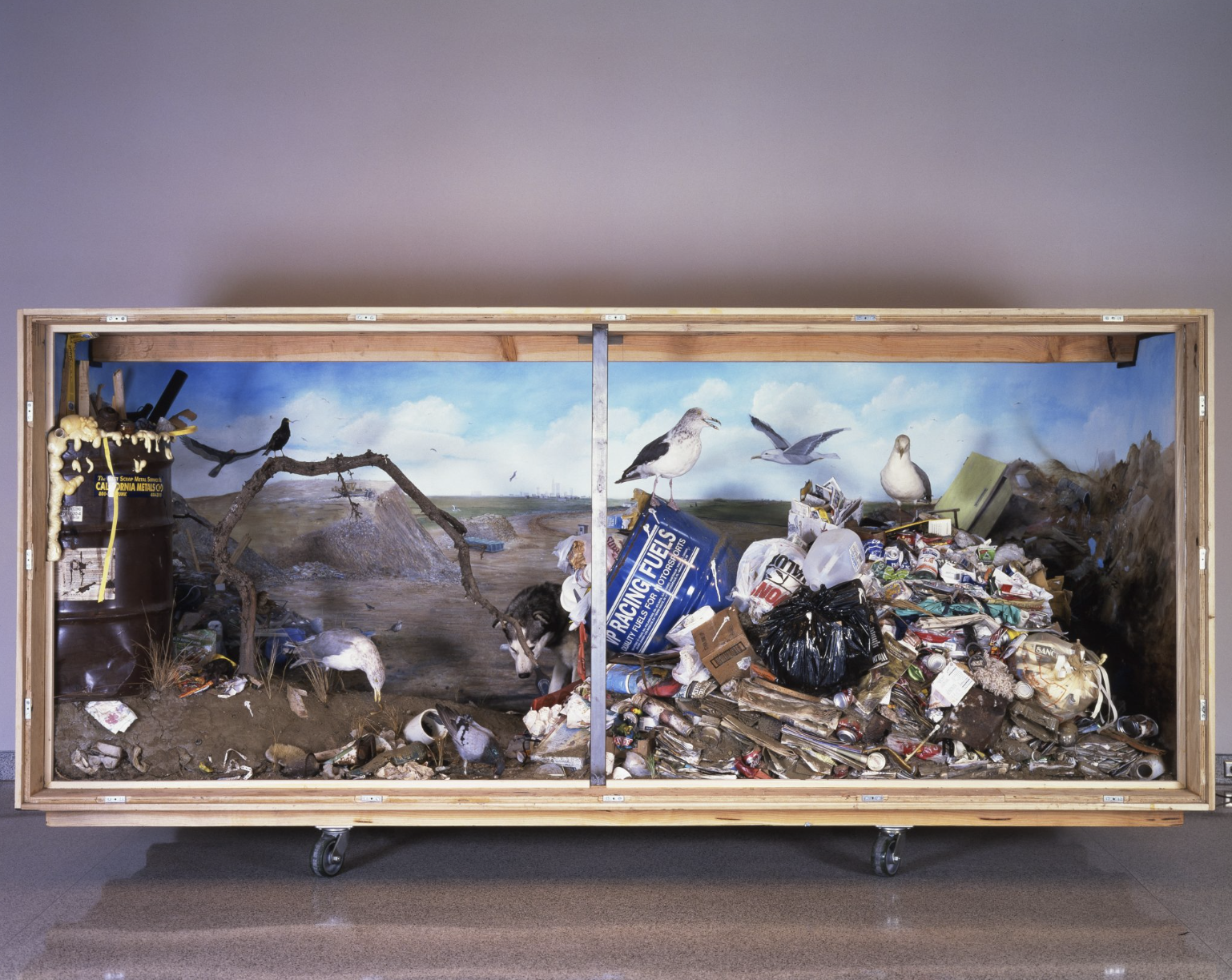
Mark Dion, Landfill, 1999-2000, mixed media, 71 1/2 x 147 1/2 x 64 inches (181.6 x 374.7 x 162.6 cm). Museum of Contemporary Art San Diego. Photo by Pablo Mason. © Mark Dion.
To see through
Artists from Mark Dion to Saya Woolfalk to Anicka Yi “see through” the habitat diorama as an epistemological vehicle rooted in imperialism. By the turn of the twentieth century, dioramas had become central to natural history museums in Europe and North America, where immersive displays of wildlife served as powerful instruments for shaping public concepts of nature as a historicized construct. Amid rising conservation efforts, the habitat diorama emerged as a subgenre characterized by three main elements: taxidermied animals, three-dimensional props like rocks and trees, and meticulously painted backgrounds imbued with the illusion of perspectival depth. The museological setting confers a sense of authority with the propensity to obscure the constructedness of these ideologically loaded Eurocentric displays.
Appropriating realism as the visual language of natural history museums and scientific display more generally, Dion questions age-old constructs distinguishing nature and culture, wilderness and civilization, and animal and human. Landfill (1999) stages taxidermied rodents and gulls in a mound of garbage—a heap of consumer excess—against a blue sky. Paris Streetscape (2017) is likewise brimming with trash piled to the top of the container. Taxidermied crows, pigeons, and rats scavenge amongst the clutter comprising their alleyway habitat. These particular urban critters—those often overlooked, if not actively targeted for extermination—resist the classificatory fantasies that elevate certain species as models of evolutionary fitness according to cultural scripts. Dion confronts these eugenicist underpinnings of dioramas geared to reinforce social hierarchies, often centering the alpha-male as the pinnacle of any particular species, for example. As Joanna Page reminds us, “the ‘resurrection’ of animals through taxidermy is always a rebirth into a cultural world in which they will be recast and resignified according to human values, conscripted to serve a particular vision of nature.”1
Dion exposes an irony embedded in the diorama as a colonial mechanism designed to protect ideals of nature that colonialism itself simultaneously threatened. Taking this paradox a step further, Dion evokes the tension between museological ideals of preservation and the realities of disposability culture. By situating these constructed scenes within free-standing shipping containers, Dion embeds the displays within the global circuits of late-capitalism, while recalling the imperial routes that delivered the dead animals in the first place. These familiar scenes operate in the present tense of ecological crisis, where the residues of hyperconsumerism shape ecosystems in which humans are inextricably enmeshed and undeniably implicated.
Artists like Rodrigo Arteaga and Adriana Bustos model an alternative approach through site-specific interventions into natural history museums, recalling the late-twentieth-century paradigm of the “artist as ethnographer”2 exemplified by Fred Wilson and James Luna among others. Epistemological and ontological questions converge with Arteaga’s Wetland (2018), a reconfigured diorama displaying painted ceramic ducks alongside taxidermied ducks, both from the collections of the Potteries Museum in the United Kingdom. This pairing belies the arbitrary nature of museological taxonomies while implicitly prompting consideration of the material and immaterial distinctions between the two types, one designated decorative and the other quasi-scientific. Are the taxidermied ducks as the restored remnants of once living creatures any more “real” than the ceramic ducks? Aren’t both ultimately abstractions, referential in nature? When it comes down to it, the same representational logic applies to both types of duck in the context of habitat dioramas, which fundamentally blur distinctions between the “real” and the “fake,” incorporating found and taxidermied specimen alongside fabricated props, all ontologically leveled within the context of display calibrated through illusion. The diorama becomes legible as a system that produces equivalences between heterogeneous materials under the guise of scenographic coherence. Through these interventions, realism appears less as an inherent property of objects than as an effect of staging.
If photography freezes a moment in time, the diorama freezes an environment in a static tableau—in essence an image—that can be apprehended at a glance.
(Re)photography
Photography introduces an additional layer of mediation, further complicating representational logics in the context of the diorama as a theoretically referential yet fantastical construction. Richard Barnes foregrounds the behind-the-scenes labor underpinning habitat dioramas and their enterprise of illusionism. Desert Scene With Woman and Coyote (2005)—like Dulce Pinzón’s aptly titled Nostalgia (2011)—captures a human within the frame of a diorama, at the physical and ideological center of the display. The architectural frame is likewise rendered visible in Suspended Giraffe (2005), which mobilizes the diorama as a stage, in this case for a tragedy: a plastic-wrapped taxidermied giraffe appears dramatically hung by its neck, as if a performance of execution. The morbid image prompts reckoning with the violence baked into the ideologies advanced by the theater of these displays, cloaked by imperatives of “conservation.”
There is a deep sort of ontological affinity between dioramas and photographs as historically intertwined cultural technologies that manufacture reality-effects. Beyond their shared nineteenth-century origins, the diorama can be said to operate with photographic logic before the advent of photography itself: a proto-cinematic format, the diorama is a carefully composed scene organized around a privileged point of view, manipulated to produce the illusion of an autonomous world. In transforming dynamic environments into coherent visual fields, both rely on precise framing, spatial compression, and perspectival control, while masking those operations. Both derive certain authority from associations with scientific objectivity. If photography freezes a moment in time, the diorama freezes an environment in a static tableau—in essence an image—that can be apprehended at a glance.
Where Barnes foregrounds the seams of dioramic construction, Hiroshi Sugimoto moves in the opposite direction, playing into the seamlessness of museum displays. The photographer recounts his formative experience at the American Museum of Natural History in New York, which inspired his Dioramas series (1976–2016): “I made a curious discovery while looking at the exhibition of animal dioramas: the stuffed animals positioned before painted backdrops looked utterly fake, yet by taking a quick peek with one eye closed, all perspective vanished, and suddenly they looked very real. I had found a way to see the world as a camera does.”
At first glance, photographs like Nyala (1980) seem to have been shot on site outdoors, with Sugimoto as a brave witness. The photographs are meticulously staged, however, just like the dioramas themselves. By aligning his lens with the single perspectival point of the diorama, Sugimoto effectively obscures its physical and discursive frame. Where the museum visitor is aware that they’re looking at a display, the photograph is devoid of contextual clues—cropping out object labels, museum architecture, and even the glass, a surface notoriously difficult to capture without reflections. Detached from these markers of mediation, the fabricated environments acquire an uncanny plausibility. Antelopes, tigers, and zebras are transformed from museum specimens into living creatures encountered in the wild. Photography, in this sense, completes the illusionistic ambitions of the diorama, intensifying its realism. As Sugimoto himself remarked, “However fake the subject, once photographed, it’s as good as real.”
At the same time, the realism underpinning the series is ever so subtly unstable. Certain photographs like Polar Bear (1976) seem just a bit too perfect, the arrangements too symmetrical and the animals too still, not to mention the implausibility of capturing such a vicious predator at such close proximity. This nuance is crucial to the critical force of the series, insofar as the viewer becomes aware that realism itself has been staged.
Sugimoto terms his process “(re)photography,” insofar as his lens captures what is in essence already a photograph, enacting a representation of a representation. By this logic, the camera enters into a preexisting apparatus of representation, documenting a cohesive world already constructed for viewing, the image then effectively performing a second more convincing act of authentication. Both dioramas and cameras produce persuasive realities not because they faithfully reproduce the world but because they organize vision according to a unified predetermined perspective. This notion of (re)photography effectively shifts the discussion away from the epistemological function of dioramas as ideological instruments to the ontological uncertainties latent within the format.
At first, dioramas appear to be technologies of knowledge, but understood as “eye machines,” they become technologies for producing reality effects. Dioramas have never simply represented worlds—they engineer modes of seeing within the context of the particular display and beyond. The significance of the format lies not only in the realities they depicted but in the perceptual conditions they established, which continue to inform photography and emerge across installation art and other immersive media. The emphasis shifts from “What knowledge is being conveyed?” to “What conditions of perception make this world appear real?”
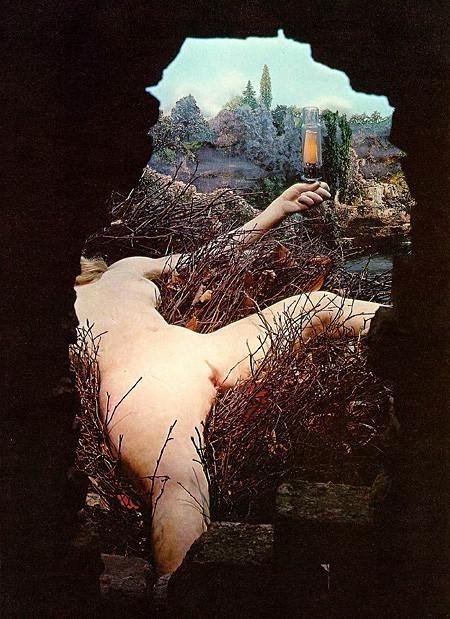
Marcel Duchamp, Interior view of Étant donnés, 1946-66. © 2009 Artists Right Society (AGP), New York / ADAGP, Paris / Succession Marcel Duchamp. Courtesy Philadelphia Museum of Art.
Sculpture-construction
As is so often the case in art history, the discussion of dioramas leads us to Marcel Duchamp. Étant donnés: 1° la chute d'eau / 2° le gaz d'éclairage (1946-66) evinces the potential of the diorama as a site of avant-garde inquiry, foregrounding the psychological and erotic implications of spectatorship. After having publicly renounced art-making to pursue chess, Duchamp toiled in secret, assembling this intricate apparatus in a corner of his Manhattan apartment over the two decades leading up to his death.
The posthumously constructed permanent installation at the Philadelphia Museum of Art invites visitors, one at a time, to look through two small eye-level holes in a rustic wooden door to a carefully constructed scene: an almost life-sized nude female mannequin appears splayed atop twigs in a rural landscape replete with a waterfall running with real water. Viewers encounter the scene—the virtual space—only at a distance. Bricks staged inside the wooden door simulate the experience of looking through not just the peepholes but also a hole in a wall, intensifying the voyeuristic quality. The apertures restrict visual access to a carefully controlled perspective from which the single vanishing point of the scene aligns with the vulva of the mannequin, recalling Courbet’s infamous L'Origine du monde (1886). On one hand, the wooded setting together with the spreadeagled mannequin mobilizes the colonialist trope conflating women with “nature” as passive objects of consumption and possession. Is the gaze established through the peepholes—those eroticized apertures—the male gaze in its purest form?
The disturbing scene undoubtedly objectifies, while drawing attention to the visual mechanisms of objectification. Duchamp plays upon the reclining nude and the pastoral landscape as art historical traditions, yet resists the uncritical scopophilic pleasure expected from these subgenres. As Elena Filipovic explains, “a mix of hyperrealism and strangeness, pornographic explicitness and utterly un-arousing awkwardness [. . .] keeps the viewer from being seduced by the very ‘tableau’ that the painterly tradition seems to be inviting us to behold.” The uneasy artificiality of the display is most palpable in the crackled parchment skin of the mannequin. Here, realism teeters into the uncanny territory of the hyperreal.
It might be surprising that Duchamp of all people committed himself to handcrafted verisimilitude, departing from the readymade logic underpinning a career spent prioritizing ideas over aesthetics. That said, Étant donnés reflects his sustained interest in eroticism and the mechanisms governing spectatorship and exhibition. Crucially, too, Duchamp’s illusionism does not simply revive traditional representation but interrogates the conditions through which representation functions. In the broadest sense, this commitment to illusionism might be considered a conceptual intervention, a reflexive gesture that unsettles the ontological basis of his oeuvre.
By forcing viewers into the role of peeping observers, Duchamp foregrounds the act of looking as an embodied, psychologically charged process rather than a neutral, objective mode. Duchamp’s extremely detailed Manual of Instructions for the assembly of Étant donnés (1966), a guide replete with diagrams and polaroids, attests to his imperative of controlling perception as integral to the experiential piece. Through these voyeuristic dynamics—which extend to museum-goers waiting in line, looking at the looker—Duchamp effectively thematizes the very act of looking, in addition to the eroticized implications of institutional display. Perspective itself, then, is bound up with desire, charged by exhibitionary power.
This project in its ontological complexity confronted the limits of sculpture as an established category, calling for a more nuanced term. Duchamp—ever the linguist—went with “sculpture-construction,” a hybrid category geared to this totalizing scenographic format, which involves yet exceeds sculpture. The tacked on “-construction”—even just the hyphen itself—signals a sense of provisionality that undoes the finitude of sculpture as an elevated category, evoking the elaborate underlying process of fabrication. On one hand, “sculpture-construction,” seems to anticipate the later advent of “installation art.” And yet “installation” isn’t quite right in its phenomenological associations. Where installations, like sculpture, can typically be viewed from all angles, allowing visitors to move freely, Duchamp’s diorama is premised on perspectival control.
Étant donnés operates more like a pre-composed image: the scene is framed, the vantage point is fixed, and peripheral information is cropped. Looking through the peepholes does not mean looking at a fluid, interactive three-dimensional room. Instead, the viewing apparatus collapses the 3D space into a flattened image. The door acts as an emphatic spatial barrier—the antithesis of museum glass designed to go unnoticed—clearly distinguishing between the virtual space of the scene and the physical space inhabited by the viewer.
By this logic, Étant donnés might seem conducive to photographic documentation, which captures the view through the peepholes. However, photographs eliminate the very experience of looking through the apertures as crucial to the work. The voyeuristic dynamics recede, as does the trickling sound of the water, the woody texture of the door, and the pressure of people waiting their turn.
Étant donnés is a case study in how the diorama, as an illusionistic spectacle supposedly “alien” to modernism, in the words of Hal Foster, reenters avant-garde discourse as both a subject and a format ripe for artistic inquiry. The generative force of Duchamp’s culminating piece is reflected by the countless works that have revisited its premises, whether through explicit recreations by artists such as Richard Baquié (1991) or more oblique homages by artists such as Richard Jackson (2006). Where Simon Leung (1996) incorporated a photographic reproduction of Duchamp’s set-up, Marcel Dzama (2007) channeled the conceptual thrust of this infamous provocation.
(Re)pictorialization
Robert Gober repeatedly recalls Étant donnés, which he visited ahead of his 1997 exhibition in Los Angeles, where he included a fabricated tide pool glimpsed only through a grate in the floor. Apertures, windows, and barriers appear throughout Gober’s work, simultaneously inviting and frustrating visual access. As with Duchamp’s peephole, these ocular devices demand awkward acts of peering, heightening awareness of how vision is constricted and oriented.
Gober incorporated real running water in Waterfall (2015–16), which explicitly recalls la chute d’eau in the background—and the title—of Duchamp’s enigmatic display. Gober’s “waterfall”—more of a trickle over rocky terrain—is viewed through a small square opening in the back of a suit jacket, which acts as a frame and an object unto itself. The opening, on one hand, seems like a window or a portal, the inlaid vignette seemingly belonging to an alternative dimension, surely something, somewhere other than the white cube. At once, the opening acts as a pictorial frame that presents the real thing in literal terms rather than an exacting representation or a Platonic ideal. The subtle sound and movement of water intensify the tension between material presence and representation.
Gober, who once described his work as “natural history dioramas about contemporary human beings,” extends this ontological ambiguity to his more recent constructions, which simultaneously recall Duchamp’s miniaturized Boîte-en-valise. The shallow boxes contain mundane props like a can of grease and a clothesline that initially seem transplanted from everyday life. The meticulous details of these objects encourage close inspection, though, which reveals subtle markers of their handmade construction. Gober’s fabricated realism—a sort of hyperrealism—never stabilizes into seamless illusionistic coherence. Somewhat ironically, verisimilitude here becomes a vehicle for estrangement by rendering seemingly ordinary objects subtly uncanny.
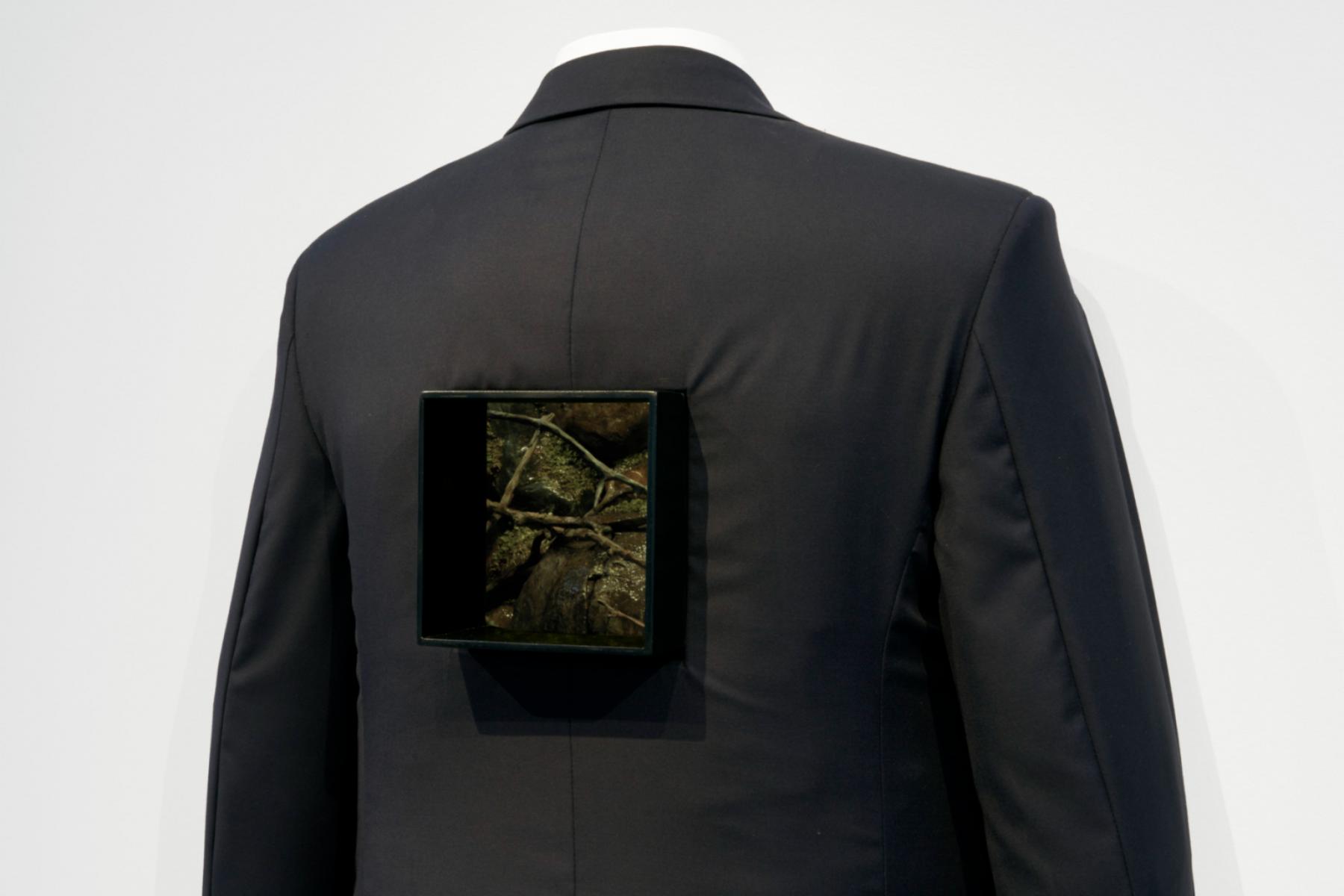
Robert Gober, Waterfall, 2015–2016. Wool, cotton, wood, paint on epoxy putty and resin, recycling pumps, lights, water. 115 × 67 × 64 inches. Courtesy of Matthew Marks, New York.
.jpg)
Each box amounts to a sort of impossible perceptual puzzle resulting in ontological confusion. In the cryptically titled Help Me (2018–2021), wax-coated curtains appear billowing yet paradoxically immobilized, fixed in encaustic perpetuity. Miniature paper snowflakes are taped on both sides of the glass threshold—the fourth wall, if you will—leaving viewers unsure whether they occupy an interior or exterior position, whether the scene belongs to memory or fantasy. On the back wall of a more recent tableau, a miniature window with prison bars transforms the metal box into a microcosmic world unto itself, a dollhouse in which sentimentality is undercut by the suggestion of jail. Simultaneously, blinds that hang from the top—a scaled-up threshold layered in front of the barred opening—suggest the metal container itself as a window. In another work from the same series, blinds emerge from the bottom, gravity notwithstanding. Each thus seems like a discrete world governed by its own inconsistent and incoherent spatial logic, if any at all.
Through these works that oscillate between sculptural objects, architectural fragments, framing devices, miniature stages, and sites of psychic externalization, Gober intensifies the ontological instability of the diorama, engaging the same complexities that compelled Duchamp’s articulation of the “sculpture-construction.” And yet Gober’s scaled-down boxes operate in a more ambiguous register, recalling the multitude of age-old metaphors through which painting is conceived—as a window, a screen, an interface, an object—without settling into any particular association.
Rather than inviting viewers into coherent fictional worlds, Gober’s constructions revel in the instability of the spatial systems upon which representation depends. Reflecting on this persistent sense of disorientation, Foster explains that Gober’s work reflects “a (re)pictorializing in which the space of installation, for example, is treated as fictive, semivirtual, or again quasi-fantasmatic, a space of psychological projection.” With this key notion of (re)pictorialization, Foster suggests that Gober counters the effort of much postwar art to move beyond the picture plane, whether to emphasize objecthood, site-specificity, or phenomenology. Gober, by this logic, reintroduces pictorial experience within the realm of three-dimensional art, evoking a sculptural environment as a tableau. Gober’s uncanny objects might be seen as image-like, encountered not as functional things but as props carefully staged with a sort of theatricality.
This notion of (re)pictorialization coincides with (re)photography in that both terms describe a secondary layer of mediation, neither artist working with untouched reality. If Sugimoto’s series investigates photography’s capacity to authenticate an already mediated reality through (re)photography, Gober's installations perform a related operation in reverse. Through (re)pictorialization, ordinary objects and architectural fragments are transformed into image-like tableaux. In both cases, the artists reactivate the diorama’s fundamental ability to convert physical space into a virtual scene—the diorama emerges as a useful intermediary in occupying unstable territory between object and image, environment and picture, material construction and virtual world.
Gober offers perspective on the ontological status of his dioramas in describing them as “cabinets.” On one hand, this description might recall the wunderkammer—the cabinet of curiosity—as a proto-museological format. More pointedly, though, Gober invokes domestic craft, reveling in quotidian associations that likewise define his dollhouses. The palpably handmade household props maintain the tactile intimacy of DIY projects. The small scale invites close inspection and imaginative projection, further aligning the boxed environments with hobbyist traditions of world-building, from model train sets to primary school projects assembled in shoeboxes.
In condensing entire systems into bounded spaces scaled for detached observation, miniaturization has the potential to subtly reproduce fantasies of mastery.
Are dollhouses, then, dioramas of the domestic variety? Nancy Buchanan invokes the dollhouse as a site of fantasy—namely the American Dream, in which private property is a central signal of capitalist ascension. In each of the six windowless, structurally sealed-off houses, a video plays on a tiny TV. The found footage, ranging from nuclear-age propaganda to accounts of relentless suburban sprawl, renders tangible the interpolation of politics within domesticity as a politicized phenomenon itself. Buchanan and her collaborator Carolyn Potter upend any notion of “separate spheres,” a construct tied to the dollhouse as a site of gendered pedagogy. The videos undercut any pretenses of play, while rendering the gleaming gold decor all the more gaudy, mobilizing tension between the visual rhetoric of prosperity and the lived realities of housing precarity. The dollhouse becomes a site of structural intervention: the fantasy of a self-contained suburban home is continually interrupted by the external systemic forces that produce and sustain it. Miniature environments are never neutral, but encode social hierarchies. The dollhouse is not outside the history of the diorama so much as an ideologically charged inflection of the format.
Olivia Erlanger likewise confronts capitalist logics of private property at a shrunken scale, leveraging the theatricality of the diorama to play out curdled promises of technological futurity. Through Erlanger’s conception of dioramas as “proposals for a speculative future,” the container becomes both a world and a critique of world-making. The series of four boxed environments recall architectural mock-ups and film-set maquettes, each a discrete ecosystem differentiated by atmospheric tint. In Blue Sky (2024), the meticulously manicured garden might first seem serene, but this eerily empty setting quickly becomes unsettling in its palpable artificiality. Modeled after Alain Resnais’s shots of Nymphenburg Palace in Last Year at Marienbad (1961), the rigidly symmetrical landscape with its trimmed hedges and classical plinths evokes an obsessive desire for control. Meanwhile in Green Sky (2024), vacant apartment towers seem to play out the logic of late-capitalist development. The peculiarly colored skies heighten the theatricality of these scenes, as does the extreme tilt of the ground, which exaggerates the technique through which perspective is traditionally achieved in dioramas. Simultaneously, the distinctive hues suggest ecological instability. The orange tint of a barren desert landscape recalls the all-too familiar skies of ecosystems on fire.
Erlanger’s interest in “the ways in which we express power through property” is embedded not only within the depicted scenes but also within the logic of the miniature itself. In condensing entire systems into bounded spaces scaled for detached observation, miniaturization has the potential to subtly reproduce fantasies of mastery. In this series—with its aim to “move between the problematic lexicon of a natural history museum and the intimacy of a hobbyist’s world”—miniaturization intensifies the friction between playful make-believe and dystopian speculation. Operating at the convergence of nostalgia and anxiety, these dioramas function simultaneously as fantastical refuges and stages for the material rehearsal of fears surrounding ecological catastrophe.
The rhetorical power of the miniature diorama as a speculative apparatus is reflected by the recurring centrality of the format across World’s Fairs. Erlanger specifically recalls the mobilization of the diorama as a vehicle of commercial propaganda with General Motor’s Futurama in 1939 and Futurama II in 1964. In the first iteration, GM materialized a utopian future centered around the automobile, projecting suburban expansion enabled by dense networks of highways. The choreography of fairgoers seated on a moving platform recalls the theatrical premise of Daguerre’s diorama, though in this case the elevated vantage point conferred a sense of superiority over the shrunken landscape. Under the guise of entertainment, Futurama was propaganda geared simultaneously toward corporate interests and American Exceptionalism, as championed by the official brochure: “This vision of 1960 dramatizes possible highway progress—highways to new horizons of a country's welfare and happiness.”
The second iteration espoused reinvigorated technological optimism with a three-block-long model featuring underwater retreats, lunar civilizations, and arctic weather control stations embedded deep beneath an Antarctic ice shelf—habitats similar to Erlanger’s tinted ecosystems. The physicality of the model enabled visitors to imagine far-fetched futures, while associations with architectural models lent a sense of plausibility. This experience billed as a “ten-minute trip into the future” effectively naturalized a specific vision of development, staging fantasies of total infrastructural mastery secured through technological advancement.
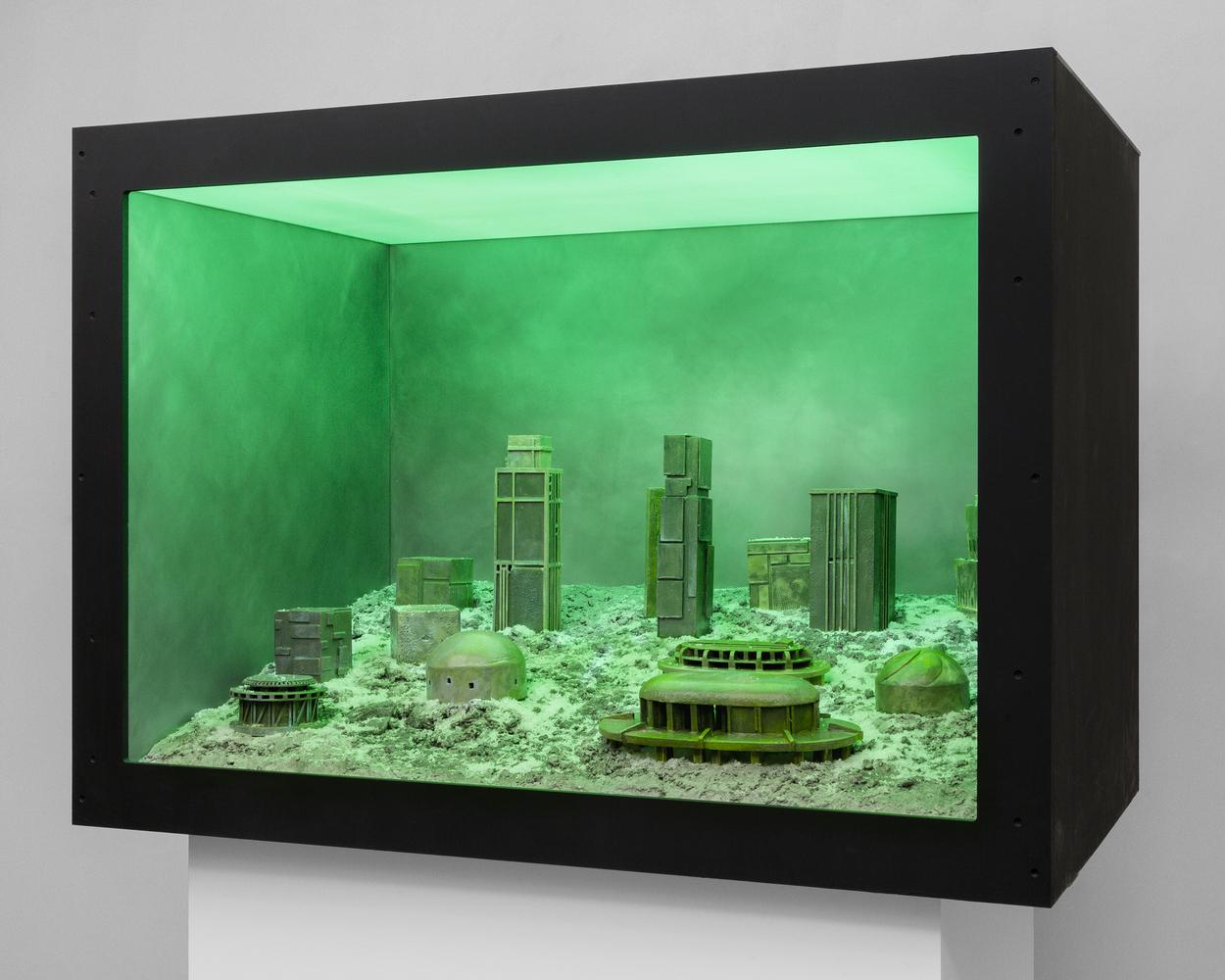
Olivia Erlanger, Green Sky (detail), 2024. Wire, flocking, foam, plaster, acrylic, aluminum, graphite, shoe polish, LED, Plexiglas, and driver, 50 x 32 x 36 in. Photo: Daniel Terna, © Olivia Erlanger, Courtesy the artist, Soft Opening, London, and Luhring Augustine, New York.
-rama
By trademarking “Futurama,” extending the logics of private property to linguistics, GM strategically tapped into the lengthy history of “-rama” spectacles. From the nineteenth century, countless international attractions adopted the suffix to signal novelty—cyclorama, cosmorama, georama, and myriorama, and so on. The suffix itself soon came to signal immersive visual experience, while serving as a branding mechanism tied to consumer spectacle. The modifier connoted an expanded visual field that exceeded ordinary perception through technological mediation. The totalizing logic of these spectacles often catered toward fantasies of mobility and mastery over distant spaces, histories, and futures. The diorama promised a total environment; the panorama a total view; Futurama a total future.
Today, the catchy suffix is kitschy, perhaps with a tinge of nostalgia for simpler outmoded technologies. On a deeper level, “-rama” shifts focus from the diorama as a discrete medium to a broader cultural logic tied to aspirations of novel perceptual experiences. Whether surveying a panoramic battlefield, peering into a habitat diorama, or gliding alongside the miniature infrastructure of Futurama, the spectator is centralized, granted privileged access to a coherent totality. This linguistic legacy is a testament to ocularcentrism as the defining register of Western modernity.
Both the Futurama models and Erlanger’s miniatures rely on the diorama as a technology of projection, a means of rendering speculative futures visible and graspable within a contained visual field. Erlanger, though, offers a critical counterpoint to the utopian futurism of mid-century spectacles by questioning the underlying assumptions about technological advancement. Where both editions of Futurama staged visions of ultimate infrastructural command, Erlanger’s compact worlds register the exhaustion of those promises, setting forth environments shaped by the consequences of modernist fantasies.
Like many contemporary artists working with miniature environments, Erlanger exploits the peculiar tension between containment and expansiveness embedded within the diorama form itself: the world appears reduced, ordered, and possessable even as the scenes evoke systems—ecological, architectural, technological—that exceed human command. As Susan Stewart contends, “the miniature has the capacity to make its context remarkable; its fanatic qualities are related to what lies outside in such a way as to transform the total context.”3
In our era of VR headsets and 4D IMAX, The Sphere in Vegas and endless Van Gogh “experiences” worldwide, the commitment to physical model-making feels critically charged. The handmade quality of Erlanger’s series complicates contemporary desires for frictionless virtual simulation. These interventions aren’t automatically technopessimistic, inherently pitted against computational world-building, though. These constructions can render visible the extent to which all environments depend on constructed conditions of perception. Such projects can reveal the shared spatial logic through which both analog and digital worlds are organized as coherent, inhabitable totalities.