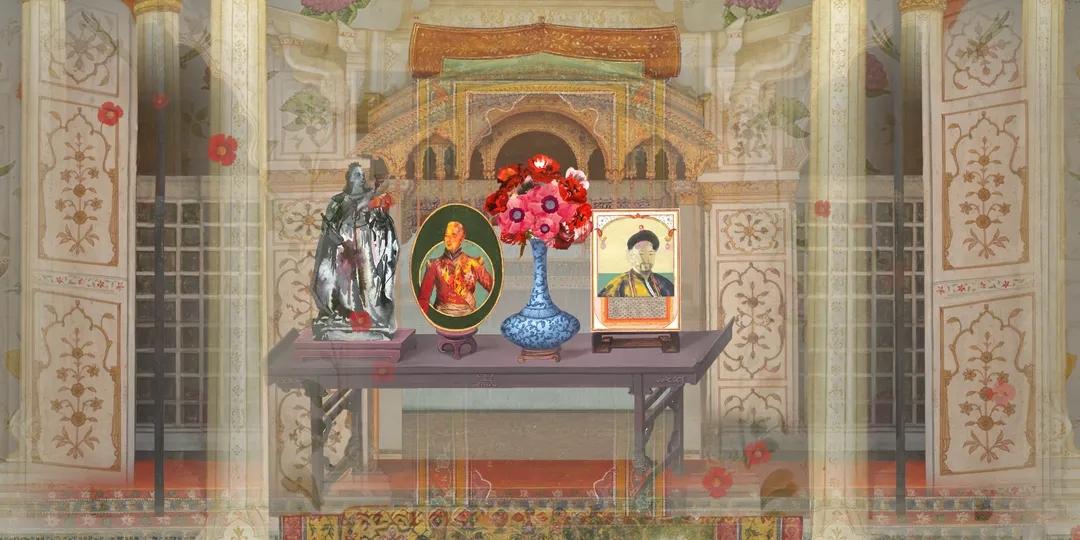
Shahzia Sikander, 3 to 12 Nautical Miles, 2026. Sourced Via
Artists often subvert imperial and colonial forms to critique the present, but such reimagining requires a refusal of easy answers in order to speak through and with the chaos of our present moment, ripe with contradiction, tediousness, shifting foundations, and novelty, which constantly remind us that the past is never past. Shahzia Sikander’s body of work spanning over 30 years expands to hold such necessary complexity.
Known for reimagining the Indo-Persian tradition of miniature painting, Sikander is a forerunner in neo-miniature, a practice that rethinks the traditional miniature form through experimentation with scale, medium, and context.
In the High Seas; Closed Skies exhibition at Victoria Miro in London, UK, Sikander’s cinematic animation, 3 to 12 Nautical Miles, is a hallucinatory palimpsest of intricately hand-drawn histories, heavily punctuated with various flowers like poppies. Initially commissioned by the M+ Museum and Art Basel as a site-specific public art installation for the LED screen overlooking the Victoria Harbour in Hong Kong, Sikander’s animation challenges the unrepeatable nature of site-specific installations because it is constantly shifting, hooking into the city’s rhythms imperceptibly, so that the flows of poppies across the screen feel akin to moving with a crowd through a packed commute.
The title of the animation is drawn from a maritime law which states that 3 to 12 nautical miles is the territorial zone that a nation can claim as its own. It reaches far back in time and is detailed in a United Nations convention from 1998: “In the eighteenth century, the so-called ‘cannon-shot’ rule gained wide acceptance in Europe. Coastal States were to exercise dominion over their territorial seas as far as projectiles could be fired from a cannon based on the shore […]. [T]he range of land-based cannons was approximately one marine league, or three nautical miles. It is believed that on the basis of this formula developed the traditional three-mile territorial sea limit.” In the 1960s, the distance extended to 12 miles.
What are the horizons of sovereignty when the littoral troubles the map? What kinds of knowledge need to be unlearned and embodied to imagine the possibilities that can arise in such a liminal zone? If these questions are lofty and abstract, it’s because I’m trying to situate us in the fugacious, mica-speckled threshold that is Sikander’s zone. Her work is as deceptively beautiful as her technique, which sparkles and shifts across surfaces and mediums but confronts us with pressing questions about sovereignty, neocolonialism, and extraction through the ephemerality of icons and art.
The congruence of her oeuvre makes it difficult to speak to each artwork separately. In the mixed-media illustration that opens the show, The Golden Nap, a cracked blood-red and ochre sphere is overlaid with gold leaf, the veins of which give it a molten, dynamic, earthy quality. At the top of the sphere, the heads, feet, and ribs of what look to be colonial figures are visible as they bend with the curve of the sphere. Gold leaf was frequently used in miniature paintings and in text in manuscript illumination, such as in the Shahnameh or Book of Kings, conveying the divinity of the stories told. It is also sprinkled on South Asian and Middle Eastern sweets, often on those served during celebratory occasions like Diwali or Eid. The effect of Sikander’s Golden Nap is one of inevitability; as the world turns, the sun rises and the light breaks; people arrive and depart in the shifting frames. This motif is one of the ways Sikander’s disavows binary thinking and easy answers. It finds echoes in the opening frames of 3 to 12 Nautical Miles in the arabesque pattern of the shamsa, a sunburst type of medallion frequently found in Islamic architecture (on the underside of domes), manuscripts, and art. While geometrical patterns can sometimes feel like gridlock, in Sikander’s images they swirl and dance, setting the rhythm of cyclical change, which informs all that follows.

In a series of animated tableaux, an emperor from the Qing dynasty gradually sits on the throne previously occupied by Mughal emperor Akbar. The stacked and layered perspectives of Indo-Persian miniature are jostled by the moving image, so that even though these rulers are monuments in themselves, they appear to be replaceable, as if they were paper puppets in a pop-up book with moving parts, whose architecture changes ever so slightly to convey a shift in time.
Sikander’s rebelliousness shines in her shapeshifting versatility across mediums and materials, such as in her treatment of another ruler: Queen Victoria, who referred to India as the “jewel in the crown” of the British Empire. In Possessed, the Queen is cast in mosaic tesserae arranged as intricately as the fine lines of Sikander’s paintings throughout; the smooth colour gradient across thousands of cut glass and stone fragments left me speechless. In place of the Koh-i-Noor diamond (still a part of the British Crown Jewels in the Tower of London), on the Queen’s chest lies a clump of heart-coloured red stones in the shape of India. Sikander touches on a truth that shapes the work of thinker Lisa Lowe, whose Intimacies of Four Continents details how Western historiography and the architecture of disciplines and archives obscures interdependencies between Asia, Africa, Europe and the Americas. Like Lowe, who reads across archives and disciplines “intimately,” recasting the meaning of emotional closeness to one that connotes the entanglement of four continents, Sikander also disrupts borders, boundaries, and maps to glimpse the grounds on which knowledge itself has been constructed.

In The Alchemist, the Queen is adorned in algae green. Cast in ink and what looks to be watercolour, she takes on the quality of an apparition rising from a shipwreck. The forms are fluid, and the spatial layer comprising the foreground makes it seem as though she is standing in the sea. There is a floating, transient quality to the work, similar to the way the Chinese and Mughal royals in the animation cycle through the images. Sikander is anti-monumental in this regard. Her cosmic scale, established through the motifs of shamsa, flowers, and cycles troubles the permanence of history precisely because of ephemerality; all the images are transient, challenging the monumentality of royalty and history, which is typically made to last. By including local craft such as the sampan, a flat-bottomed wooden boat found in South Asia, she builds with intimacy, as Lowe does, in thinking about what made today’s conditions possible.

Her reliance on fragments in the mosaic portraits and on collage in the miniature paintings scaled up for the moving image is a thorough reimagining of what a miniature painting can be. What lasts beyond the ephemerality that makes icons anti-monumental is the beauty of it all: the glint of gold leaf, the intricacy of tile, and the impeccable lines of her paintings and drawings. Sikander revives the once-shunned attitude towards ornamentation through her neo-miniatures, harkening the power of adornment and beauty across archives, disciplines, maps, and reigns. Sometimes, beauty is enough.