Claire Johnston, 2025, Stop Using AI! in Metis Beading Resurgence exhibit, Courtesy of the artist
Claire Johnston is a beadwork artist based in Winnipeg, Treaty 1 Territory, who began her practice as a way to connect with her Métis heritage. She’s fascinated by the history and materials of beadwork. Last year, she went to Venice as part of Canada’s entry to the 2025 Biennale and researched the connection between Métis beadworkers and Venetian seed beads.
Along with traditional seed beads, Johnston has also experimented with the use of various non-traditional materials, and is currently working with the St. James Civic Center here in Winnipeg for a large-scale installation that she described as an interpretation of beadwork in wood.
Johnston’s initial career path in provincial and federal politics turned out to be an unsustainable one for her. After a few years, she took a year off work to focus on her mental health. During that time, she was diagnosed with autism and ADHD, a combination referred to as AuDHD. Johnston has since become an advocate for neurodiversity. She’s a team member with the Re*Storying Autism project at Queen's University and firmly believes in cripping the arts – a movement that calls for centering disability as a generative site for creative practice, and for disrupting institutional hierarchies and norms.
After her diagnosis, I saw a post Johnston made about how finding out she has AuDHD changed her life. I did a double take on that post. Her words made me realize that my perception of autism was too narrow, and that I didn’t actually understand the breadth of its presentations. In 2023, I began to suspect that I might be autistic myself, and in March 2025 I got my diagnosis.
I saw something of myself in Johnston and finding out that she’s autistic sowed the seeds for my own journey. She’s talked openly about how her diagnoses allowed for self-acceptance and the ability to give herself grace. I would say the same for my diagnosis. While she stated in that post years ago that finding out she has AuDHD changed her life, it changed mine as well.
I approached this conversation wanting to learn more about her journey as an AuDHD artist and how the teachings she’s learnt from her Métis heritage connect to her understanding of neurodiversity. Johnston is among a growing resurgence of traditional Métis beadwork. She speaks of beadwork as a tool for connection: a connection to cultural heritage and a connection to one another.
Indigenous peoples worldwide have had words for people with specialized knowledge or specialized ways of thinking. It wasn't seen as some disease or a disorder. A lot can be learned from Indigenous people's understandings and languages around thinking about difference.
Can you tell me about the first time you tried traditional Métis beading?
It was with my sisters, we were all part of the Seven Oaks Métis Community Council, and during pandemic they had a six or eight week program for people to learn how to do floral bead work. We were part of a cohort of twenty women, all different ages, and we learned together through five different projects. I've kept up with all of these women and pretty much all of us have continued beading.
Did you feel connected to it right away or did any part of you know that it was going to become such a big part of your life?
I did immediately know, I was absolutely obsessed with it. The first time I tried it, I was like: ‘oh, that feels really good.’ I was immediately inspired to practice it and learn tons about it. As a young person, I had previously been creating with beads. So, I already knew that beads, as a material, were something I was drawn to. I like very, very tiny things and piecing them together slowly over time. But I wouldn’t have ever imagined that it would be as much of an important part of my life as it is now.
Dr. Sherry Farell Racette recently gave a talk at WAG-Qaumajuq on the resurgence of traditional media. At the start of the talk, she mentioned a few different Indigenous languages’ words for beadwork, and their translations. Some of the words translate to ‘a god-like activity’ and ‘emanating a life force.’ She then quoted Robert Houle saying that beadwork is, “like a prayer.”
Dr. Racette commented that this language makes beading seem like a holy activity, but that it doesn’t account for just how hard beading actually is, or the dedication required to be good at it. I was wondering if that brought up any thoughts for you, or how you would describe beading.
Yeah, I really liked that description of beadwork. It is prayer-like, it’s incredibly meditative. When I bead, especially if I’m making something significant, I need a strong purpose associated with it. As I’m beading, I'm spending time thinking about and putting energy towards a person or a thing. So, in that way, it is a prayer. Even right now, I'm creating a piece of beadwork for the Civic Centre, but I'm thinking about the community as I'm beading it. With the flowers I'm beading, I'm thinking about certain concepts or values that I want the community to have or feel or to be reflected in that space.
It can also be quite gruelling at times. If you're working on something significant for many hours, it can feel very frustrating or angering. There's a balance though, and those are the times where you have to take a step away, and then come back to the beadwork later.
In your artwork, you’ve used a range of materials including traditional seed beads and glow in the dark wooden beads. How do you balance traditions in Métis beadwork with contemporary designs and materials?
I've been playing with scale and materials in terms of contemporary interpretations of Métis beadwork and just seeing how it can feel different in different applications.
The glow in the dark wooden beads I despised working with, which was an interesting teacher for me. I wanted to create this large-scale interpretation of beadwork, so I spray painted large wooden beads with fluorescent spray paint. As I was assembling them and beading with them, when I went back to my own glass beads, I was just like, “my god, thank goodness.” The wood beads didn't give me that same feeling or excitement that the tiny glass beads do. It was still great to create that piece and explore beadwork on a large scale, in a different material, and with a different effect; but doing that piece gave me so much energy to go back to my own beadwork.
I'm very inspired by the beadwork of our ancestors. Going into collections and viewing old bead work, that's where an intense appreciation for materiality comes from for me. A lot of the old beads utilized very expensive modes of glass production, and they aren’t able to produce the same colours and finishes in contemporary beads. For example, the most special beads are often opaque pink beads, and 24 karat gold is required to make that colour. It’s expensive to produce those types of beads and those old beads existed during a very particular time, during the expansion of colonization.
I do incorporate a lot of antique beads from Italy and France into my beadwork. Just because I am drawn to those old colours and the old ways of making the beads. The diversity of the colours just does not exist now. A lot of them were also cut with a knife by hand. Now, most beads would be cut using a machine, so they're very exact. Every size and shape is pretty much the same. The old beads aren't necessarily that way. So, they take a bit more time and dedication to bead a perfectly straight line because each bead needs different tension and care when you're stitching them. I love using old beads for that reason.
Even the types of wool felt that were used, like Stroud, and whether those wool materials came from England or Scotland, where the silk thread would come from, all of those things interest me a lot because of the relationships and economies that were involved. Nowadays, those relationships or economies look quite different.
Dr. Cathy Mattes will often speak about how our ancestors would incorporate their current thoughts, ideas, and values into the beadwork. Contemporary artists are doing that too. We're beading similar florals, but we're putting into the work the values and things that are important at this time. For example, I’ve had very strong feelings about AI and wanted to channel that through an object that is sort of the antithesis to AI.
I wanted to ask you about that next.
One of your pieces included in Beading Métis Resurgence at Gallery 1c03 is a fire bag titled Stop Using AI! Can you expand on why that message is so important when it comes to Métis beadwork?
I was seeing an increase in AI generated images of Métis beadwork that looked grotesque to me. To me, it feels like a disrespect to our ancestors who made this beautiful tradition and left this beautiful legacy for us. To see images of our beadwork being generated in the flash of a second, utilizing technologies that are rooted in some pretty bad things (like water consumption, energy consumption, and exploitation of people's labour), it feels unnecessary.
Living Métis artists can be paid to create designs, there's no need to be generating them. Seeing Métis organizations in particular, who have funding, utilizing AI image generation to advertise for things like women's entrepreneurship or beading circles, to me is incredibly inappropriate. It’s also not aligning with the ethics behind beadwork, as well as the reverence that is and should be associated with our beadwork. It's really disturbing to me. Online, there’s a complete disconnect from the respect that should be associated with our beadwork.
In addition to that, even just for myself, understanding more about the history of AI technology, who has been involved in developing it, who benefits from it, and who is exploited in its development, I feel pretty strongly about AI. Not just as it relates to Métis beadwork, but in a societal way. AI disconnects us more from our bodies, disconnects us from our spirit, and disconnects us from the land, just so life can be easier in a way that maybe we don't need it to be easier.
It’s set to become the leading contributor of climate change, and a lot of governments worldwide are investing in dirtier energy again because of the need for energy to fuel data centers. Even here in Manitoba, the Port of Churchill is involved in discussions regarding energy for data centres in the province. In creating that bag, I wanted to contribute to critical discussions that are needed.
You mentioned earlier that when you're making beadwork and when your ancestors were making beadwork, all the thoughts and care that you're putting into it. If a generated image can be made in a flash of a second, all that is absent.
It's more in the way of viewing beadwork as a product. It's not a product. There's ethics with it. There's a way of knowing, a way of being and understanding the world that's involved in creating beadwork. Beadwork is a living object; it’s not just a static product that has no history or future, but that’s absent in an AI image.
Your mentor, Jennine Krauchi, told you: ‘We taught you. Now you go share it with others.’ How has your role as a teacher and workshop instructor informed your work?
A lot. When you're given the knowledge, it's your responsibility to pass it on. I don't just have that teaching from Janine, I also have that teaching from my dad. If you're not teaching and sharing the gifts that you have, that's an irresponsible and selfish way of being. Whatever gifts you have, they weren't just meant for you to have on your own.
When I'm teaching others, one of the most important things I try to teach is having confidence and gentleness with yourself. I also teach folks that it's okay to do things in the way that feels best for them, whether that’s using a different size bead, or a different size needle, or a different material to bead onto. It’s okay to be adaptive and to have a different approach. I think it's very beautiful when you teach somebody and there’s that spark of confidence when they get it. It reminds me of why I love to bead and what it brings to my life.
I have a young person who I mentor in a more serious capacity named Lily. This summer, it will be the fourth summer that we're working together. I started working with Lily when they were 17 years old and now, they're in their third year of university. Being able to directly share the knowledge and skills that I've received from people like Janine, and then directly give that to Lily, who's a generation under me, and then Lily is also now teaching other people, it's a really beautiful continuance of sharing knowledge and practises.
Lily also teaches me different ways of understanding things. I think intergenerational knowledge transfer is how we're supposed to live, and I'm fortunate to engage in that through being both a teacher and a learner, in both directions.
I've been hearing a lot lately about the need to learn from younger generations, how they have intuitive knowledge that we've kind of forgotten.
Yeah, I think it’s important.
As part of the 2025 Venice Biennale, you were selected as a fellow to engage in research on Venetian seed beads and their connection to Métis beadworkers. How was your time in Venice? Can you tell me about that connection between Métis beadworkers and Muranese impiraresse?
The research I did in Venice really impacted the appreciation I have for the materials that I use. I feel like I'll never use my beads in the same way again. I went to Venice to research the connection between Métis women here on Turtle Island and the beadmakers in Venice. I wanted to know what they knew about one another. No seed beads are made in Venice anymore.
Not even on Morano?
No, none. I went to Costantini Glass Beads, a factory that used to make seed beads, but they stopped production around 2001. Now they just sell the old stock beads.
In Italian, seed beads are called conteria. There were only a few people available for me to speak to about them, in part because the economy and production of conteria is of an older time now. In addition, there's very few Venetians who live in Venice anymore. I would ask people about the beads, and they would in turn ask why I didn’t go to Japan or Czech Republic. That's where the best beads are made now; but for me, it was the connection to the specific history and materiality associated with our ancestors, and their use of these beads from Venice that I was interested in.
A meaningful connection that I did make was learning about the impiraresse. There were quarters in Venice, and on Morano, where women would sit outside all day with a wooden box on their laps called the cessola. They would use these specialized needles, basically a whole bunch of needles used at one time to thread the beads. They were mostly impoverished women; oftentimes, it would sustain their household. If the men of the household didn’t have any work and couldn’t afford to buy food, the women would thread these beads day and night to sustain their families.
I met with two impiraresse, Louisa and Marisa. They were beadworkers and would also thread their beads in this traditional method with a cessola. They work very hard to keep this tradition alive in Venice, and they've both done work with UNESCO to give Venetian glass beads intangible cultural heritage. Both of them are involved in apprenticeship programs where they train women to do their own beadwork. They’ll also only work with the Venetian beads, because they have that same appreciation for tradition. I really connected with them because of that.
They were surprised that I was young, they thought I’d be an old woman and that it was only older women who were interested in these things. But that’s not the case, there are so many young people that are beading now. There were fractures because of colonization, and people weren't beading as much because you couldn't wear your beadwork, and proudly say who you are. Despite that, we have continued; there's a whole renaissance of beadwork right now.
Marisa invited me to a beading workshop when I was there. It was a different technique of beading, and the workshop was all in Italian, but the ways that everyone was around the table felt very similar to a beading circle here. There were all different generations around the table, and people were sharing stories, joking or swearing.
I also got to show them my beadwork and the Métis two needle style of beadwork. Being at that workshop, there was a familiarity through this connection of the seed beads and through remembering grandmothers and the role of women. We were all remembering those roles and trying to honour them through continuing to work with the seed beads and continuing appreciating them.
These Venetian beads will all be used one day, because they're not in production anymore. But regardless, there's still ways of holding onto that appreciation for communal ways of being and creating. It’s important to remember that, even if we don't have these particular beads.
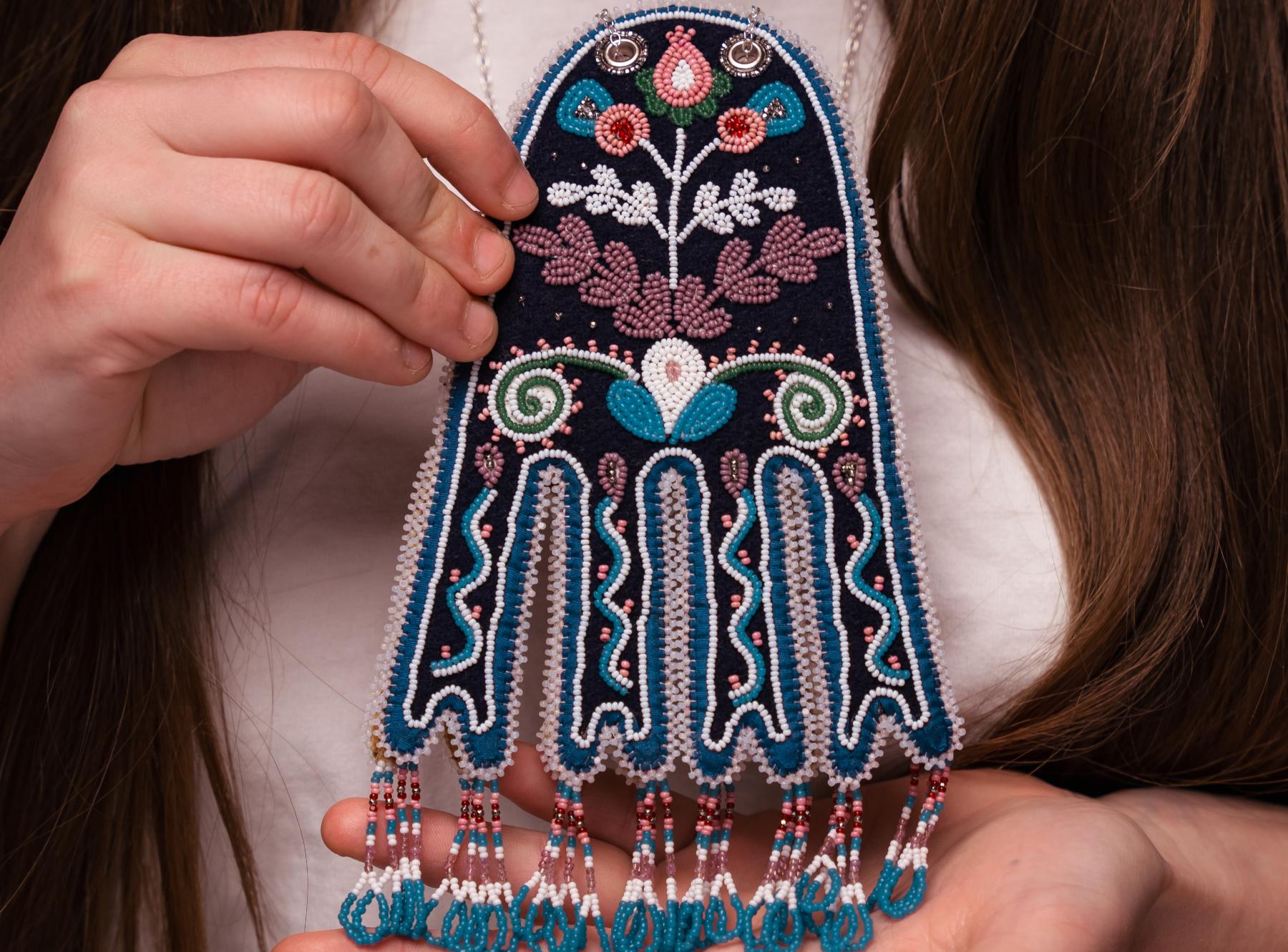
Claire Johnston, Maria's Octopus Bag, Photo by Kevin Settee
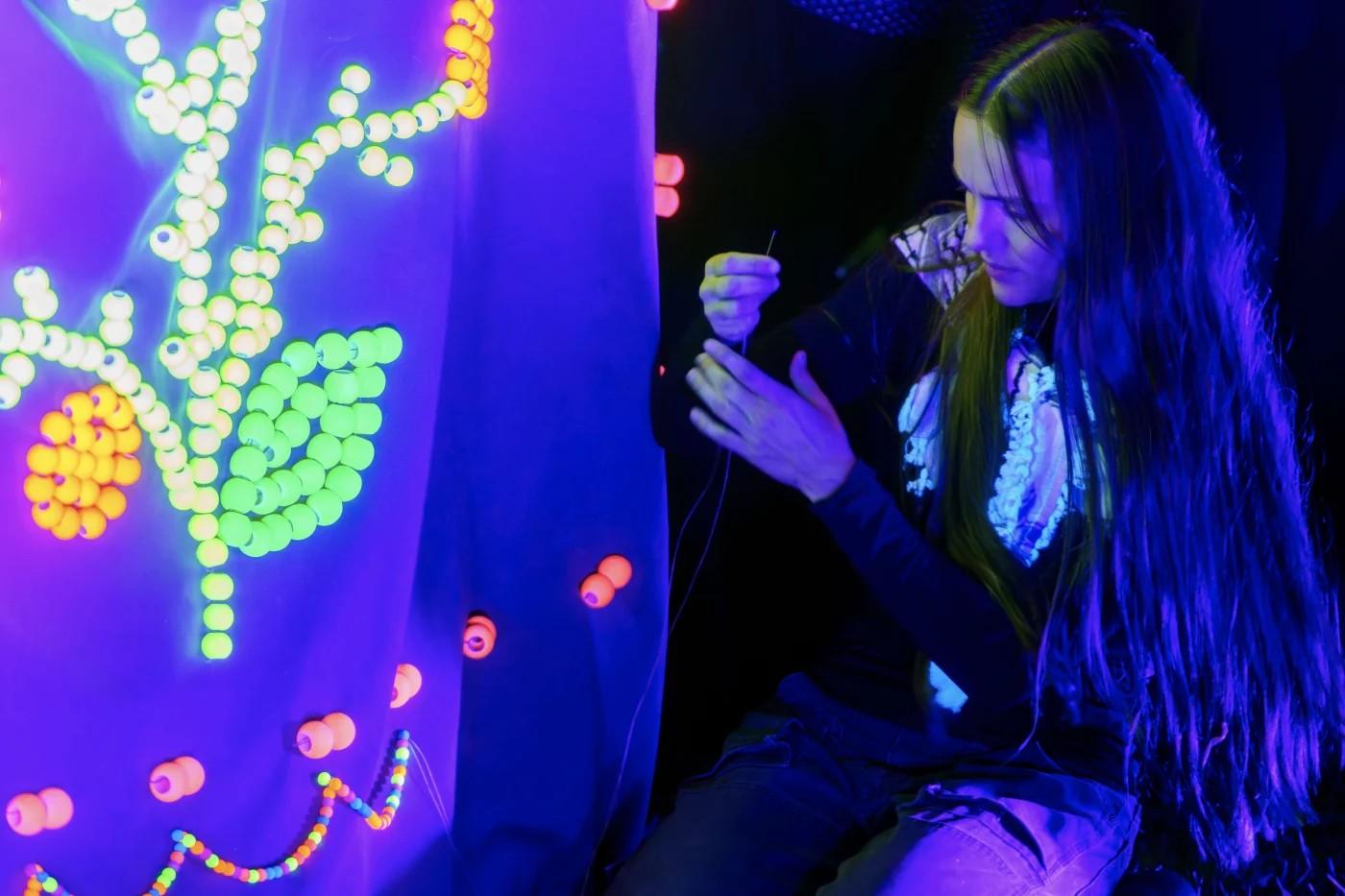
Claire Johnston at Nuit Blanche Winnipeg, Photo by Kyle Thomas
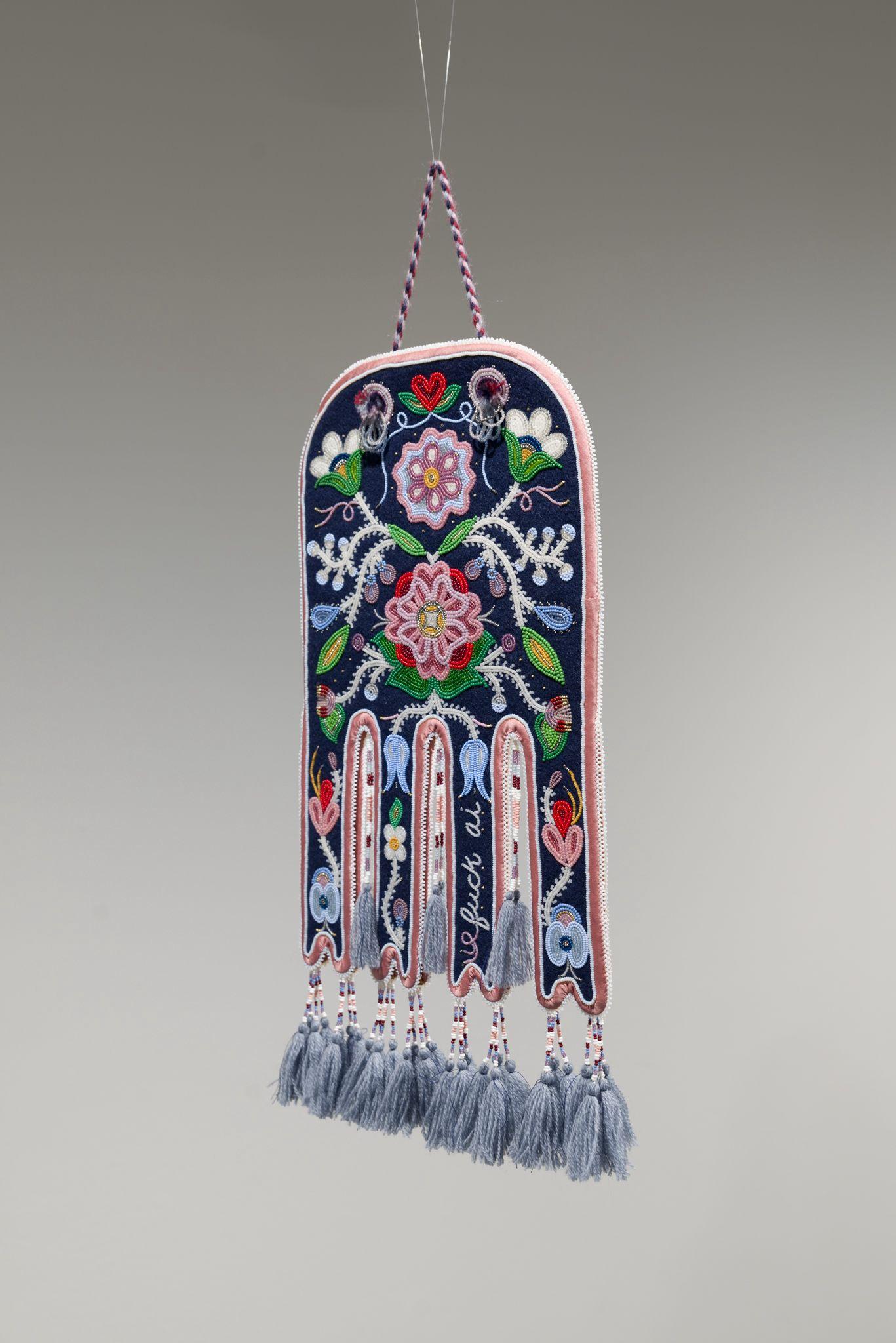
Claire Johnston, Stop Using AI!, Photo courtesy of artist
You once wrote that, “If my hands wish to move, I will honour them by moving them, utilizing them, caring for them.” I thought that was a beautiful statement to make regarding ADHD, that you should honour the movement of your hands rather than try to keep still.
How would you describe the connection between who you are as an artist and someone who has AuDHD? Are those two identities integral to one another?
When I'm looking at old beadwork, those remind me of me. The maker of the beadwork reminds me of someone who would have been like me.
People that are gifted at or love beading, I think are folks who get a deep sense of gratification or meaning from being able to do the same thing for a very long period of time. It's not everyone. The way that I bead, it’s very much incorporated into my everyday life and it helps me to be well in a lot of ways. It’s important for me to always have a focus and be doing something.
When you look at the DSM5 diagnostic criteria for ADHD and autism, the criteria are also what you would need in order to be a master at beadwork, or a knowledge keeper in some type of direction. The DSM5 categorizes these things as a disordered type of person, but it's actually a tool. I’m not saying I'm a master, but to be doing beadwork or something at such a level, you need to be obsessed. You need to have prolonged attention in a certain direction, and you need to dedicate your life in a way that most people wouldn’t.
I think that a lot of the ways that autism and ADHD are seen as disordered and wrong ways of being, are actually a lot of the things that are required to be good at something like beadwork. There are so many things I can think about with beadwork; I love patterns, we're constantly creating patterns. I have really gifted eyesight. I have very gifted dexterity. My dad does too. A lot of the gifts that I have, my dad also does. My dad doesn't do beadwork, but I'm sure he'd be incredible at it.
Do you think you ever would do beadwork with your dad?
I think he's much more likely to criticize my beadwork. One thing he says is, he hates working with, quote, “floppy materials.” He likes wood and materials that he can have really intense precision with.
My dad has pretty intense attention to detail. He's very good at making little, tiny, interesting things. My grandfather too, he made beautiful, intricate miniature wooden objects. Woodworking has been very important on the paternal side of my family. Both of my paternal great grandfathers were carpenters and woodworkers. My dad was an arborist and a woodworker, so wood is huge for us.
In my studio, I have pieces of woodwork from my grandpa and my great grandparents. I'm surrounded by these wooden objects as I'm creating. In the way that they loved creating tiny objects in wood, I have that same love for tiny beads and for beadwork.
In Elder Maria Campbell’s memoir, Halfbreed, she writes that healing work is done “always in the spirit of wahkohtowin,” which Dr. Kim Anderson defines in the foreword as “an interconnected web of relations in which everyone has responsibilities.”
You’ve connected this philosophy to your own journey in connecting to your Métis heritage, does it also connect to your art practice or to healing after your AuDHD diagnosis?
Central to the world view of wahkohtowin is that everyone has a place in the circle, and everyone has responsibilities based on that. A fundamental thing that's necessary is difference. Each person has a different part of the circle, a different role, and everyone has different responsibilities. We live in a Western world that pathologizes difference rather than celebrating it and seeing it as an integral part of society that’s needed and should be valued. Central to the Cree and Métis world-view of wahkohtowin, people who are different and have a different way of thinking are needed. There's inherent value in difference and in creating a balanced world.
My view on autism and ADHD, and neurodivergence in general, is that it's needed. That's why neurodivergence exists, because there's something that the world needs that we have. If we didn't exist, the world would be missing something. The same thing extends to sexuality and gender as well. That different sexuality and genders are also needed to live in a good world and good society.
Plants tell us that, too. Plants always live and exist in such intense difference. They usually flourish and grow healthier when they're around other plants, and not in a monoculture
Oh, I've never thought of it that way.
Yeah, monoculture is really bad for soil. Plants have relationships with one another that help each other. They have root systems that are connected. The same thing exists for us; we all have things that each other need, whether we're conscious of that or not.
I think about that even with my beadwork designs. I don't like doing mirrored designs but having difference and imperfections. Through different shapes and colours, there’s usually balance that exists within asymmetry.
The piece I just drew for the Civic Centre is titled Community Stitches Us Together. The whole piece is a floral design I drew and it's not mirrored. There are different plants everywhere, and it's not symmetrical, but it just finds balance. I feel like that's not just representative of the plant world, but also reflective of us. We're not supposed to be fitting within a perfect way of being. To be balanced, we require difference.
Cripping the arts is also decolonizing the arts, both of those things often go together because when you're recognizing the gifts of each individual and how they fit in the circle, then you're not going to create a system that doesn't allow people in the circle to contribute
At Nuit Blanche last year, you created how do you use your medicine?, an 8-foot-tall medicine bag. Nuit Blanche can be a highly sensory experience and Jennifer Markides noted that your work “was designed to be contemplative, slow, and intentional—teachings integral to Métis beadwork.”
What inspired you to create the medicine bag for Nuit Blanche? As an Autistic artist, were you worried about sensory overwhelm with Nuit Blanche?
Yeah. I've only gone to Nuit Blanche once when I was young and I haven't been back.
I’m the same. I went once, found it too overwhelming and I've never gone again.
Yeah, typically, it’s super loud and it's like… actual hell.
Yeah, I'm in full agreement there.
So, when Nuit Blanche reached out for me to submit a proposal, I almost said no. But, within the submission, they allowed you to propose a site. I thought I could maybe choose to do something different, in a way that works for me. If I did, then it also might attract people that typically might not come but would be okay to come to this.
I love the water, I feel very peaceful being around the river and trees. So, I went for a walk all around the perimeter of the festival and selected a site near Stephen Juba Park. I didn't want to use bright lights or loud sounds; rather than having those typical things, I went with something slow and glow in the dark.
Janine has this massive octopus bag in the Canadian Museum for Human Rights that involved community in an active role. Part of the construction of that bag was done with elementary school students; they strung the bottom tassels of beads with her. I thought I could have the community come and add a bead, one at a time, with me throughout the night.
Part of my initial hesitation was that I can't stand around my art for six hours of socializing with people. I can't do that. If I'm actively doing something that’s of interest to me though, while I'm with people, then that's okay. In the end, the night went like that.
I had a big needle and one by one, folks would come to add a bead onto the thread, and I would stitch it on. People were so excited to actively participate and add a bead. Children also, it was very, very sweet to see children participating and being excited to participate.
Going back to that concept of prayer or the holy act with beadwork, when people came to put on a bead, they came with an intention in adding that bead. They would either tell me their intention, or they would take a moment to hold the bead.
It was a super nice evening. It was away from most of Nuit Blanche; I personally wouldn't have been able to have my piece in more active areas. I made the piece in a way that worked for me to be able to be there, and I hope I created an experience that worked for people like me to come too.
You’ve used the term Piitoshi-iteeyihten (one who thinks differently) and talked openly about decolonizing your understanding of Autism and neurodiversity. Can you talk more about that and what Piitoshi-iteeyihten means to you?
Piitoshi-iteeyihten is one word that was shared to me by Heather Souter, who is a Michif teacher. I was at a conference last winter, where I was speaking a bit about my experience. There were Cree teachers there from up north who had their own Cree words for people who think differently. Language is important for people to be able to describe their experiences. Indigenous peoples worldwide have had words for people with specialized knowledge or specialized ways of thinking. It wasn't seen as some disease or a disorder. It was language to describe people that have these special gifts. I think a lot can be learned from Indigenous people's understandings and languages around thinking about difference.
That's interesting you say that they have words for people with specialized knowledge, it's a very different framework from that of Western culture and medicine. I really like that.
You’ve done work to expand accessibility for Disabled artists and were a committee member for the Critical Autism Summit, which took place in Manitoba in 2024. Could you talk a little about cripping the arts? How have you found the art world as an AuDHD artist?
Oftentimes, people with very, very special gifts are the ones who also have the most difficulty, or the most barriers. It’s important to bring those gifts forward into the world and have those celebrated or acknowledged. How much is lost when people don't have the opportunity or aren't supported to share those gifts?
I believe pretty strongly in creating conditions and ways of existing that allow it for more people to be able to contribute their gifts. Sometimes that might involve doing things in a completely different way than what might be the norm. For myself, I've personally had some difficulties in accessing or even being in certain arts programs for artists just based on the way that I feel comfortable, based on the ways that I feel like I can contribute, and that not being an acceptable way to contribute to the group or contribute to what's going on. For me, that makes me feel unsafe, ashamed of who I am, and not wanting to share certain parts of who I am. Even in programs for early career artists or emerging artists, having programs that meet individuals where they're at and for what they need is expanding from Western colonial ways of doing things. That's still very much embedded in the arts. Questioning and critiquing those things is important. Cripping the arts is also decolonizing the arts, both of those things often go together because when you're recognizing the gifts of each individual and how they fit in the circle, then you're not going to create a system that doesn't allow people in the circle to contribute.
When you first started connecting to your Métis heritage, you joined the Circle of Sisters book club and read Halfbreed by Elder Campbell, are there other books that you’d recommend or that you’ve been reading lately that inspire you?
There’s two that relate to the interview a bit. One I'm just finishing is called Empire of AI, it’s informed some of the ways I'm thinking about AI. I wouldn't say the book is perfect, but it gives a good overview of some of the worrying aspects of AI; both the history of it and where we're headed in the future.
Then the other one that I really like in terms of autism, ADHD and disability, is called Empire of Normality. That one is about the origins of neurodiversity as a Western concept coming out of the Industrial Revolution. It’s an interesting way to think about autism and ADHD and pathologizing neurological difference.
Oh, I'm definitely going to read that one.
Yeah, it's really good.