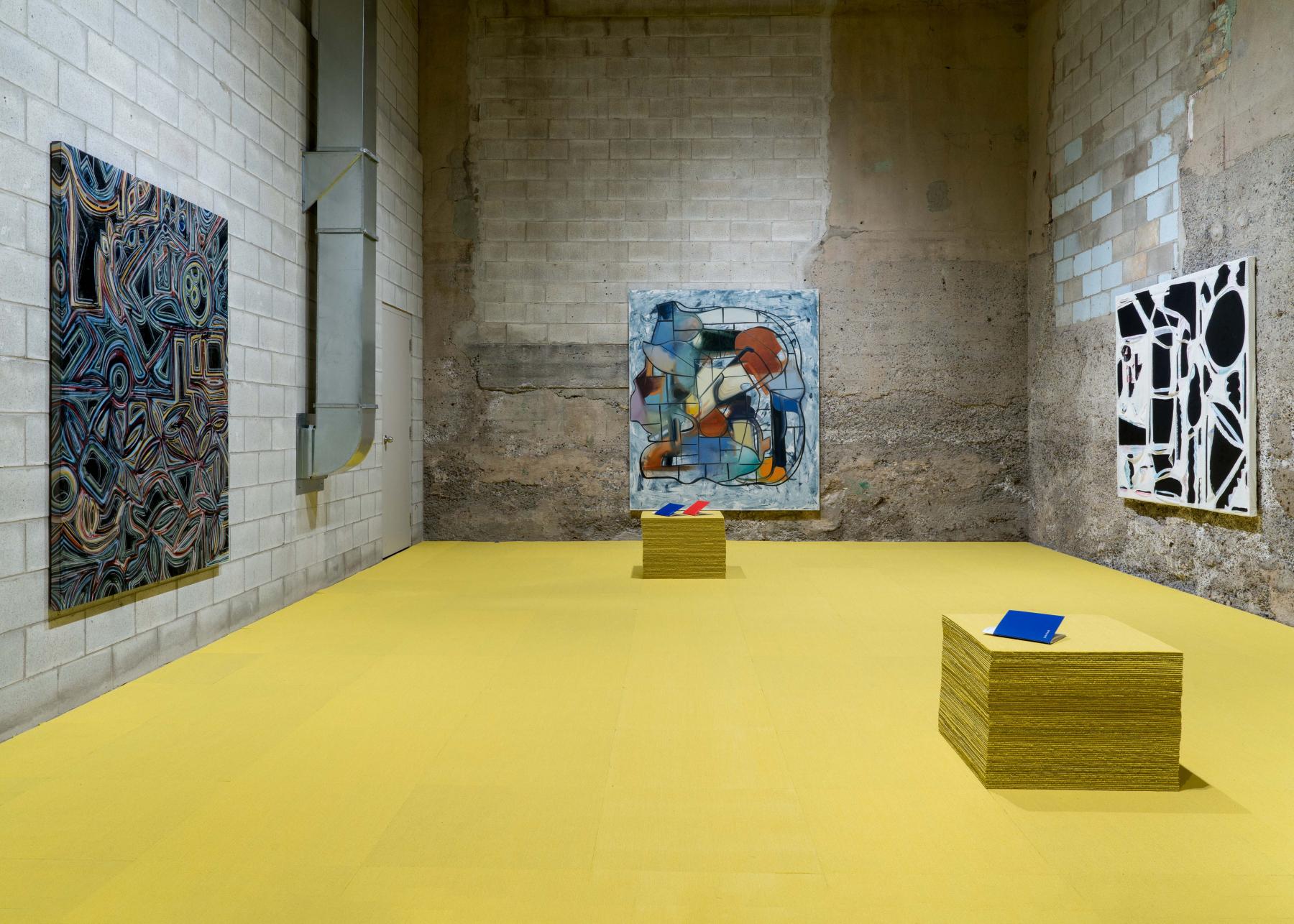
Julia Dault, Primary Information, 2026, Exhibition view, Bradley Ertaskiran. Photo by: Jean-Michael Seminaro.
The day after the opening of her solo-exhibition, Primary Information, I met Julia Dault in the basement 'Bunker' at Bradley Ertaskiran—a space that she specifically requested for her third presentation at the gallery. There's a certain drama to the room, given the mass of concrete, visible rebar, ventilation ducts, and amalgam of building material that cover the walls, like mineral deposits from preceding epochs of use. There we sat, shoes off, cross-legged on the most uncannily-coloured carpeting I've ever seen—not quite sulphuric, nor mustard, but somewhere between the two on the binary of fertilizer and food.
The colour of the carpet wasn't planned ahead of time, as the massive quantity was repurposed, and yet, its presence doesn't feel accidental, either. This is no doubt due to the material sensitivity that lies at the core of Dault's practice. Across her career and through the various disciplines she engages with—sculpture, painting, and, more recently, public art—there is a recurrent lightness of touch and precision of treatment, stemming from a keen awareness of the affective dimensions of the materials she engages with. Dault began as an art-critic for one of Canada's main newspapers, then pivoted from this work of producing secondary information to that of primary information: she "came out as an artist," completed an MFA in New York, and has since had developed a rigorous practice marked, in part, by a curiosity and interrogation of what is at stake for those working in the tradition of Modernism and Abstract Expressionism. Having had solo-exhibitions in the United States, Canada, the United Kingdom, and group exhibitions across the world, Dault is now shifting gears, not for the first time. Where, previously, Dault took up electric, straight-from-the-tube colours with intuitive automation, this exhibition is instead rendered in a grounded, deeper, and complexified palette. Related to this revision of hue is an underlying question concerning whether or not a long-term commitment to abstraction forecloses the possibility of using painting to process certain experiences of raw, primary emotions. Here's where Dault's work crosses into the realm of literary deconstructivism, as she regularly does and then undoes her own tools.
Over the course of what was a freezing cold morning, we spoke of how, perhaps, the distinguishing characteristic between primary and secondary sources—and therefore the type of information that each category contains—is rooted in touch and manipulation; the affective dimension of industrial materials; and the possibility to exhaust one's physical or chosen form. I'm left thinking about how secondary information has literally been handled a second time, fed through the machinery of augmentation, elucidation, or complication. This distinction between first and second, top layer and underlayer, immediate and gradual, float around the exhibition, our conversation, and Julia's practice writ-large.
On a negative day, I can feel that stylistic cohesion is just the market speaking, and that the real creative freedom comes from not worrying if something's coheres into a ‘body of work.’
I find this title, Primary Information, to be particularly intriguing. I’m interested in this category as one that contains raw data, original documents, and firsthand accounts from people who physically experienced something.
Mm-hmm, go on.
So there's this evidential quality that then you can base analysis or interpretation on later. I'm wondering about two things: the stickiness of identifying primacy, like a primary document, but also how we identify this primacy, because it's not an objective enterprise.
I was raised by a fairly well-known art critic who also made art and believed that as an artist, you're producing primary information. If you're an art critic, you’re producing secondary information, which is wholly dependent on the primary information. He always said to do something primary. So Primary Information hearkens back to his idea—which I always disagreed with. I always felt writing about art is itself a beautiful act. Yes, it might need art in order to exist. But ultimately it's its own thing.
Right, like chain reactions of primary and secondary.
Yes, that’s it. I’ve printed a book to coincide with this show, and it’s also called Primary Information. But, in a way––in his way––you could argue that this is secondary information. The primary would be the paintings in this space. But I believe the contextual information of the essays is itself primary.
A factor that often distorts, or comes into interaction with primary information is time. Memory fails. Documents are damaged. Then we die, and the information we carry also dies. So I’m curious about elapsed time as a compositional tool that has a direct, or at least distinct, relation to primary information.
For sure, that's definitely a through line. In my last show at Bradley Ertaskiran, I made a clock. It was a painting covered in spandex. It had a piece of matching spandex draped over its face, and at the bottom of that drape was a rock with a hole in it; it was a very heavy, beautiful rock. The spandex wove into the hole, and so, over time, the rock pulled the spandex lower and lower and lower to the ground. This work also came with a soapstone pedestal that you could place under the rock to effectively stop time. Around the same time, I was labouring on a giant painting, and it had layers and layers of work that I was never happy with. So I covered it entirely with white paint—but of course you could see the texture from each previous layer. I took the smallest brush I could find and painted tiny black marks on every single bump or mark. Covering the white surface in this way took two years. Tiny little black marks on every single bump on the topographic relief. When it was exhibited, I placed a small black shelf next to the work that held a flipbook of photographs I’d taken of every single layer. A viewer could stand there and effectively go back in time. In this show, “Big Boss” was painted again and again, each time with a single color. Each time I added to it, I made the marks smaller and smaller. Then, when I felt that it was nearing completion, I had it photographed. Then I took a knife and essentially destroyed it.
Okay, wow!
I then collected all the bits of paint that fell away from it. I had the documentary photograph of the not-yet-destroyed version, printed on mesh. So you're looking at an earlier version of the work that is then skewed and stretched over a later version. The effect is that it looks almost like a lenticular print, as if it has depth, yet it's all surface. I later put those little bits of paint on a different canvas, called “Rare Earth.” It felt almost timeless because it looked like it was made of minerals. Which essentially it is. Paint is mineral.
So these two works have a connection, like simultaneous chronologies, or timelines. This ties into a question I had about iterative potential, through repeated lines of inquiry, repeated forms, gestures like scraping, repurposing, or transposing.
Also known as self-cannibalization, right?
Yes, exactly. So I’m wondering about exhaustibility, and if you have thoughts around exhausting form, material, or yourself?
Yes. That's a very prescient question, because this show is different from my past efforts. I've always worked with self-imposed rules: off-the-shelf colour only, say, or pitting my physical capabilities against my sculptural material’s capabilities—and we’re always meeting in the middle. These rules worked for me for a long time, but then I had this crisis because I'd stopped learning. The ways I had been working didn't feel right for the complexity of the time in my life, in the world. I had been drawn to bright, almost day-glo, colours. But then I started to feel like I had pushed this palette as far as I possibly could, iterated as much as possible, like I was starting to go through the motions. You know when, at midlife, Jerry Seinfeld got tired of his jokes, and he threw them out and started over? I'm not suggesting that I'm Seinfeld [laughs] or even that I started over, necessarily, but there is something to be said for this midlife awakening. For understanding that something doesn't fit anymore because you've changed. As an abstract artist, how could I bring in all of that complexity? How do I become less tightly wound, or how do I stop obfuscating and let myself do more with fewer tricks? In the past, I always thought I was being direct. It’s been a tough journey! [laughs]
I’m thinking of this in terms of the repurposed carpet that covers the floor of the exhibition space, and that you’ve also stacked squares to create makeshift stools around the exhibition space. The colour of the carpet is pretty distinct, almost sulphuric. It doesn’t seem like a colour that would’ve fit into your previous, flashy palette. Is it a colour you would naturally gravitate towards, before?
Probably not, no.
Right, but then you got a massive quantity of it. And this colour comes with its own tone and associations.
Yes. While working on the show, I had this plan for the carpet. And because it was in my mind, it surely affected my choice of colour. But at the same time, I don't need everything to perfectly coordinate. This hearkens back to a fundamental aspect of my practice: I always work by responding to what is given. The key here is that there is so much waste in general, but also in the art world. And some of the carpets in these stacks are disgusting! Thousands and thousands of people have walked on this material in its previous life—it was installed at a museum—but now the carpet has a second life. I used to use this term, ‘dirty minimalism,’ to explain parts of what I do, especially the Plexiglas sculptures, and I’m happy that it still applies here.
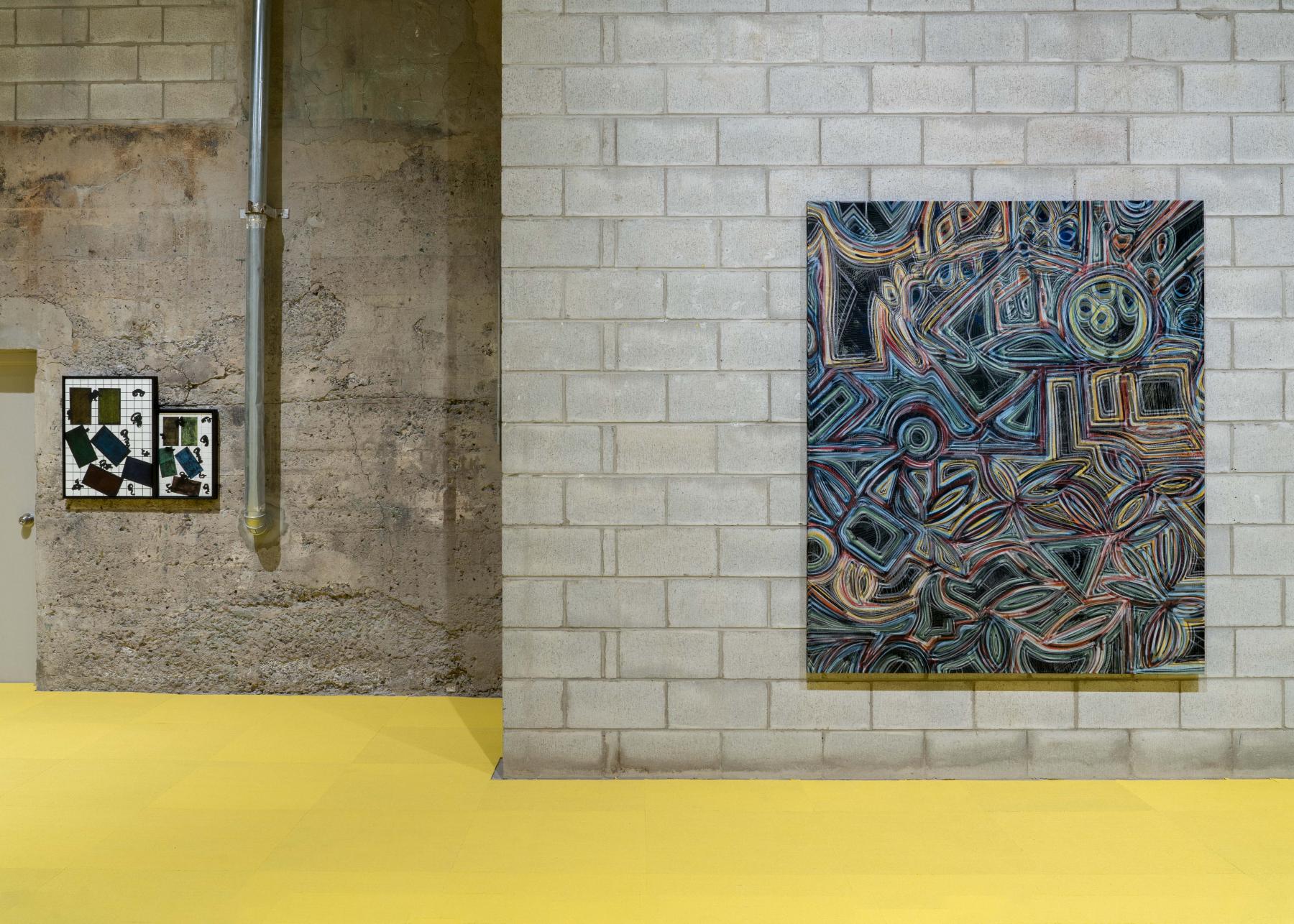
Julia Dault, Primary Information, 2026. Exhibition view, Bradley Ertaskiran. Photo by: Jean-Michael Seminaro.
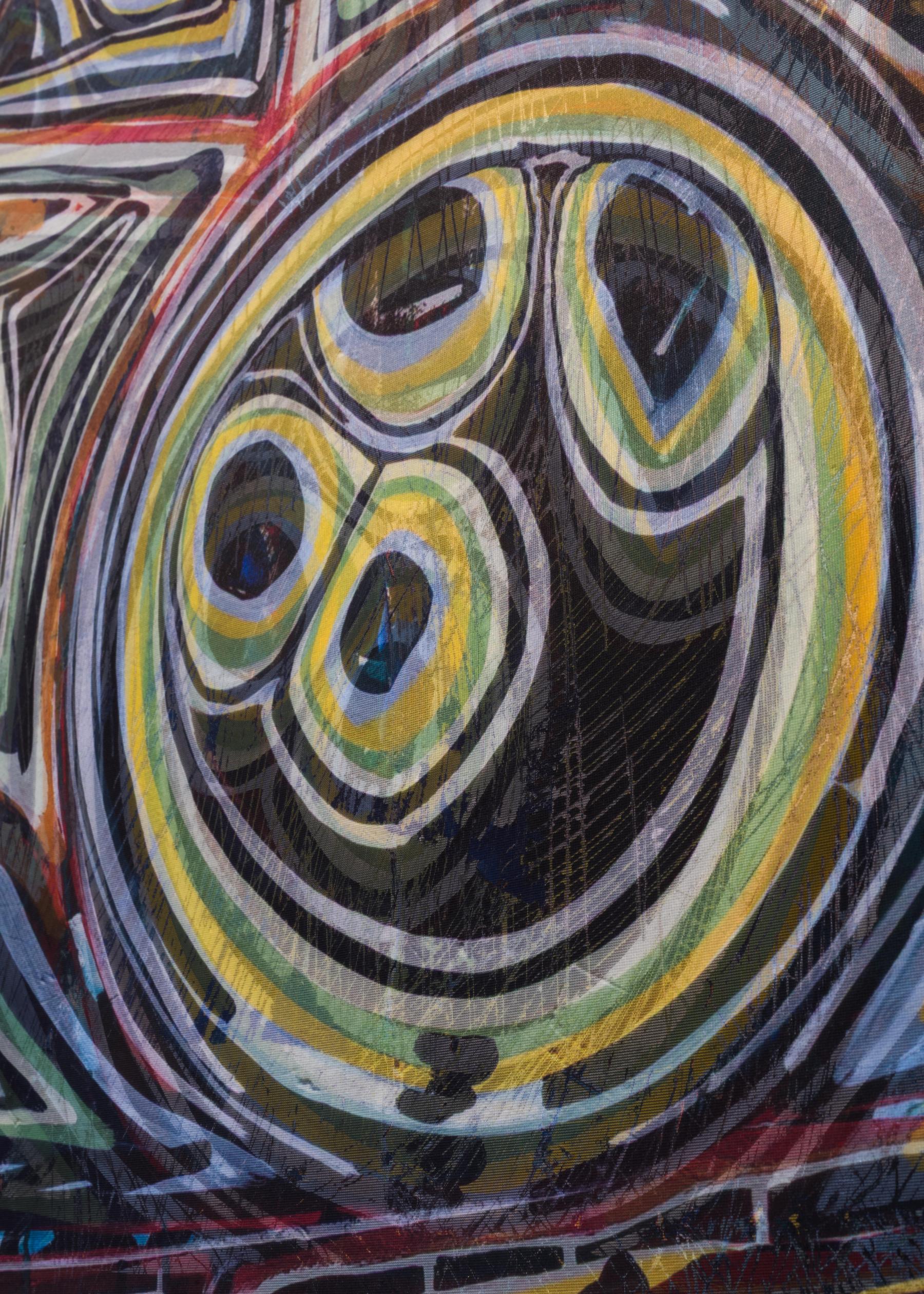
Julia Dault, Bigg Boss (detail), 2026. Printed mesh, acrylic, and oil on canvas, 72" x 60." Photo by: William Sabourin. Courtesy of Bradley Ertaskiran and the artist.
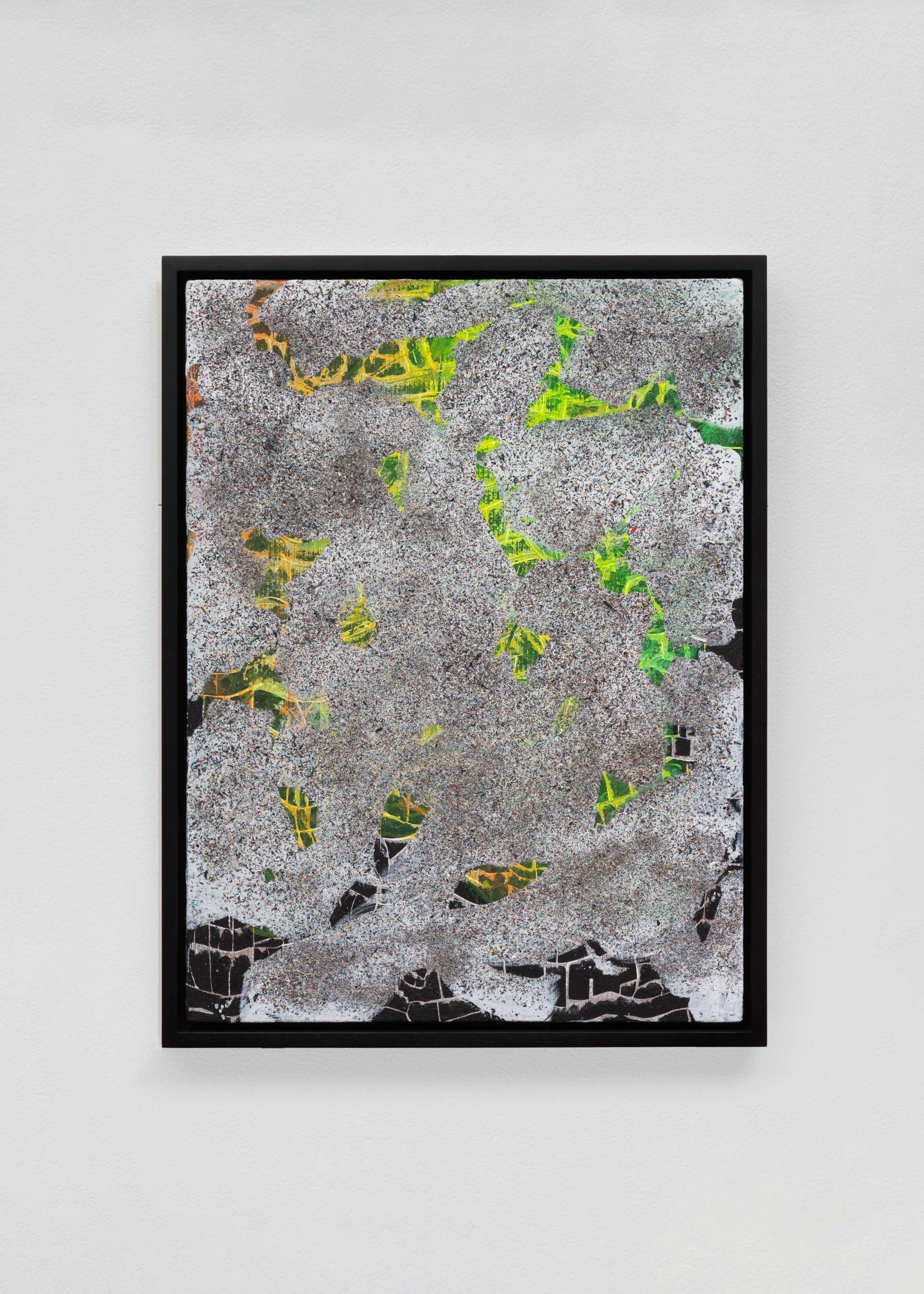
Julia Dault, Rare Earth, 2020 - 2025. Acrylic and oil on canvas in painted wood frame, 24" x 18." Photo by: LF Documentation. Courtesy of Bradley Ertaskiran and the artist.
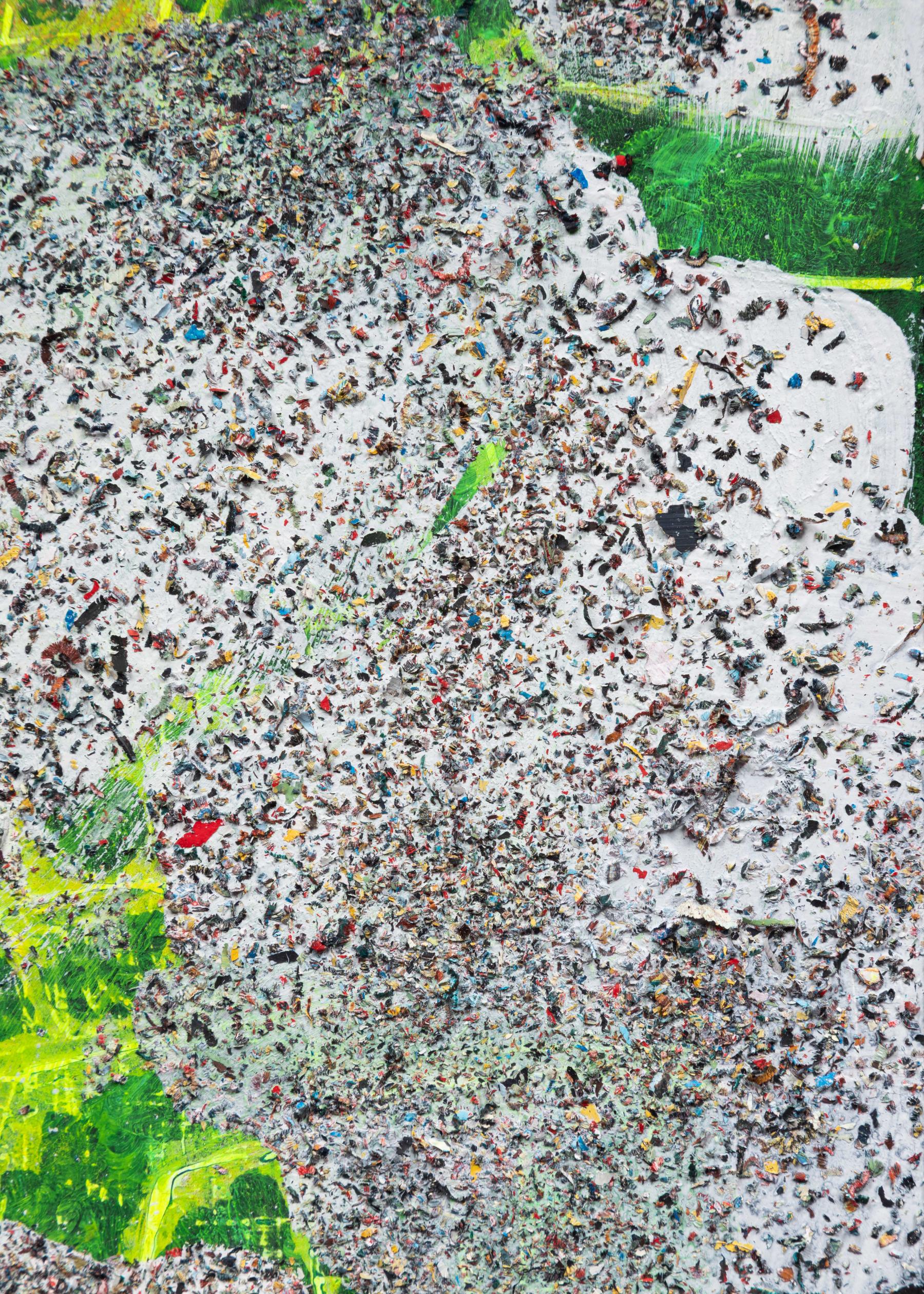
Julia Dault, Rare Earth (detail), 2020 - 2025. Acrylic and oil on canvas in painted wood frame, 24" x 18." Photo by: LF Documentation. Courtesy of Bradley Ertaskiran and the artist.
Now I want to ask about style, because this seems to tie into a question I had about Raymond Queneau. In his 1947 book, Exercises in Style, Queneau tells of a brief moment witnessed first on the bus, then in the metro, and then recounts the anecdote 99 different ways. The culminating effect is not of solidifying one style in particular, but rather of disassembling style, and therefore any mythology surrounding cohesion itself. I'm wondering about how you think about or approach repetition. As we do things again and again, what happens to this notion of style, or to the cohesion of style?
On a negative day, I can feel that stylistic cohesion is just the market speaking, and that the real creative freedom comes from not worrying if something coheres as a ‘body of work.’ I get bored easily, and I also swore that I would never make the same move twice—that I wouldn’t make the same painting over and over. Sometimes people say, and I take this as a compliment, that my solo shows look like group shows. I think this is also because I operate with the premise of X and Y… like, if you take this tool or you take this colour palette and you put it here just so, what do you get? When I was younger, I worried about things fitting together, but in not cohering, there is, in fact, cohesion. You can do so many different things in one space and still have a legible aesthetic because you’re declaring it. The more experience I’ve gained, the harder it is to surprise myself, and it’s when I surprise myself that I know I’m exploring new terrain. Oh yeah, there’s a prop painting in this show that many people haven’t noticed, at the entrance to the space. It’s titled “The Hawk Painting.” Did you see it?
Yeah, I was wondering who made it.
In the book we printed for the show, the central essay, “Primary Information,” is about my work. In it I describe a moment that encapsulates the crisis of abstraction that I’ve described. I was out on a walk with my kids and saw a hawk descending towards a bird’s nest, swooping in to eat the baby birds. I could see the birds’ parents flying around, and I had never heard birds scream that way. This scene was in my head for a long, long time—but as an abstract artist, what could I do with it? It represented a lot of things that I'd been going through. So I painted it, “straight.” The experience of making the hawk painting opened up a different painting in the show, also called “Primary Information,” which initially was covered by taut fabric. It was very unsatisfying, and I stared at it for a long time in my studio trying to figure out why it wasn’t working. I eventually just started slashing and cutting into it. I became less concerned with tightness, or the optics of the object. It took a while to come to that place. It sounds so simple when I put it into words, but it wasn’t—or isn’t. That might be because I have a background in art history and art criticism. My mind second-guesses itself: how is that relevant? How does this fit into a broader historical trajectory?
This ties into how I was thinking of exhaustion, because to me it seems like we typically, or historically, think of exhaustion in biological terms, whether that’s our bodies or our planet.
Or our spirit.
Yeah, exactly. In my mind, this kind of exhaustion comes into tension with industrialized and modernized production. So I’m wondering what you identify in the industrial materials that you engage with. Your bound sculptures are quite iconic, and to me they seem to be a momentary unraveling of efficiency—like they’re made useless or incapacitated by their own restraints. I think there’s also something about permutations in here, again.
Well, that's why Queneau is interesting. With the Plexiglas, the question was, “What can a four by eight sheet do?” And the sculptures are iterative, each one a different version. They're never repeated. I say that I’m like a magpie when it comes to shiny, industrial materials. Working with the material is also about globalization. Industrial materials are available wherever I am; I just have to come in and shape them.
Yet the works are never secure, I like to say they are securely insecure. One of my rule sets declares that with the Plexiglas sculptures, if the forces and physics meant that they weren't tied tightly enough by me and they sprung out, I would then have to leave them installed like that, splayed out, and collapsed on the floor. That never happened, even though I secretly wanted it to happen.
There was no obfuscation.
Yeah, totally. And about the materials, there’s a painting upstairs called “Infinity Fades” with silver, perforated spandex hanging off it. That the material is hanging instead of stretched taut feels to me like a statement on the power of that twentieth-century industrial era. But it also plays with the idea of what is a substrate and what is a painting. And also, finally, the question of what happens to us when we look at art IRL? There must be a justification for coming to see something in space. So of late, I seem to be asking how I can reward that viewing.
Prolongated viewing, or like, reciprocity?
Exactly. With the Plexiglas sheets or Formica that I used, I would install them so that they would appear to have mass and volume, but galleries and institutions were never actually burdened by the mass of the work because it was temporary. The works could always be taken apart and laid flat. Maybe this connects to my deep-rooted, Modernist self. I appreciate the grid, for example, but I’m always breaking it down. My “structures” always fall apart in some way; and then all of a sudden you can see the fallibility of humans. Full stop!
I’ll just end the interview there. There's an essay on your practice written by Jason Farago entitled “Better Angels.” In that essay, he notes that the majority of your paintings “are structured according to an underlying grid,” but then the “...grids get wonky and elastic as [you] over-paint and erase with frequent all-over motions” which expresses an infinity for “more gestural kinds of non-objectivity.” I often think of the grid as a non-hierarchical structure that assigns logic, or has a categorical function. What is the relationship of the paintings in this exhibition to the standardized measure of the grid? Is this a method that you're still employing? Specifically, in this show, there’s a work titled “Fate Xclusive” that’s all about grids.
In 2021, I made the drawing that is on the right side of that work. I thought, “I need to see this work again, somehow.” And as I was making the painted version of the drawing, I thought “God, I never work this way.” Normally, I call my approach ‘making is thinking.’ That is: I don’t plan or preconceive, I just go in, respond, make, be in the moment. I couldn’t fathom what I was doing, which was reproducing something I had already made, but bigger. So the joke with the title, “Fate Xclusive,” or the play, is that they could only have ended up together, their fates are connected. The title, like many of my artworks’ titles, is something I found; I think I saw “Fate Xclusive” on a sign somewhere in Toronto. Later, I realized that I wanted them framed together, to make this relationship between the two more apparent, rather than discard the “study” work. And then it dawned on me that this was a plan view of the space we’re in at Bradley Ertaskiran, of this bunker. As we were planning the show I got five shag carpets that I thought of installing in this space to mirror the rectangles in the drawings, and the carpets were these amazingly disgusting colours. Then when I finally got in the space it didn’t work at all! But I had to go through with it, and so now this work is pure potential of what could have been.
Like a score for a performance that didn’t happen. And the rectangle space of the carpet makes me think of how the grid evokes the way we orient in space. All these rooms, units, rectangles and squares that we inhabit on the grid of the city. My next question is about whether there is an underpinning to your sculptural works like the paintings’ grids. Do these works request a similar scaffolding, grid or otherwise?
The Plexi pieces are titled based on how long it takes me to make them, which is in many ways their structure established in real time. But at one point, I did a 180° turn and created a series in collaboration with a computer programmer and robotics expert; we made ceramics with a programmable robotic arm. Whereas with the Plexi works I shaped industrial materials with the human hand; in these works, ceramic, which typically carries an expectation of human impressions, was instead made by this robot. I loved “making” these “organic” forms in a highly industrialized way. We made grids and spheres that looked like woven baskets, forms that would be impossible to make by hand. The process was amazing to watch. Yet when the arm made a giant sphere out of clay, and I placed a clay grid inside of it, there was inevitable decomposition.
Oh wow, like the trace of a human hand gets totally distorted. In a productive way though, it seems?
This is something I think about a lot. It’s funny, in the hierarchy of making, if you touch too much, it’s craft. It’s not considered valuable. If you have paint on the surface, people love it. If you don’t have paint on the surface, it’s no longer valuable or as valuable. There’s this thing about how much an artist has touched a work, how involved or present they are in the production. Can we see their hand? I’ve spent many years trying to obscure my own gestures. This latest work is more about letting in the viewer, for real.
I have two compositional questions. First, it feels like, in what I’ve seen of your work, there’s an attention to equilibrium, without symmetry.
Between the works in an exhibition, or in and of themselves?
Good question, but I’m thinking more in and of themselves, each individually. Is this something you think about, or not really?
I think I must be in some way, but it’s not conscious. I do get this thrilling feeling in my knees when a work is done, when I know that I can’t add anything else. It’s very bodily. And in general I’m very analytical, I love words, so I appreciate that this is another way of understanding the work.
That seems to be what harmony feels like, no?
Yeah, I don’t like to be too spiritual, but it does feel as if it’s beyond words. But I do still think that artists have a responsibility to be able to talk about their work.
My other question comes from being initially struck by the dynamism in both your wall and sculptural works. Does this stem from a preoccupation with time and materiality—since neither of which can be static even if we try to manipulate them into being that way? Do you think about movement in your practice?
Well, I definitely think about choreographing the space when I do installations. In this exhibition, I placed one of the carpet benches in a specific spot so that visitors have to move around it. Often when I build a show I’ll integrate an element that obscures sightlines, so that you can’t stand at the threshold and see the whole thing in one glance. So, in a way, I like to guide the viewers’ movements in space. But that’s installation-specific. I think this dynamism probably comes from the fact that I just don’t want to be bored. But don’t get me wrong, I also love paintings that are really static.
I guess this is a question of the relationship between work we feel drawn to from a viewing perspective, and then the work we feel compelled to make ourselves. And how often they don’t entirely overlap. I guess it’s the dynamic of input and output.
Should we say primary and secondary information again?
Why not! My last question relates to the encounter between material and concept. For you, do materials arrive first, with their inherent affective dimensions that then lead to concept? Or do you seek out materials that can respond to certain needs that you have?
For me, the most successful pieces balance concept and material in perfect harmony. For example, with the sculptural piece that I consider my first real artwork, I went to a place in Long Island City in New York that was like a warehouse of recycled materials that were being discarded and sold for almost nothing. I found this piece of extremely dirty, turquoise blue Formica that had this magnetic pull. It was just this beautiful sheet of colour, so I took it to the studio and started playing with it. That became my thesis piece, and my sculptures went on from there. So that was material first. But then there’s the idea of that sculpture somehow encapsulating a gesture or action, of it being expressive. I’d been obsessed with the Abstract Expressionists. But also the Minimalists, even though I didn’t believe in the purity of their perfectionism. So I came up with this idea of dirty minimalism; I didn’t wipe any of the dirt off.
Oh okay, so literally dirty.
Yeah, exactly. If it’s just material, it’s not interesting. If it’s just concept, it doesn’t need to be an artwork, it could be something else. So maybe I lead with material first and find the concept through it? I’m not sure! I guess it’s very specific to what I’m making at any moment. Public art has to be concept-first, which I struggled with when I started making it. I love to work alone, but in the public realm you can’t, you have to work with a team. So I learned to do concept-first art-making, but it’s not my preferred method. Okay, so maybe I am material first! I’ve never articulated that. Thank you for that question!
Of course!
[Both laughing]