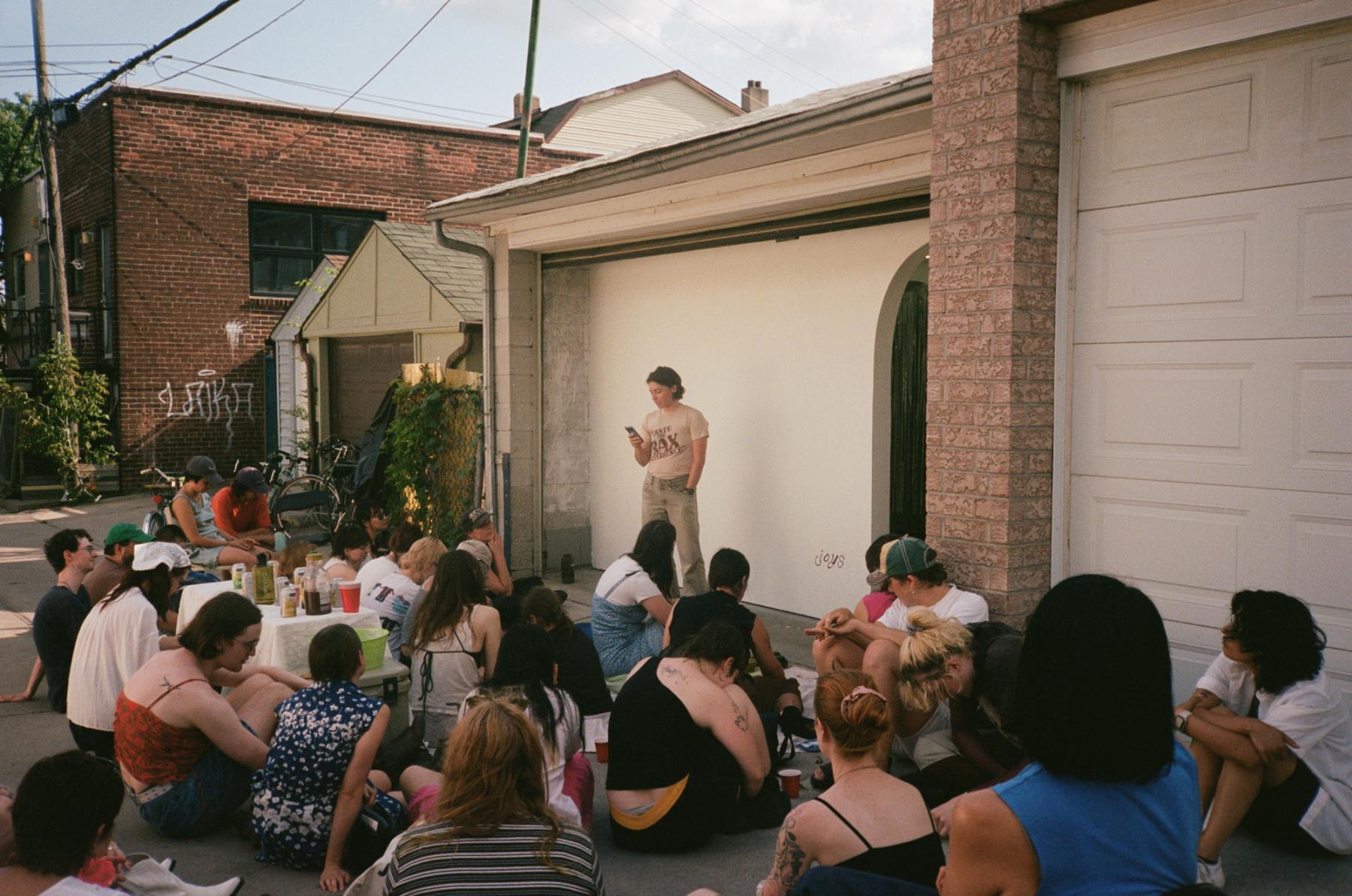
Café Sprinkle 1 documentation, July 22, 2023. Courtesy of Joys.
For the past three-and-a-half years, the garage behind 903 Lansdowne has been home to Joys, an independent gallery operated and initiated by writer and curator Danica Pinteric. Accessible by the laneway between Lansdowne and St. Clarens in Toronto's west end, the gallery’s entryway is marked by its iconic arched door and—most Saturdays—the presence of Pinteric, awaiting visitors. With a curatorial style as incisive as it is intuitive and process-driven, Pinteric’s mark on the city has been lively and thought-provoking, emanating a particular poetic quality. As a poet myself, perhaps what draws me to Pinteric’s work is how she borrows the techniques of poetry in her curatorial practice. Playing with iteration and repetition within and across exhibitions, Joys’ programming has a sense of rhyme and rhythm. Working at the meeting-point of precision and feeling, abstraction and clarity—the frequent wheelhouse of poets—the impact of Pinteric’s approach is felt both through the quality of the work she presents and the community that surrounds Joys.
Prior to Joys, Pinteric was co-curator of Calaboose, an independent space in Montreal, alongside the artist Garrett Lockhart. She received a Master of Arts in Curating Art & Cultures from the University of Amsterdam in 2021, and has worked at Stedelijk Museum Amsterdam, Vtape, and the Goldfarb Gallery. She was an Exhibition Curator for Nuit Blanche Toronto in 2024, and has curated exhibitions for Unit 17 (Vancouver), Badwater (Knoxville), and the Visual Arts Centre of Clarington (Bowmanville). Joys, named in part for Pinteric’s late grandmother, Joyce, and in part for its mandate to make room for joy alongside criticality, is Pinteric’s first solo endeavor, and has been her central concern since its inception.
The first time I attended Joys was for the opening of its first show, Fuzzy Logic, in May 2022. It was three months after I’d moved to Toronto, and I remember it as a sudden feeling of solace and optimism about the city and the people in it. In the following years, I was lucky to have the opportunity to collaborate with Pinteric on the reading series “Café Sprinkle,” which is set to continue this year. Working closely with Pinteric has given me a deep appreciation for her dedication to artists, audiences, and collaborators.
With that dedication comes the need for rest. After ten on-site exhibitions and several other projects, Pinteric is taking a temporary step back and subletting the garage this year, taking time to hibernate while a new collective, Parlour, takes over. While some off-site Joys projects will continue during the fallow period, Pinteric and I took this opportunity to reflect on Joys’ history, discussing its programming, her curatorial approach, prescient themes, and the precarity and affordances that come with operating an independent space.
There's also something about patience that's a reminder to myself—that I want to continue to operate with this level of freedom, transparency, and dignity with artists, but in order for that to continue, I need to also prioritize other aspects of my career and respect my own capacity. So it’s also a personal assignment: Patience.
To begin, can you talk about the start of Joys? How did the gallery come into existence?
Prior to Joys’s presence, the garage was a gallery called TAP Art Space run by Marx Ruiz-Wilson and Audrey-Anne Morin. I’d known the previous iteration of that project in Montreal, which was active around the same time I was living there and running a gallery in Montreal called Calaboose with Garrett Lockhart. In 2021, I moved back to Toronto from Amsterdam, where I’d been for my master’s program. I’d grown up in Toronto, but hadn’t lived there since I was a teenager. Landing back, I intended to find work as a curator. Those hopes ended up being answered super quickly, because around the time I moved back, Marx was hoping to move back to Montreal, but he wanted the garage to be used in a similar way.
I have a lot to thank Marx for: the way that he set the space up, the way he envisioned it, the way he offered it to me to keep it in the community, and also the way that he built a relationship with the landlord and trust with the neighbors. By the time I moved into Joys, Marx had already made everyone fall in love with him. Everyone was very welcoming; those relationships were a really lovely thing to inherit.
So Marx had already built the gallery walls, and when you moved in you put in the archways?
Yeah. I added the archways, and we built out a wall in the middle which allowed Garrett to have a studio in the back, which included a second arch for good measure. The archways became part of the gallery’s identity.
The reference for the main archway—the entrance to the gallery—was a cartoon mouse hole, like in Tom & Jerry. It’s super wide and meant to be a little bit silly with proportions that are a bit off. There's a lot of different connotations an arch can have based on its radius. The rounded mouse hole—this silly, kind of innocuous but transformative shape—became a helpful reference that embodied the spirit of Joys. I’ve always felt a subtle psychological shift when I walked under an archway. I like that it’s a bit subliminal.
That seems super fitting for a laneway gallery, as a place that’s tucked away and a little hard to find. For some it’s an unexpected discovery and for others it’s a home to return to. Either way, there’s a sense that that kind of place—a small animal’s burrow—will be hospitable, which is exactly how I feel at Joys. Is that part of what you were hoping Joys would bring to the art community in Toronto?
When I first moved to Toronto, I felt a real heaviness in the air. It was a time of very thick grief and existential angst—which continues now. But back then I felt it especially strongly in the tone of exhibitions and curatorial texts—a bit removed. It was surprising because it seemed in opposition with the warmth of the people I met early on while living here. Everywhere I turned I felt I was finding very academic programming—which had imagination and a vision and a voice—but was ultimately lacking in sparkle. With the exception of a few smaller galleries and artist-run initiatives, it all felt very safe. Every show I seemed to visit had a prescriptive tone—a thesis—executed in this essayistic format, where every component of the exhibition furthered one narrative a little too neatly. I couldn't resonate with that form of curating. There wasn't much space to dream through a show, or an artwork, or understand it differently than in the way it was being presented. I needed some levity, and it felt like Joys could occupy that lane. By nature, it could be a kind of quirky or humble space, where there would be some room to break from that trend in curating.
So then, your first show, Fuzzy Logic—the title was inspired by a rice cooker?
Yeah, it was. When I first moved back here, after having moved a lot of times in a few years, I was trying to set up a place that would have a sense of longevity and comfort. The rice cooker was a domestic appliance that I had been making do without, but I really dreamed of having one. I find peace in cooking, and it became this aspirational object for me—maybe even a symbol of rootedness or having my own space. I think it felt inventive in that it has this one purpose in your kitchen: it makes rice, but it makes it so reliably and perfectly. Like magic, every time. It's not magic, but…at the very least it’s poetic, especially in the language used to describe its features.
There's an engineer who was based at UC Berkeley named Lotfi A. Zadeh who invented fuzzy logic, which is this technology that many different rice cookers use. The term fuzzy logic, which is also defined through a system of “partial truth,” became inspiring to think about. Basically it’s an internalized logic system that uses a range of values between 0 (completely false) and 1 (completely true) rather than a true-or-false binary for its decision-making. In a rice cooker, that means the appliance senses temperature and moisture content in the rice, and makes adjustments to heat and cook time according to “degrees” of truth. If you wanted to, you could trace its reasoning, but it's almost more nourishing and efficient to chalk it up to fuzzy logic. (ChatGPT came out later that same year, 2022, and conversations around machine intelligence are more advanced now than they were then.) But this idea of fuzzy logic prompted me to think about artists whose work seemed to follow a distinct internal logic system that evaded language—its mechanisms were evident, but the specifics were abstracted. For example, Nabil Azab’s work has a lot of emphasis on the materiality of the photograph, but there's also this push-pull on the level of how much is shown or how much is denied. There's this range of legibility. Nabil lands on it perfectly and expressively every time, but the exact formula or ingredients for that decision only Nabil might know.
Before Joys came into being, you were co-curator of Calaboose in Montreal. What was your relationship to curating when you first opened that space? Do you think of that as the starting-place for your curatorial work, or is there another, deeper starting place I don’t yet know about?
I grew up around the arts, but not so much visual arts. I attended a public arts high school in Etobicoke in the theatre program. I made friends who were in the visual arts and I've always felt really impressed—even at that age—with how much emotion could be rendered in that medium. But I never considered myself artistically inclined in a visual sense. And then theatrically, I had this point in Grade 11 where I decided, “I'm not good enough.” So instead of acting I tried directing. I found that that suited my personality a lot better than performing. It was more interesting to be behind the scenes, thinking about how, in the context of the play or performance, so many different pieces coalesce—audience, environment, artists. Looking back on that now, it’s a lot like curating.
And then through my undergrad in Montreal I also had many friends who were artists and ended up co-running Calaboose with Garrett. There was something really helpful about it being collaborative because I had no training. I was actually in school for Communications & Cultural Studies. It was cool because living together and running Calaboose, we found ourselves gravitating towards different roles. We made sure everything got done, but we also had the chance to figure out what we each liked doing and split it up in a natural way. That was really great to learn.
Within the first year of running Calaboose, I recognized my strengths were in the mediation of a project and understanding overarching narratives within artistic practices, in establishing context. I was having conversations with artists and audiences that made me interested in doing more school. I also found myself becoming more curious about art writing and understanding where style or poetics could intersect with the work I was doing curatorially. I ended up attending a curatorial master’s program at University of Amsterdam.
That brings me to a question I have about writing. Throughout Joys’ lifetime your exhibition texts have taken many forms—from more typical didactics to short stories or poems and many in-between. I’ve often admired how your texts offer doorways to the work without overdetermining how the work should be read. How did you arrive at this way of writing, and how do you think about writing and its relationship to the work you present?
Thank you! Towards the end in Montreal, I had started experimenting more with poetic approaches to exhibition texts. I think in Amsterdam I was expecting for that to continue more, but being in school ended up feeling like a bit of a regression. I was in a curatorial program, but the foundation was art history, so the reference in terms of writing style was more traditionally academic. I was also in school during COVID, which made it difficult to grow a new limb in terms of writing style, so to speak. I ended up resorting to the academic foundation I had learned in my undergrad.
I also worked at the Stedelijk Museum Amsterdam for a year. I had a really amazing mentor there, Karen Archey. She'd been a writer, critic, and freelance curator for a really long time and I learned a lot about mediation and developing perspective from her through writing. Working with her, I was writing a lot of different things for the museum, like wall didactics and contributing to the collection database and thinking about how new works that were coming into the collection could be written about in the future. That really opened up my world in terms of thinking about audiences and accessible writing. Thinking about writing for an audience whose first language isn’t English became something more on my horizon, for instance. So I was in this curious place where in school—which was sort of my priority while being there—I ended up feeling unfulfilled with my writing. But at the same time I was given this professional challenge where I needed to write about extremely complex works of art in the most fulsome way, but also in the simplest way. It’s difficult to be poetic in a museum didactic. It's more like, how can this touch as many people as possible, on a technical and emotional level? You need to render something conceptually rich without being pedantic, and you need to move past a simple description. All in 50-70 words. There was a certain grace and efficiency that I was trying to emulate and learn from Karen in her approach to writing. I am really grateful for how much freedom she gave me in the task. It was also lovely to have that chance to work directly with artists and also have my voice be trusted—or perhaps not my own voice, but my capability as a writer, writing in different voices.
My approach to writing at Joys really built on the foundation I developed at the museum, but with more space to respond and infuse the language with style, anecdotes, quotations, or secrets. It’s a curatorial consideration too—how to address the levels of abstraction and representation around an artwork. There should be a dance, a push-pull between the literal and metaphoric registers. With the texts, I’m trying to find a harmony between form and content, and it’s a spectrum depending on what an artist’s work is doing, and of course also what the artist feels interested in as a response. It’s also important to take time to marinate on ideas. Usually if I take enough time and leave some work for my subconscious, I arrive at a sense of how to approach an exhibition text without too much second-guessing.
So would you say you tend to mirror the level of abstraction or representation in your writing, or do you try to balance the scale?
I think sometimes it's a balancing act, and sometimes it's about surprising myself too. I'm thinking about Alyssa Alikpala’s show in late 2023, for example. Her work is installation using a lot of found organic materials, and it's very ephemeral. Her project was oriented around a residency that she did in the laneway. She was using all these different plants, mostly grasses and goldenrod from the laneway, building up architectural casts using a homemade glue that ended up becoming sculptures. They became quite a literal representation of the gallery space. Alyssa was also taking some new risks in her practice with this show, infusing her installation practice with her background in fashion design. I remember feeling so inspired and honoured by her bravery and it made me want to try something out of my comfort zone, too. For the text for her show, I wrote a short story that was told from the perspective of two birds watching Alyssa do that work of gathering, coming in and out of the garage. A lot of the conversations I was having with Alyssa at the time were about the laneway as a character, and its vitality. This marked a rupture in the tradition of texts I had been writing for Joys. It was inconsistent and vulnerable, but it kind of balanced out how directly Alyssa was confronting the space and her own history. She was creating a really beautiful imprint of the space at that time, incorporating the resilient plants that sprang up from the concrete right outside. I felt there was more room for a little fiction to come in, and for that fiction to enhance some of the themes, allowing different points of view to come to their own conclusions.
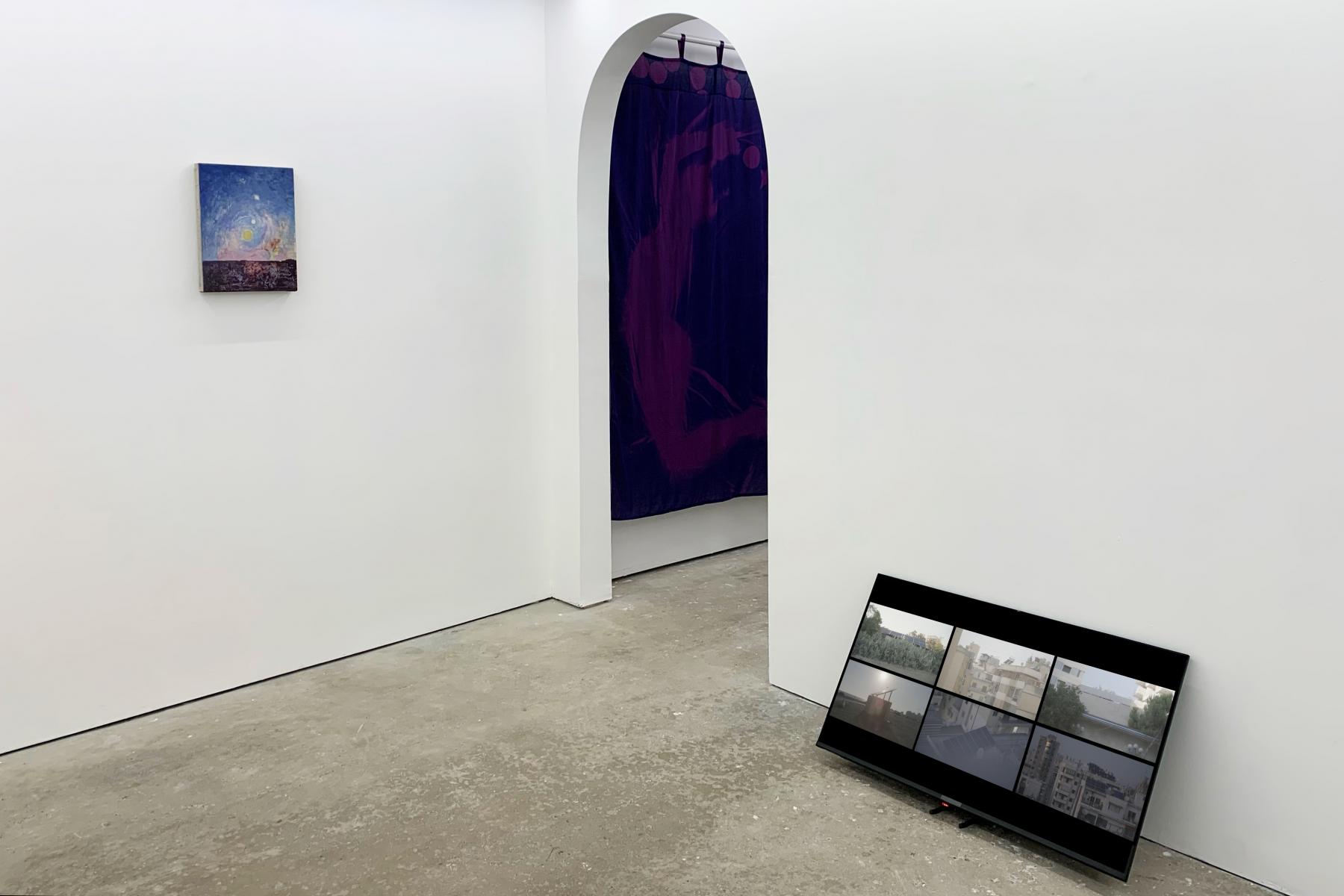
Pardiss Amerian, Sofia Mesa, and Joyce Joumaa (exhibition view), part of dawn draws, dusk drops III, 2023. Photo by Garrett Lockhart courtesy of the artist and Joys.
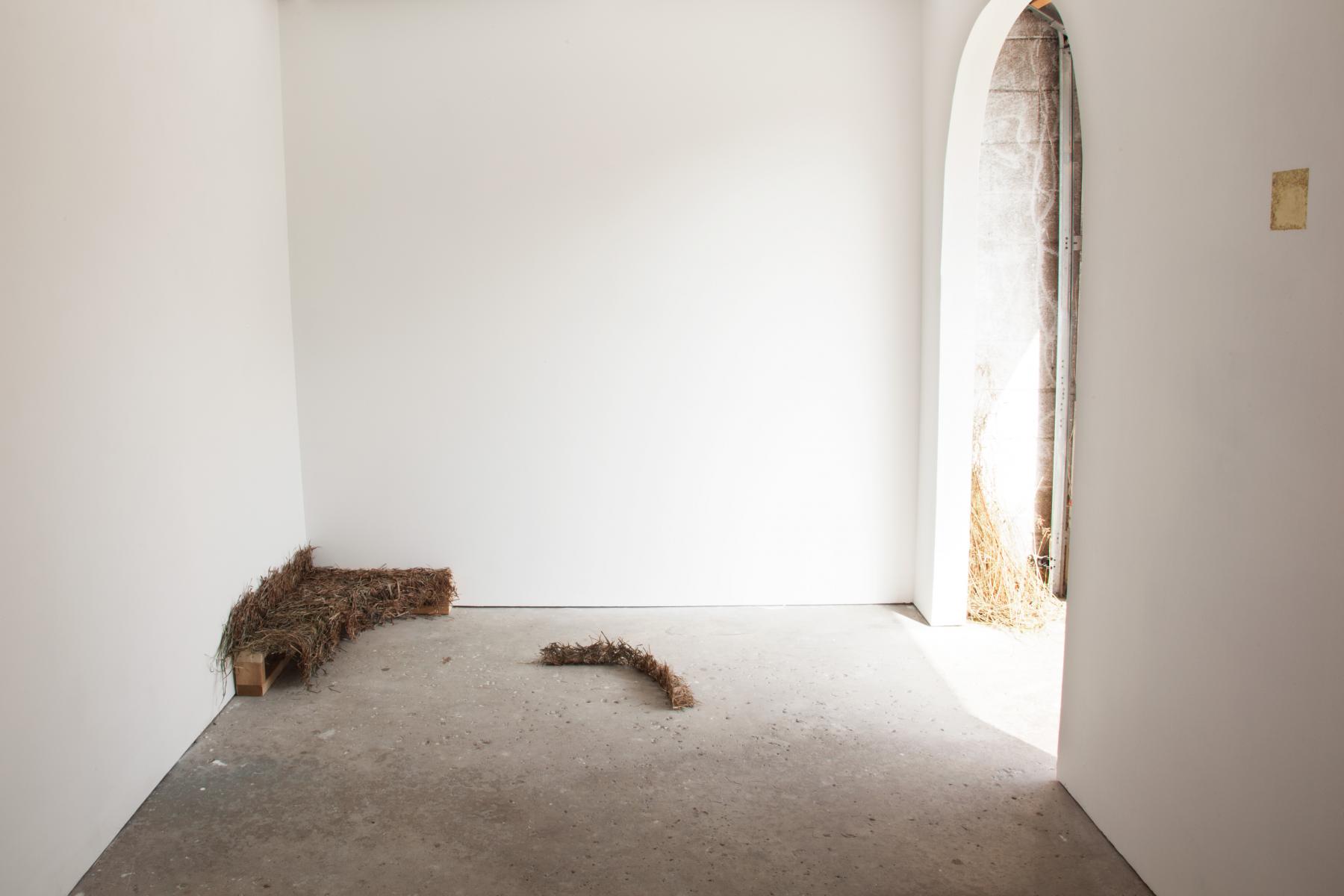
Alyssa Alikpala, Tracings: in situ (exhibition view), 2023. Photo by Holly Chang courtesy of the artist and Joys.
.jpg)
Natasha Katedralis, Toy Bubble (exhibition view), 2024, part of Toy Bubble. Photo by Natasha Katedralis courtesy of the artist and Joys.
How do you think about time in your practice? Do you work with it or against it? I’m thinking particularly about exhibitions like Patience or dawn draws, dusk drops where you're working time into the structure of the exhibition. What draws you to working that way?
One of the first things that comes to mind is how, when I was running Calaboose with Garrett, we quickly fell into a tempo of programming that matched the art market. We were looking around at other galleries and matching their pace without questioning it. After that project ended, we were catching our breath and realizing how tired and burnt out we had been from matching that pace. It was this whiplash two years of really rewarding but very back-to-back programming. Maybe if we had been older or more experienced, we would've thought about that more critically in the moment. We realized that it wasn't actually a sustainable pace, especially because we were a non-commercial space. There was not a financial incentive to do that. We were really driven by wanting to promote and create as many things as we could, which was rewarding in its own way, but it did come at a cost. That was a lesson, especially for Joys.
Very soon after that I was working at a museum and institutional time is a whole other thing. You're thinking at least a couple years ahead with most of your exhibitions. Especially working with acquisitions, for example, one of the things that you're thinking about is the work’s longevity and conservation needs. How can we preserve this artwork for as long as possible? The rough target is the next lifetime, at least. That's really different from putting on a show every month. I encountered these different curatorial temporalities in close succession. It helped me realize that time is something you can play with, and further, it’s something that I want to address and grapple with. It’s important to understand how much the temporality of a project dictates its feeling and message.
When I was first thinking about how I wanted Joys to run, I came up with three core tenets: collaboration, sustainability, and trust. Sustainability, for me, meant sustainability in terms of human resources, energy, and capacity, and a lot of that had to do with timing and how long you leave for things to happen.
One other thing that I wanted to shout out was when I was in the Netherlands, writing my thesis on experimental artist residencies, one of the case studies I did was this residency program in the Netherlands called Hotel Maria Kapel. It's this old chapel about 20 minutes north of Amsterdam. The artistic director at the time, Miriam Wistreich, had been running a residency program that was a curated year of different artist projects. She was inspired by this book called Enduring Time by the British psychoanalyst, Lisa Baraitser. It's about the perception of time from a psychoanalytic lens with an emphasis on grief. Each chapter cycles through a different experience of time—like when time speeds up or when it's still, or cyclical time, when you have deja-vu. Interviewing Miriam for my thesis definitely inspired me to keep thinking about time in relationship to curating.
How does that sense of time come into the way that you work with artists?
I didn't set out for time to be such a core theme in the program when I first started the gallery. I think my interest in the relationship between curatorial practice and time grew as I was considering the question of sustainability. The last two years of projects, I realized how much sustainability was just about timing. I think something that's always been important to me and modeled from people I admire is that you can’t rush greatness. It doesn’t do what you think it’s doing when you rush others. Deadlines can be important, but it's more important to make sure that the fullness of someone's humanity and practice is accounted for. All artists are living people navigating things like taxes, children, loss, family, grief, et cetera. I think more important than seeing a project through to a certain schedule is accounting for the relationship with the artist or collaborator. When you work in an institution, you have to balance those things—you don’t have as much flexibility. But with Joys, I had the pleasure of having my hand right on the dial. Time was even more play-dough than I could have expected.
I started to experiment with it, first with dawn draws, dusk drops, which was a three-part exhibition that happened over the winter of 2022 into 2023. That was a first attempt at organizing an exhibition with a more protracted sense of time, and was partially inspired by one of my influences, Shimmer, a space in Rotterdam that approaches long format exhibitions with works that fade in and out across the season. That was something that inspired me, especially with dawn draws, because running a space by myself, I was always doing a lot of things at once. That format allowed me to slow down and really hold each work that I was presenting.
Using time in that way also means you're fitting a lot of work into a small space. Is that part of why you took that approach?
Definitely for dawn draws, dusk drops. I really wanted all nine artists to be in that exhibition. The exhibition itself was about Daylight Savings Time and the retreat of sunlight in the wintertime and how during the winter, at least in this part of the world, where we lack Vitamin D, we are craving sun on a very somatic level. A kind of scarcity complex develops around sunlight and it garners a material currency. And of course, the sun is also an amazing indicator of time that predates the concept of time. Anyway, the artists in the show were instrumental in my understanding of how that material currency could manifest, but it would've been a mess if I had put them all in at the same time because the space was too small for all the big ideas. The chapter model became a solution to that spatial problem.
Then with Patience, the overlapping conversations felt very important. I wondered if the exhibition could feel like a long conversation around the same thing with different voices entering and exiting—like when you're at an event and someone enters a conversation and they have like a new take on whatever topic is being discussed. Or maybe even like a play.
Can you talk more about Patience and the ideas behind it?
Patience was one of the bigger attempts to marry form with content at Joys. The idea was to truly engage with the meaning of the word “patience.” In the beginning, for me it was really about endurance, lasting as long as you can at something. Or having patience meant having a lot of tolerance. The more that the project grew and the further the different artists I was in conversation with developed their ideas, so many different inflections of the word came to the fore, such as suspense or boredom or faith. I love that patience isn't just an orientation towards how long something takes—it’s an attitude. I also love that it's considered a virtue—which now comes in such opposition to the world and the media landscape we live in. There's a righteousness around it too, which I find to be something interesting to play with.
Thinking about patience as a “virtue” brings me to one of the important works in Patience, “prayer for greater compassion in the art world, prayer for Toronto,” which was a restaging of Ben Kinmont’s 1991-94 “Prayer for Greater Compassion in the Art World.” Can you talk about that work and your interest in prayer?
I first came across Ben Kinmont’s “Prayer for Greater Compassion in the Art World” on his website, which is a great archive of his work. While living in New York, he spent three or four years speaking with different faith leaders about prayer and posing the question, “can prayer be considered a sculpture?” Through those conversations, he was also exploring if it was possible to will something like compassion into existence. It culminated with him writing his own prayer on his studio wall, and then chipping it away. That was the end for a while, but with Ben, a lot of his work is never really finished. When I spoke with him about presenting the work at Joys, he surprised and challenged me by inviting me to restage the work instead, creating and circulating a new prayer.
That’s how I came to organize a closed workshop with people—mostly artists or writers—who had some relationship to prayer. I had given us this impossible-feeling mandate of writing a prayer for the art world. We ended up writing a prayer directed towards Toronto’s art world specifically, each writing “I prayed here” on the wall of the gallery as a nod to Ben. We decided our prayer would be recited upon request for the remaining duration of the exhibition.
Something that we talked about during the workshop was how the energy of the intentions described in the prayer could be circulated differently. Beyond recitation, how could we, as a group of people coming together to pray that day, carry forward some of those ideas, different attitudes, or behaviours into the world? How does the product of what the workshop was become an attitude and not just a stagnant text or even just one moment in the gallery?
I was raised in a non-religious household, so I had no previous relationship to prayer. In 2024, I started asking myself the difference between wishing and praying, whether it was a material difference or just semantics. I began trying to understand prayer personally, and in the process had many great conversations with friends who were brought up religiously or did have some faith.
I was thinking about how the prayer considers what is needed in Toronto’s art world. While there is an enormous history of spiritual art, it feels rare in this context to encounter art that engages earnestly with prayer. Do you feel there is a need for spiritual art here and now?
In Toronto specifically, I’ve met some very spirited people who have influenced the way that I allow myself to experience art. The artist, educator, and healer Patrick Cruz comes to mind as someone who has been influential in my understanding of spirituality and art. He was part of Patience as an artist and led two “Psychic Self-Defense” workshops, which were about channeling a protective energy for yourself, and ended up being very connected to breath. Patrick contributed to the prayer, and the others in the workshop similarly offer the city some blend of spirituality and artistry.
The other piece of it was that I had felt so utterly helpless in the world we're living in. That was one of the main reasons I wanted to learn the difference between wishing and praying. The awakening of witnessing the genocide in Gaza online and feeling the powerlessness of that really sent me, along with many others, into a new awareness. It brought me into a sense of loss that many people had already been living and connected with. Through that reality, prayer became one outlet for that feeling.
Part of the impact prayer has is the impact on the individual doing it. The sincerity that you approach ritual, or any practice, with—I think that changes you. On a personal level, I think I needed to be changed. One of the lines in our prayer for Toronto is a request to be changed, and in a way, that’s the whole point. One of the ways this manifested was, through connecting my body and mind with prayer, I was able to recognize my agency a bit more with the Joys community. We were able to come together and raise a considerable amount of money for initiatives in Gaza which have offered material changes, through things like print fundraisers (with Arvo Leo in 2024) and the Run for Palestine in Toronto this past summer.
I'm really grateful for Joys as a venue because a lot of grants that you apply for, you cannot have a religious message. A lot of what I've done at Joys this year with relation to spirituality couldn't happen in the mainstream, for somewhat understandable reasons. Part of the freedom of being a self-funded space is that those ideas can be explored in a genuine way.
How do you deal with the baggage of organized religion when you’re engaging with prayer? Is that something you worried about in offering the prayer?
Definitely. Everyone has their own relationship to prayer and spirituality, and some of those realities are harmful and have caused a lot of grief. While that grief is not something I can answer to alone, keeping that in mind and respecting those experiences and boundaries are important to me. I have awareness of that, but like I mentioned, not a direct lived experience, so it’s something that I try to be gentle about. Something that’s been really helpful was that I was never doing this alone. Thanks to Ben, I had an invitation to have a more open conversation around praying first; it was exploratory. A variety of different religious backgrounds were represented in the workshop group, and I believe that enriched the prayer too.
There is something really grounding and fitting about how the prayer is a piece of text that gets recited and animated again and again. There's an iterative quality to many of the projects at Joys. The way that the prayer is newly activated each time, upon its recitation, and it's also a piece of writing—there's something illustrative in there about Joys’ sensibilities.
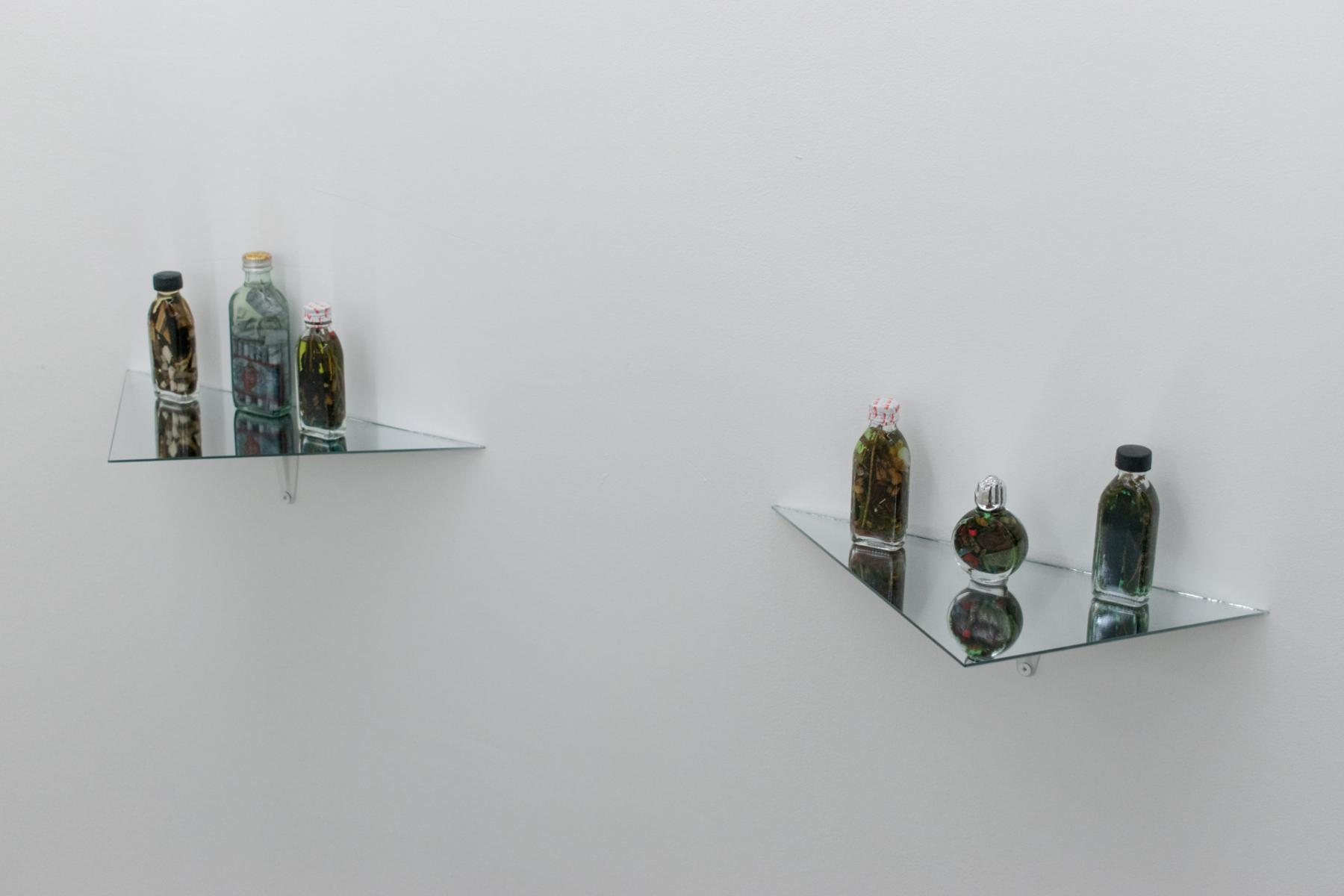
Patrick Cruz, xsagradong lana (sacred oil), gathered by the artist between 2022-2025, part of Patience, 2025. Photo by Philip Leonard Ocampo courtesy of the artist and Joys.
Christian Vistan, Wawa Walk (2013), part of Patience, 2025. Photo by Philip Leonard Ocampo courtesy of the artist and Joys.
.jpg)
Steffani Jemison and Patrick Cruz (exhibition view), part of Patience, 2025. Photo by Philip Leonard Ocampo courtesy of the artist and Joys.
In Ashley Culver’s column on Joys in Cornelia Mag, she mentions that your core values are “plurality, iteration, play, and process,” but you also mentioned collaboration, trust, and sustainability. Can you talk about these values and any others that are important?
There’s a distinction here between what are values and what are methods or attitudes. Sustainability, trust, and collaboration—those are values to me. And plurality, iteration, play, and process are methodologies or attitudes that I'm trying to navigate. I'm using them as channels for unearthing new truths. When I say process, I mean the form of sharing something actively in-progress as a method, honouring and representing artistic processes as they unfold, as opposed to say, valuing the artistic process which is a bit more obvious.
A value I haven’t spoken about yet is the politics of vulnerability—the question of who gets to be vulnerable and what politics dictate what is considered to be vulnerable. My biggest concern with Joys—and this underlies all Joys projects, including the offsite ones that will continue during our break—is thinking about how these things intersect, how they’re governed, and as a result, what kind of work we feel we’re able to make and share. My hope with Joys is that it offers an arena to be vulnerable that doesn’t exist elsewhere. I think part of that is just because there tends to be a lot of intimacy in the way I work with artists. Good art is vulnerable. There’s a shared truth or insecurity that comes about when an artist is connected to their strength, their history, their weaknesses, that I resonate with on a very deep level. I wanted to share that with others too, if the conditions were right. I think at Joys, the conditions have been right. Maybe this connects well with the point I was trying to make earlier about that bullet-proof, thesis-based curating I first encountered in Toronto.
The level of comfort artists feel in the space is important. There’s also a level of freedom that unincorporated non-profit models like Joys’ can offer. Financially, it’s not much of anything, but in terms of creative freedom and control, artists have a lot of autonomy and that allows some really nuanced things to happen. I’m thinking about Christian Vistan’s contribution to Patience, which was informed by a blend of conversations about vulnerability itself as well as vulnerable conversations that don’t necessarily get repeated in the gallery. When I’m working on a show, I often ask artists how much of the story behind their intentions in the work should remain a secret—our secret. There are a lot of personal experiences embedded in an artists’ work that only they can make and speak to, and often those experiences are politicized ones. We are in a time right now where we see a lot of marginalized experiences being discussed in this universal and highly politicized way that is often tokenizing and essentialist. In reality, there's so many ways to talk about these things, and I think that everyone should be given the control over the register used to speak about their experiences.
Are there other curators you learn lessons from? Who do you admire and model yourself after? Is there a style of curatorial work you shy away from or have learned to avoid?
I'm very lucky to be in conversation with a lot of amazing curators in Toronto. I often commiserate, collaborate, conspire with Parker Kay of Pumice Raft. Liz Ikiriko always inspires me. I loved learning from Karen Archey. A bit further afield, I greatly admire Candice Hopkins’ work, and Shimmer in Rotterdam, run by Eloise Sweetman and Jason Hendrik Hansma has been an important reference to me in terms of exhibition temporalities.
I do tend to avoid the more academic aspects of curating, like archival exhibitions, for example. I think I'm always going to be most interested in working with people who are making rather than looking back in time. Maybe that's its own kind of temporality that’s about wanting to have the conversation. There was this funny phrase that came up from time to time from art historians at the University of Amsterdam, which was like: “I prefer to work with artists who are dead.” They were basically joking that it's easier to present an exhibition when you don't have opinions from the person who made it. Because artists have personalities! It carries forward this antiquated idea of the sense of removal and objectivity that happens on the part of the curator, but the curator is never objective either. People had this attitude of, I won't have to negotiate, which I hate for obvious reasons. I think that speaks a lot to the level of authorship some curators feel over the work of other people. I reject that sentiment wholeheartedly.
Can you talk about some of the affordances and precarities that come with running an independent space, and what went into your decision to sublet this year?
After the pandemic, the economic reality is really different for a lot of people, especially in the arts. Things aren't the same as they were before—they're not better in terms of funding and support for artists or curators. That has led me towards this model that's a bit more—I say self-funded, but there's also been a lot of fundraising and small donations involved in Joys. That reflects the appetite and generosity of the people who come to support Joys, but also the recognition that things aren't free. I paid rent by myself, and that allowed for the freedom to dig deep and represent Joys’ point of view. It also meant I could experiment with text and timing, not answering to one funding body.
Part of this idea of working at a slower pace can mean taking a year to rest and grow again. I'm at a point in my life where I'm trying to listen to cues and understand how to address them—how to change things, and to not be afraid of change, like the prayer. A lot of what’s behind my decision to sublet for 2026 is connected to patience, thinking about longevity and the best way to honestly relate to something over a long period of time, accounting for the changes you might go through in your own life. In the current state of world politics, the arts, and precarity around all of these things, keeping good things going is really important. Contributing to the sustainability of existing things may be more important than starting new things. Because we see things go under, we see what a lack of support can do and how harmful it can be when we lose our footing.
There's also something about patience that's a reminder to myself—that I want to continue to operate with this level of freedom, transparency, and dignity with artists, but in order for that to continue, I need to also prioritize other aspects of my career and respect my own capacity. So it’s also a personal assignment: Patience.
It sounds like taking a break is part of this sense of sustainability you’ve been talking about. Paradoxically, you need to take a break in order to continue.
Hibernating is important for many animals. It's not so much that I'm taking time to completely reinvent things—it's more just a dormant time. It takes a lot of faith in your direct community to trust that people will remember your name or what you’re doing, but I'm willing to try. It’s also really wonderful that there will be another collective in the space during my hibernation. Marx gave me the gift of a space that I could infuse with my own ideas—and now here it is again for another group who I have great respect for, and they’re really excited.
Do you have any favorite memories of Joys?
There are so many to choose from! I loved the regular gallery hours. Last year during Natasha Katedralis's show, a baby bird came into the gallery. Her work had this installation with a bunch of jingle bells on top of a piece of stonewool installation. The baby bird was jumping all over the bells and making this beautiful jingle bell sound. That was such an iconic Joys moment. I posted online about it and Alyssa and I had a laugh, joking that it was one of the birds from my story.
Is there anything you're excited about for your hibernation period?
Actually, yes. At first I felt like, “I'm gonna miss this so much immediately.” But I'm really excited to be an audience member. I’m excited to see things without maintaining and representing whatever exhibition or project I also have on. It's really important to make a gap to just fill your mind with other people's thoughts and ideas and to be a real blank slate for that, to be a receptacle. I’m excited to just perceive.