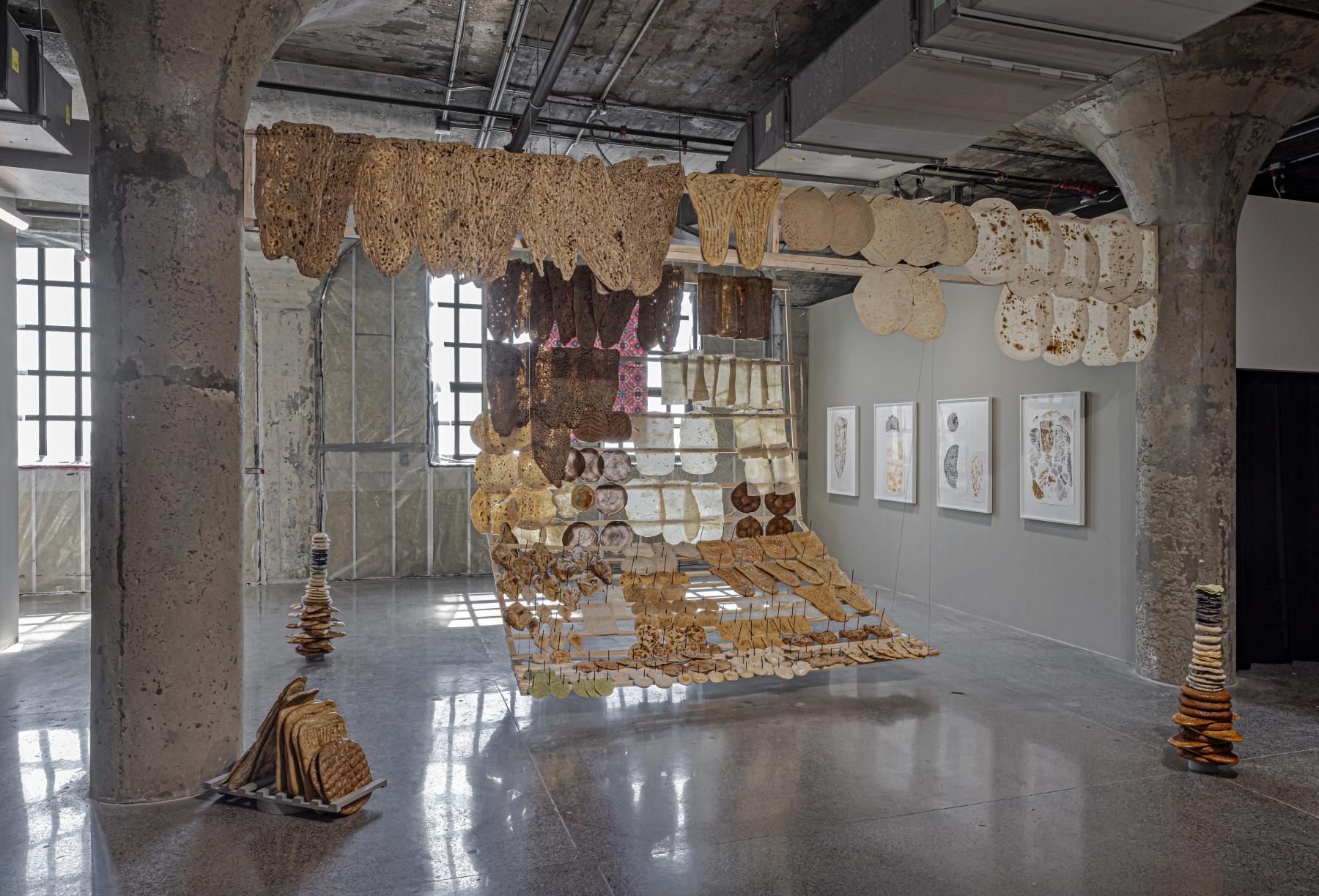
Sameer Farooq, Flatbread Library, 2024. Installation view at the Museum of Contemporary Art as part of the Toronto Biennial of Art, 2024. Courtesy of the artist. Photo: Toni Hafkensheid
I can’t quite remember when I first encountered Sameer Farooq’s work. It may have been during the years I was working full-time in a museum. What I do remember is the surprise of seeing his name, years later, on the roster for a movement class I was teaching at Mosaic Yoga on Sterling Road—just a few doors down from the Museum of Contemporary Art in Toronto. I felt shy about striking up a conversation with an artist whose work I so deeply admired. Eventually, though, I gathered the courage to introduce myself as more than his Pilates teacher and asked if he might be open to talking with me about his practice. We met after class one afternoon in early March, settling into Mosaic’s small studio as the season began its slow shift from a frigid winter toward the promise of spring.
Farooq is warm and generous, immediately turning the conversation toward my transition from arts worker to movement teacher and acupuncturist. We linger for a while on the more difficult aspects of working in Canada’s arts sector—how rigid and joyless it can sometimes feel. In what now feels like another lifetime, I worked in gallery archives and museum collections: operating in dark, cold and quiet climate-controlled basements where objects rest in carefully monitored stillness. We note, with relief, that today we are sitting in sunlight.
Over the years, Farooq has closely observed the museum, often making its structures and habits the subject of his work. For Farooq, the museum is never a neutral container. It is a site where objects are ordered, narratives stabilized, and histories made to cohere—until someone unsettles them. Across sculpture, photography, film, and research-driven installations, he enters institutional spaces to rearrange their logics. What happens when a display is disturbed? What new relationships emerge when objects are allowed to lean on one another differently?
Farooq has exhibited widely, including at the Toronto Biennial of Art, the Venice Architecture Biennale, the Rijksmuseum van Oudheden, the Art Gallery of Ontario, and the The British Library. His exhibition The Fairest Order of the World, curated by Mona Filip, is touring across Canada through 2027, stopping at the Dalhousie Art Gallery, the McMaster Museum of Art, the Musée d’art de Joliette, the Varley Art Gallery, Art Windsor-Essex, and the MacKenzie Art Gallery. The exhibition considers the museum’s authoritative voice—its vitrines, taxonomies, and carefully regulated timelines—while gravitating instead toward adjacency, iteration, and fluidity.
In our conversation, Farooq reflects on fear and fragility within museum culture, the interplay between intuition and intellect in his creative process, and the generative potential of gaps. We return, again and again, to the possibility that the museum might be something other than a temple of preservation. What might unfold if it were understood instead as a permeable, relational space—resilient enough to withstand a little rustling around?
The ideal museum I haven't seen. [...] There's a lot of fear around the collections, a lot of fears around conservation. And I think that impedes the museum to develop a type of fluidity it needs to match the richness of the world around it.
The title of your exhibition “The Fairest Order in the World” comes from a Heraclitus quote. Can you tell me about how you relate to this passage, and how you came to this as an organizing theme for the exhibition?
The complete quote is from the pre-Socratic scholar Heraclitus, who is mainly understood in the world through fragments. They’ve discovered these incomplete, esoteric fragments of his writing. Fragments have a way of transmitting knowledge in the world in far more interesting ways than cohesive, calcified narratives or stories. The full quote is “the fairest order in the world is a heap of random sweepings.” And I loved that because I really believe that how histories are formed is that things cohere and break apart again, and cohere and break apart again. They keep forming in different constellations and iterations.
This idea of how history is formed in museums is that narratives are set. They're decided and solidified in museum displays, and then they stay like that for 50 years until there's a rehang based on the politics of the moment, and then it sort of changes again. This quote is about unfreezing museum time. Museum time really aims to stop a moment in its tracks and then expand on it through display, and through arrangement, and through conservation. That's why I was really drawn to it.
When did your interest in museums and collecting institutions start?
When you're separated from your country of origin, you scramble to find remnants or fragments of where you come from. My mom is from India via Uganda, my dad is Pakistani, and all that they managed to keep through processes of migration was this one metal chest. When I was a kid, growing up on Cape Breton Island, I used to go down to the basement and rifle through it, and it was like a little museum in itself. There was a dried six-foot-long snake skin that I think my mom kept from Africa. And then there were these etched tin vases from Pakistan, and some photographs and some papers. I think from a very young age, I was really interested in this combination of materials and what it said about our family, and myself, and where we came from.
We couldn't have moved to anywhere more different—this rural Canadian life, this island. It's cut off more than most places. So I think that impulse came from trying to make sense of the world. In my work that's not research-based, you still see that compulsion to organize and arrange, to create meanings by adjacencies, and opposites, and symmetries, and dissonances.
Growing up in Cape Breton, what were your early experiences with museums?
That's a great question. There wasn't a lot. All arts funding was cut except for music. So there wasn't a lot of money going into museums. I think my interest was solidified a lot later when I moved to Amsterdam for art school. I was in Montreal for my undergrad in anthropology. But I don't think my interest in museums developed until I was in Amsterdam, where I saw these vast collections that were built out of theft.
The first museums I started to build were called The Museums of Found Objects (2011) with Dutch artist Mirjam Linschooten, who I still collaborate with. We started building these speculative improvised museums based on neighborhoods. We did one in Istanbul where we told the stories of different neighborhoods through the objects found in them. In the one we did in Cairo, we asked 50 people to suggest 50 items that were looted from the Egyptian Museum during the revolution, and to replace objects that were looted with objects from their homes. We were really interested in personal collections. Collaborating with museums came later, when I had a little bit more of a reputation as an artist, and then I would be invited by museums to decolonize their collections [laughs], whatever that means... To perform in their collections. That came a bit later.
Much of the work that you do is about the provenance of objects, their use, their display, but also the ones that aren't on display—the ones that stay in collection spaces, and the collecting or hoarding that happens in these institutions. Often, you are embedded in the museum, in the belly of the institution. Can you talk about some of those experiences?
I think these days museums are very interested in having contemporary artists come in and work in their collections. Museum workers are often overwhelmed by the size of their collections. Often the provenance of their collections are not known, and they see relationships with contemporary artists as very collegial—in that here's somebody who we can support to rechoreograph the collection, to play within the collection, to make some discoveries. With older encyclopedic museums, this also builds public, you know? Like, “Oh, this artist is coming in. They're gonna offer a series of workshops.” I've worked with youth in museums. I've worked with visitors, like, in terms of them making donations. I've worked with deaccessioned collections; I had this whole project where this creepy doll collection was being deaccessioned from a museum, and I built a huge doll museum, and then invited all the kids from the community to come and loot the museum and take all the dolls back into their homes. So I think that there's this desire to work with contemporary artists.
I’m thinking about a repaired museum, or repair in the museum. If you were to imagine an ideal museum, what would that space look like? And have you come across any examples of things that museums are doing that work towards that ideal? Is there a perfect museum that you've come across in your research and all the work you've done?
My favorite museum in the world is the Anahuacalli Museum in Mexico City. Have you been?
Yeah.
So you know [chuckles]. That's a purpose-built museum by an artist for his own collection. And the materials speak to the materials of what he's collecting. There’s these gorgeous vitrines and combinations of things. And now they're inviting contemporary artists to make very autonomous works in certain spaces in the museum. But that's a bit of a different type of museum than I’m usually studying. The ideal museum I haven't seen. Because I think a lot of museums are overly concerned with security and safety. There's a lot of fear around the collections, a lot of fears around conservation. And I think that impedes the museum to develop a type of fluidity it needs to match the richness of the world around it.
You know, if you think about a museum, there's a thick wall that separates it from the outside world. But what I’d love to do is have an exercise of having objects on the outside wall be at a one-to-one relationship to stuff that's inside, so that they speak and rely on each other. I think a lot about the Vietnamese monk, Thich Nhat Hanh's belief of interbeing, which is that everything is really connected as a long chain. Everything is everything else. Everything is relying on each other. A piece of paper relies on trees, trees rely on sunlight and rain. In order to get this piece of paper, there's all of these relationships. And in a similar way, I think a museum has to be cracked open. This idea of relationships and cross-pollination needs to be achieved more.
How do we do this?
I think display mechanisms need to be more flexible. Things need to be able to be easily moved around inside of the museum. Vitrines need to be able to be opened. People need to be able to touch the materials, cry over things. Sacred belongings that belong to different communities need to be able to be accessed and cried over, held, used in ceremony. There are moves in that direction for sure, but, for the most part, they're still very concerned with arranging things in one line and telling a single story.
And then I think if an object is returned through a process of repatriation—or rematriation—I think we should leave those gaps in the museum and see those as incredible opportunities to use them as spaces of contemplation, use them as spaces to really meditate on the human desire to hoard, to collect, to own, to calcify stories. Like, why are we so obsessed with stories? Why can't we allow things to form and reform and shape-shift? There's so many things we can think about in those gaps if we just leave them.
Museums are generally gorgeous spaces that are kind of built to look like temples, so why don't we actually use them as temples and actually get into our bodies and encourage people to work somatically in museums? So that's sort of my ideal. I'm sure you've even taught yoga in the museum.
[laughs]
But I wish we would go a little further and really allow ourselves to question these deeper impulses because the museum is a bit of an old compulsion, and I think we have to really allow the public to think through that in these spaces. So that would be my ideal.
I also think large encyclopedic museums have the potential of introducing new relationships that don't exist already. So when I visit the Metropolitan Museum in New York, sometimes I toggle between different rooms that have nothing to do with each other but are next door to each other. For example, the South Asian Buddhist room, like the Gandharan Buddhist room, is next to the Korean ceramic room. And I just love to think, like, what relationships do these series of objects have with each other? Maybe it's formal. Maybe the curve of a bodhisattva's cheek is similar to the curve of a fermentation pot or something.
And then, you know, that talks about how our bodies are made, how sculptures work across countries and across disciplines. So to me, there's a lot of value in these large encyclopedic museums and within their collections. I just don't think we're allowed to work in them as fluidly as we need to, and I don't think the public is able to do that. There's so much security and surveillance that you can barely even lean against the wall. Or you're told to, like, stand upright.
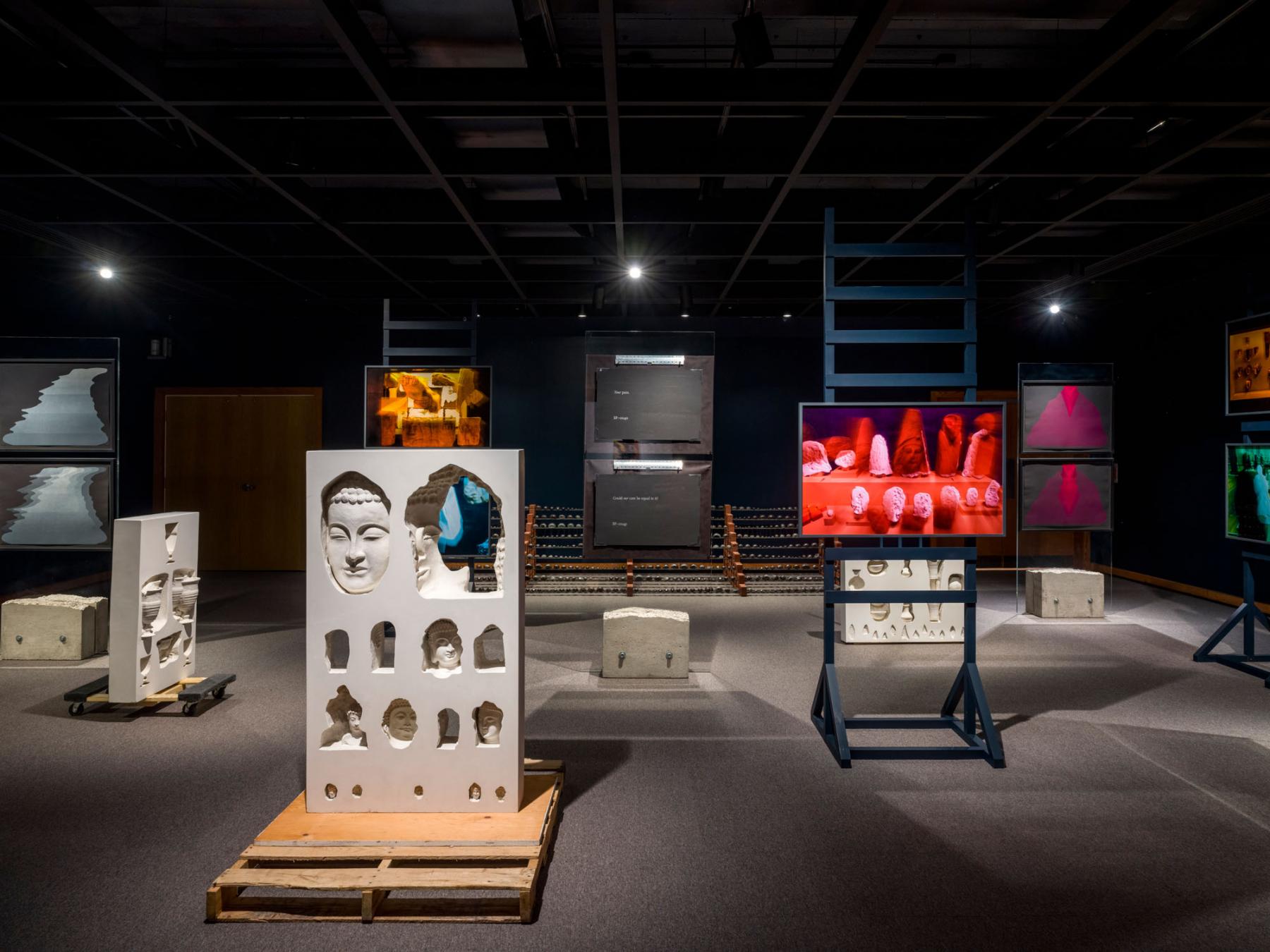
Sameer Farooq, “The Fairest Order in the World.” Installation view at the McMaster Museum of Art. Courtesy of the artist. Photo: Darren Rigo.
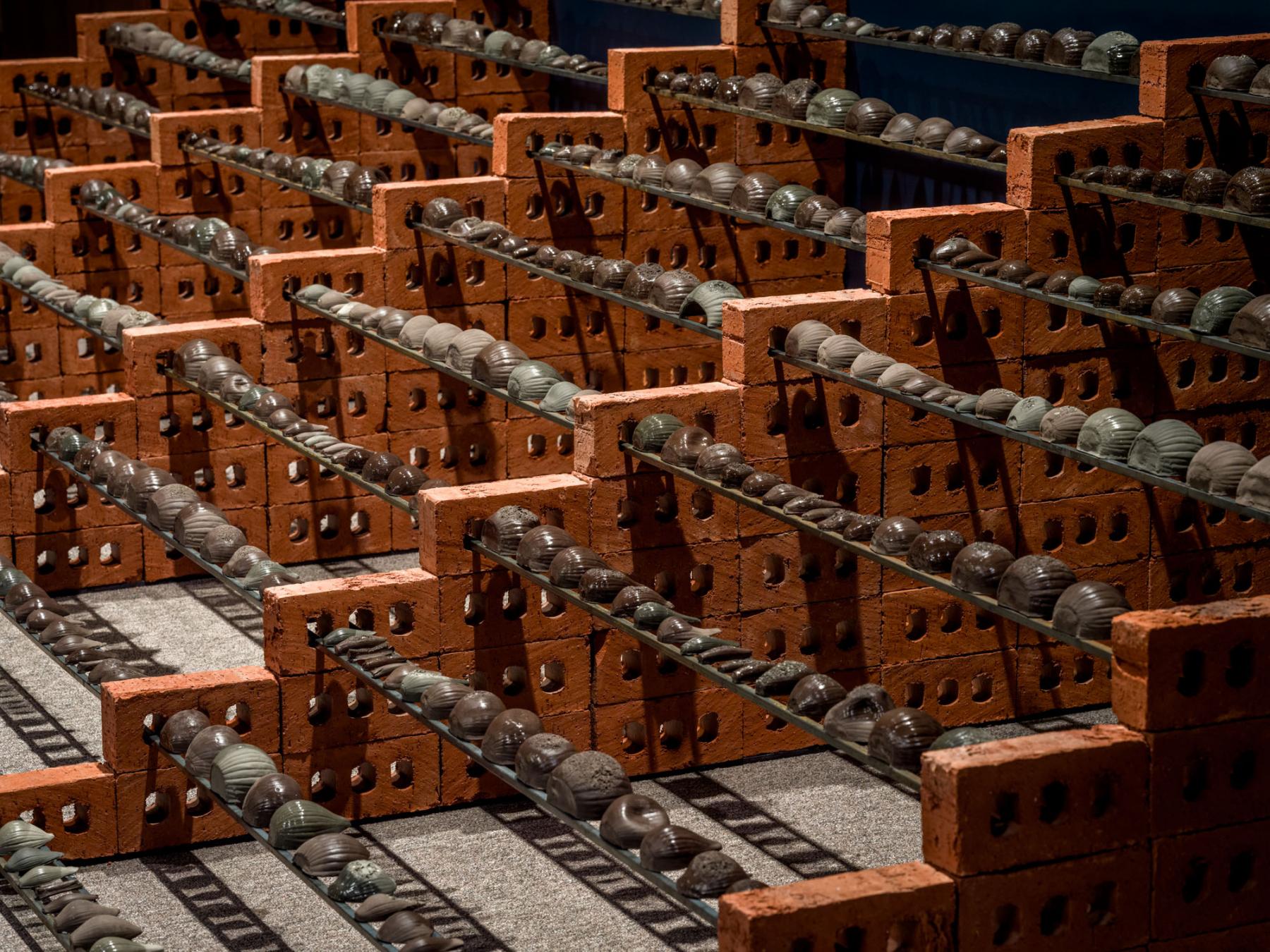
Sameer Farooq, Ascension (Onions), 2022 (detail). Fired ceramic, mason stain, bricks, steel poles. Courtesy of the artist. Photo: Paul Litherland.
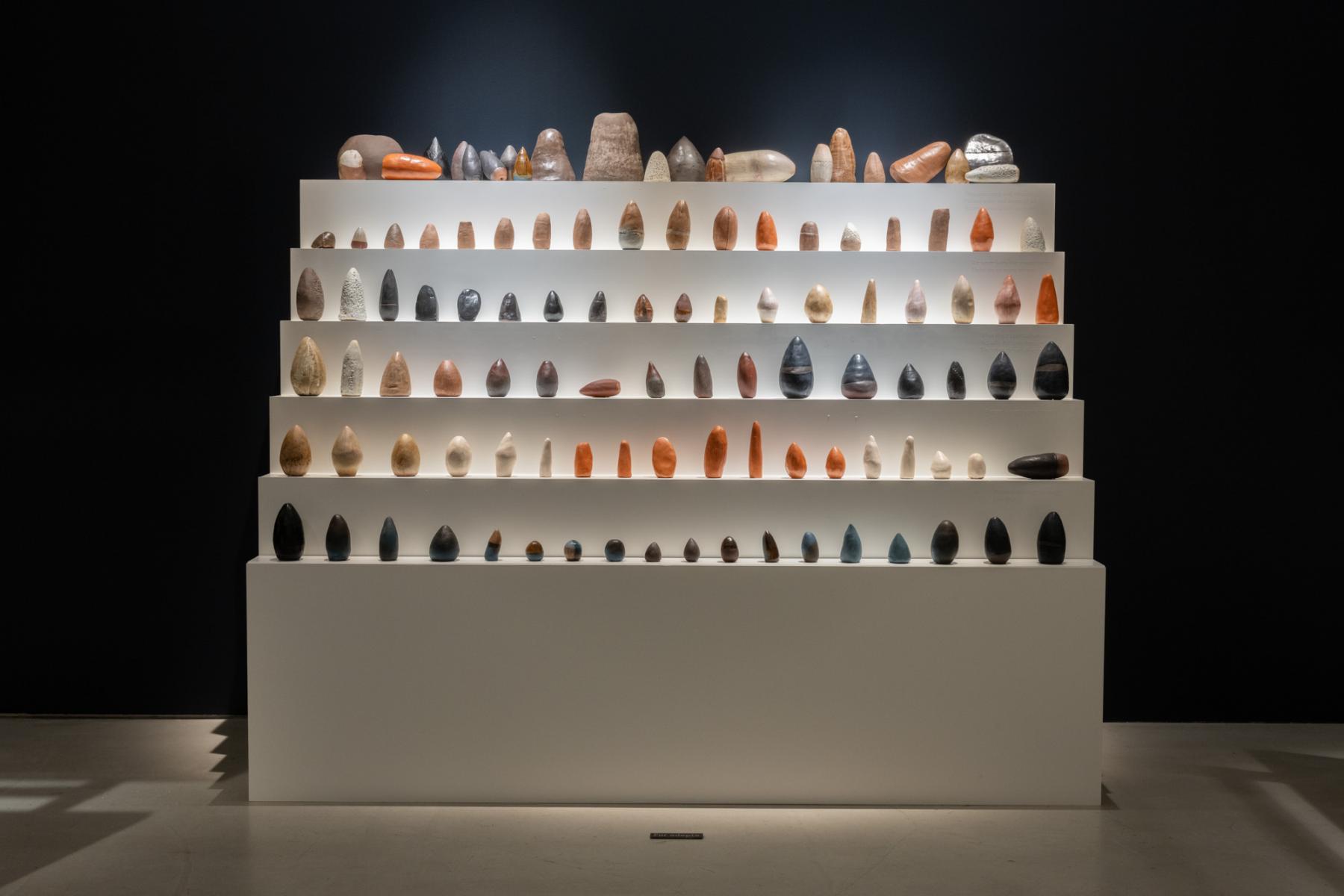
Sameer Farooq, Ascension (Omphalos), 2021. Fired clay, stepped display. Courtesy of the artist. Photo: Darren Rigo.
Thinking about your way of making, it sounds like you're toggling between intuition—this inner sense—and intellect—a more outer sense—and moving between these two spaces when you're creating. Does that sound right?
It does. For sure. There's always a research component where I lean on theorists to give me the language and a roadmap to how to look at things. So, you know, I think about someone like Édouard Glissant that talks about the joy of crossing one boundary into another, and rather than seeing it as a barrier, to see it as a relation. So that's very much how I walk through museums.
But then at the same time, you're right, I really like to counterbalance. I put the theory aside, I put the reading aside. My partner's an academic, so we often get in these big conversations about these issues. And then I put it aside, and I really try to allow the spaces and the materials to speak to me as well. So what's always been important to me is, like, a process of evocation, and I think you sort of have to sit around in silence for a while to allow things to appear. I'm really excited that something always appears—whether it's an image, an object, a text. And then that usually will be the starting point of the actual physical work that I'm building.
Speaking of the idea of uncovering, can you talk about some of the texts that show up in the work, and about that intentional veiling that you're doing?
Those texts are a collaboration with the poet Jared Stanley, who is a Bay Area poet, who currently lives in Reno, Nevada. I work with him a lot because we figure a lot out together. I was making these meditation prints where for three years, I sat, and did different somatic practices. Actually, at this period, somatic practitioner and Executive Director of the South Asian Visual Arts Centre, Indu Vashist and I were talking a lot about this stuff. I realized that repetitive movement was evoking a lot of images from my internal eye—my third eye or whatever. I was coming up with these prints that were mirroring what I was seeing after periods of movement, and then I told him, "Rather than having museum labels about these prints, I want you to take all the liberties possible to interpret what you're seeing." So he then also went into a guided meditation with these prints as anchors. What you're seeing in these prints is that one phrase appears really strongly in one, and then it's faded in the other. The idea is that all of these texts are like a cyclical poem that is appearing and getting duller in different pieces of paper. It’s operating in this way where no narrative is calcified, the poem is also appearing and then going underwater.
Moving away from the work in the touring exhibition, I also wanted to talk to you about Flatbread Library (2024) which was exhibited at the Museum of Contemporary Art during the 2024 Toronto Biennial of Art. What first drew you to explore flatbread as a subject and material?
I went to Pakistan in 2019 with my dad, after 22 years, and traveled around the whole country. What really stuck with me was the tandoor ovens and how they were these central community hubs. We would bring dough to the tandoor and have it cooked every evening with my family. I just became obsessed. And then my dad, I realized, is also obsessed with bread. He had a lot of stories around flatbreads. He said this beautiful thing: that growing up, the flatbreads were like newspapers. That the baker would bake them, and then he would deliver all the news and gossip of the town by delivering the bread door to door.
Mmmm… Wow.
So there was all of this lore around bread. We come from a family of traders—we used to trade kitchen utensils along the Silk Road. Baking bread ahead of the journey was always a huge part of it.
I didn't quite know how poignant the project would be when I set out to do it. I started building these tandoor ovens in different spaces. One was at the Scarborough Museum. One was at an art collective called Materia Abierta in Mexico City. I started making tandoors and baking bread. Then I began to be really interested with the forms of bread themselves. When the Toronto Biennial asked me to come up with a new work, I suggested a flatbread library for Toronto because it was almost like the next logical step—going a bit deeper into all the breads that are made in vertical ovens. I wasn't prepared for how rich the actual project would become in this city. Within 20 kilometers of the museum that it was shown in, I discovered almost every type of flatbread that is produced in the world—within this pretty small amount of space in Toronto. That's really how it started. It was a move from tandoor to the bread itself. I learned a lot from that project. So, in contrast to these very intense cultural critiques of museums, this project felt more universal and more joyous. People really wanted to open up and talk about it more. That was a real discovery—I was talking about the same ideas in museums but it was a gentler entry point.
Can you talk about how you worked with flatbread—an organic, perishable material—to create this display?
You bring up a great point about perishability—it's supposed to challenge what gets left out of museums. If we think about what gets left out of these collections—anything that's live, anything that's perishable, anything that's gestural, is not represented in museums. But they're such huge parts of our human history. So, that's a real gap, like, how are you gonna understand human culture if you don't have any bread in your collection? You know what I mean? It's pretty simple, you know? Or, like, if you don't have apples or onions. You know? I did a whole piece about onions and I'm like, "This is the beginning of every evening in every kitchen in the world."
Wow. Yeah, you chop an onion.
You chop an onion. So that was a real push to think about—how do we sort of make a taxonomy of bread? The process involved flattening and drying the bread under drywall sheets—an old tile making technique. The water gets pulled out of the bread, and then they stay flat. And then I coated them with shellac and flexi paint, which was this acrylic medium to preserve them.
The display is meant to look almost like a textile piece, like a woven archive. I didn't want to put individual specimens separate from each other on a wall, for example, because bread is a very fugitive object. It crosses borders and boundaries in a very, very fluid way. So you have lavash from Iran and lavash from Armenia, and when it crosses the border, it's still called lavash, but it, like, shapeshifts slightly. Or you have scorvegi from Romania and Indigenous fry bread. It shows up in these different areas, but it's the exact same looking bread, you know, just with a different name. I knew I had to come up with a display that was not just a typical scientific display. So that's why it kinda looks like this huge hanging curtain of overlapping breads.
Also in Pakistan and Afghanistan, bread in bakeries are displayed around the doorways of bakeries as these overlapping curtains of bread that are put on nails, and then the baker will just pull one off and sell it to you. So it also spoke to this historical example. But I like to think that that was how bread wanted to be shown, and then I just mimicked that in the display.
I like the idea of it being like a tapestry. I’m thinking about your work Bring It Up From the Dark (2025) which was shown at The Gibson Art Museum at Simon Fraser University (SFU)–it is also a piece that integrates weaving. Did one project inspire or lead into the next?
Oh, for sure. People saw the Flatbread Library and they said, "Wow, this looks like a big loom." And I was like, "Oh, a loom."
A woven archive, as opposed to a taxonomical archive. Pushing relations between things, dissipating the edges and the boundaries between things in order to create interrelationships. Again, interbeing. So at SFU, my whole idea was to translate an archeology museum into a loom. What would that look like? Imagine all these objects migrating out of their very distinct cabinets and then going onto a loom and, like, what would that look like?
If you put those two pieces beside each other, they are very similar. They're these large wooden structures with this almost-textile hanging from them. They both originate from this idea of encouraging relationships between things that have been kept apart for their entire lives, or for a large part of their lives.
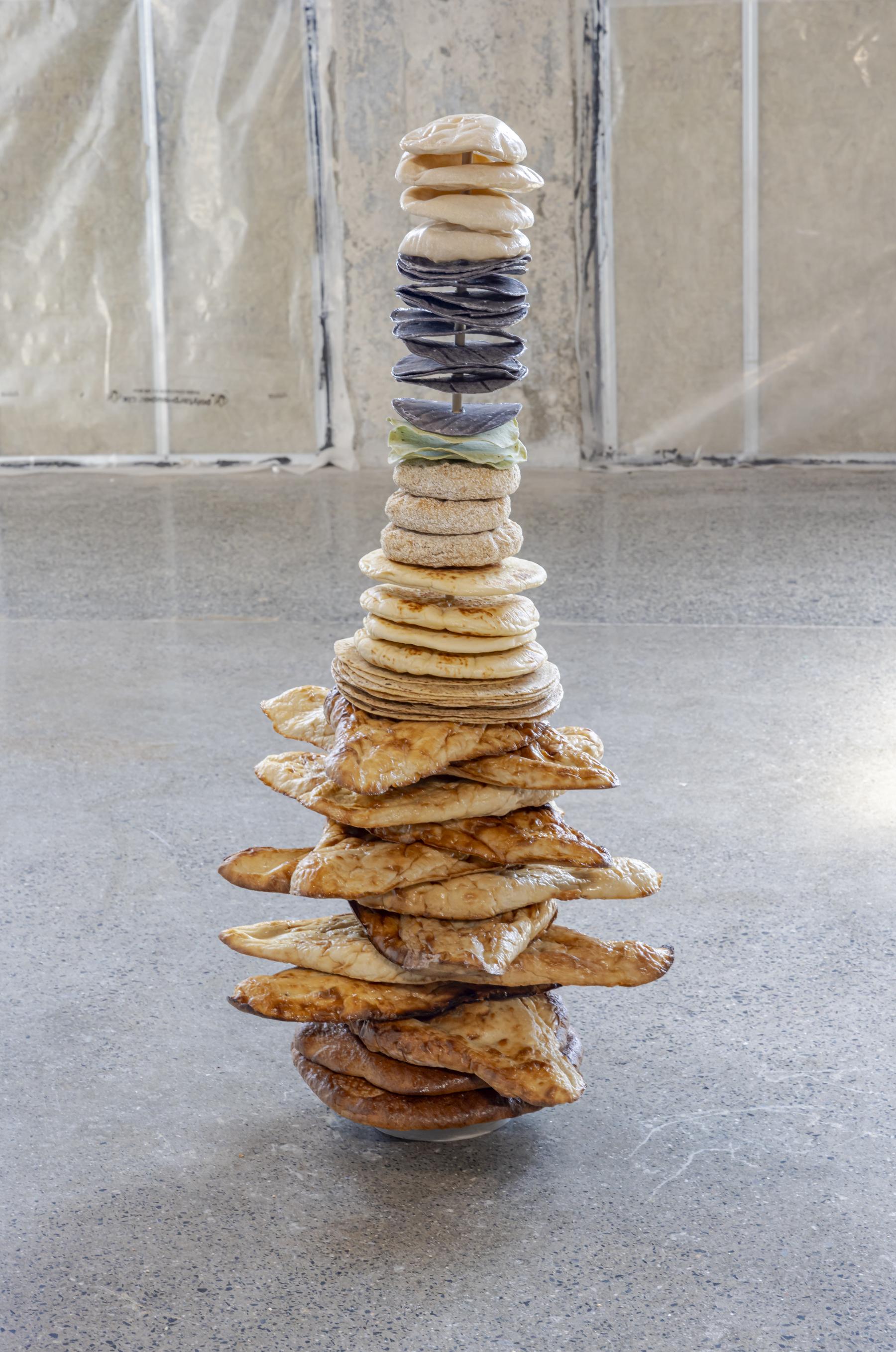
Sameer Farooq, Flatbread Library, 2024 (detail). Courtesy of the artist. Photo: Toni Hafkensheid.
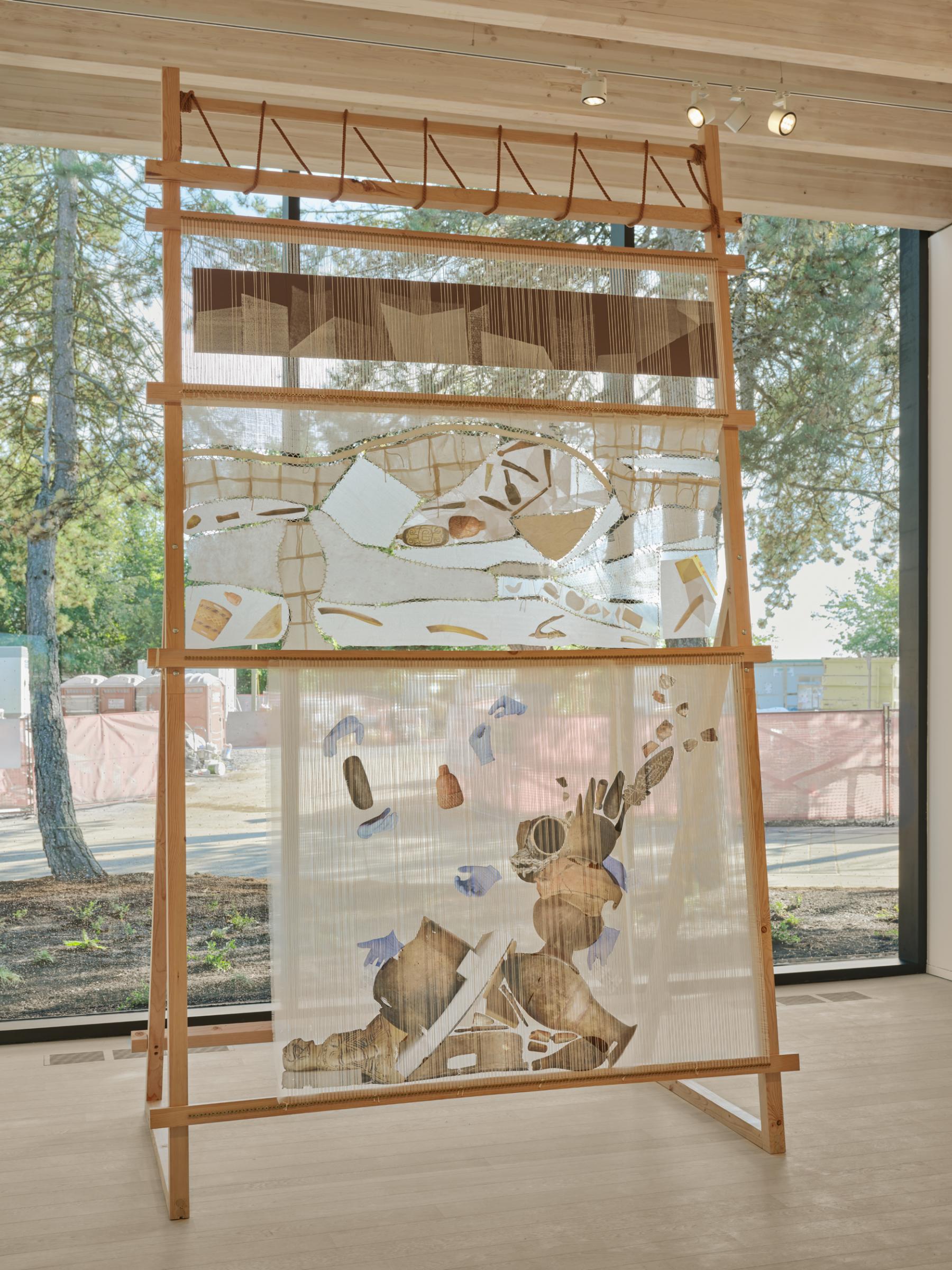
Sameer Farooq and Jared Stanley, Bring It Up from the Dark, 2025. Wood, polyester silk screen mesh, ink, paper, linen, sample bags, polyethylene foam, polyurethane foam, glassine, ace-tate, polyester batting, Tyvek soft wrap, bubble wrap, polyethylene plastic, cotton twine, packing tape. Courtesy of the artist. Photo: Rachel Topham.
In Bring It Up From the Dark, you have these objects that come together in assemblies on this loom. Can you talk about the objects, textures and forms in the installation? Are there particular dialogues or contrasts you wanted to foreground?
The loom is divided into three sections. So the bottom part is a sort of collaged tapestry where I transfer images from the collection of the museum, and you have things finding each other in a formal way. Things nestling into each other and forming these different constellations of objects that do not appear in the museum.
The second part is concerned with conservation and the materials of the museum. I've been really interested in this since 2012 around the lives of conservators, the materials they use, and really foregrounding the materials as a subject in the museum itself. I think often conservation culture hides. They try to be invisible and put the object up front. But I also want to show that that's part of the practice of the theater of the museum. They very much are part of that. So you see in the middle part this constellation of materials that come together, and the pattern it's making are these sedimentary layers that I found in these archaeology journals that were also in the museum. Students would go out on these big digs, and then they would draw these sedimentary layers of what they were finding on their digs. And so I did the same with the materials of the conservators.
And then the final section is these screenprinted pages that run the materials from the conservators through a press to make an imprint. When a weaver is starting to make their work, they have this guide that they call a cartoon. The cartoon is like the layout of the tapestry. And they have it printed on sheets of paper, and then they hold it within the strings of the warp, within the strings of the loom. I thought that was a really nice display method. The top is like the guide for the rest of the loom.
You know what, I'm curious when you saw it, what were your initial impressions? Just because I don't know really many people who saw that work.
I thought it was beautiful in the space that they put it in. Because it's showing objects that are from a collection space. I've worked in collection spaces. They're in the deep, dark basement.
Yep. [laughs]
With the HVAC system, the proper lux of lighting, and not too many humans breathing carbon dioxide around the space. To “protect” the objects. And then to see—I mean, it wasn't the actual objects—but representations of those objects in this space that is so light-filled, and with life—with people. You could see the trees outside through the strings of installations. And the sky. And then to bring you back to the collection space, you have the contrast of seeing those purple polyethylene gloves of the conservator. The hands touching and prodding and poking, and hovering, and guarding the objects. I thought it was really, really poignant.
I was really happy with it too. I hope it gets shown in other places because, yeah, I don't have such a huge community in Vancouver. I would love to show it here or somewhere else one day.
You reminded me what I was thinking about that piece. I made it in collaboration with Jared Stanley, the poet, and a lot of our discussions were around using the action of the loom to also unfreeze museum time. So to sort of stir up how things are held in collections and encourage them to be in new relationships with each other. There was his poem accompanying the loom, and it took a Malay form of the pantoum poem, which is this poem that repeats itself every few lines. So the poem itself is like a weaving—you have different lines repeating and weaving back and forth to each other. The poem was built from statements in the journals from the students.
We started pulling language out from the journals and the notebooks, and what we discovered was a very dark, very sad, very morose account of stirring up the earth. These students would go on these digs, and there would be a lot of expectation, a lot of, like, sadness about the lack of finding things. They were encouraged to write down everything, so a lot of, like, crushes and failed romances and fights between mentors and students. It was just really, really... It was, like, the most unscientific thing, you know? But then it's presented as archaeology, as a science. It was really, really bizarre. If you read the poem, there's just a realization of impending death and that the actions that they're doing are quite futile in a way. [laughs] And it really came out in these journals and in his poem.
Did you say you studied archaeology?
Anthropology. But I took an archaeology class before.
Ah, ok. I was wondering if there was any connection to seeing those student journals and if that brought up anything for you.
Yeah, I only just took a lecture class on it. I never participated in any digs. Maybe I should ask to go? I don't know. It would be really funny. [laughs] Have you ever done anything like that?
No. I studied photographic preservation. So I was in the darkroom or, like, collection spaces.
You just love these cavernous spaces. [laughs]
Oh God. [laughs] Ok, I have just a couple more questions. Can we talk about the ceramics that you make? It seems like you like to work with repetition or iteration in your ceramic works.
With the ceramic works in the touring exhibition,The Fairest Order in the World, there are three pieces that are these monolithic, iterative ceramic works. Each sculpture was an image that appeared during a meditation. So the first piece, which is called, Ascension (Omphalos) (2021), I envisioned this piece that had a flat bottom that was pointing upward. Which is similar to the cornerstone or what they call an omphalos in ancient Greece, where a village would start from the beginning of this stone. Because it's pointing upward, it's meant to symbolize the earth connecting to the heavens. I saw that in a meditation, and what I'm trying to do is, through repetition, get to know what this thing is and to really figure it out and to see how it transforms over time.
With the second piece called Ascension (Radio) (2021), the meditative vision was of an egg cracking and splattering and then going up along the side and turning into an egg again. So it was almost this egg cracking on a loop. I tried to do that in ceramics, and that was more trying to perfect it and do it over and over and over again and try to get this egg form, and I really failed. It doesn't look anything like that. [laughs]
And there’s Ascension (Onions) (2022). I meditated and envisioned this unfurling onion. In a lot of these interior images, things are moving and repeating all the time. I'm just not envisioning a static image. So in one way, the iteration is about figuring out something, but in another way, I really see all these works as a representation of my body over time. You can see my breath in all of the work. You can see my body, like how my arm is attached to my shoulder and how my body is working in time. You see a documentary of the ceramic studio I'm working in—what glazes were available. I was using what was around me. I think these pieces are really about bracketing time, and then showing a process that's going through time.
My mother’s grandmother, my great-grandma—who I'm named after—was a ceramicist. We have some pieces at my parents' home. She coil built her work—which is a handbuilding technique—and you can see where she put her fingers or thumb in some of the pieces. And I can slip my thumb into the spot where she slipped her thumb, and it just feels like I'm connected to her.
Oh, completely.
I love this quote by the Mexican artist Gabriel Orozco who said, "What does my body want to make?" And I think clay gives you the chance to make an imprint of your whole body and what it wants to make. I think dough is like that, too. Why I think bread making is so interesting is because it is bread, but it's also your embodied knowledge imprinting onto this medium. And there's something about clay and bread that are so malleable and shapeshifty.
That is really, really interesting. Where was your great-grandmother a ceramicist? Here or—
In Britain. Yeah. She was never a big artist or anything like that. She was a crafter, you know? And, she taught pottery to kids with disabilities, like how to work with clay. It’s a special medium, because it's evocative and simple, and something we all have access to.
Oh, that's the best. How amazing.
Yeah. I have one last question. I was thinking about the film that you made in collaboration with Mirjam Linschooten called The Museum Visits a Therapist (2021). In the film, the museum is being asked these questions by the therapist and is able to respond. And so, you’re thinking about the museum as a sentient being. So, if the museum became this sentient being and you were able to ask it a question—what question would you ask the museum?
[pauses] What keeps coming up is, like, are you afraid? I don't know. Like, are you afraid of losing your objects or are you afraid of ... There's just a lot of fear and surveillance. There's a lot of actions that are provoked by fear in the museum, because once you steal something, you work very hard to manufacture a story that isn't about that, and you work very hard to preserve what you stole. So yeah. Yeah, I would just ask if it's afraid, I guess. Not afraid of me—but just afraid in general.
But, also, maybe—Are you afraid of me?
Are you afraid of me coming in and rustling around? [laughs]