.jpg)
Megan O'Grady. Photo by Thorsten Trimpop
To be a critic is to question. That is, a critic asks: Under what conditions was this object made? How does the experience I’m having as a viewer relate to the work of its creation? How does this artwork make me feel? And then there is also the critic’s posture: hunched over their work, their back forms that inquisitive arch, punctuating an aesthetic experience by pondering what has this meant to me?
Critic and essayist Megan O’Grady has long inhabited this critical bent. A frequent contributor to the New York Times, she has asked questions such as: Why Are There So Few Monuments That Successfully Depict Women? How Can I Hold On To Hope and Humor While Witnessing So Much Suffering? How Do I Find Meaning and Beauty in My Life? And, introducing a review of Yiyun Li’s The Book of Goose, that pesky question: Why Write?
In her debut book, O’Grady now asks, by way of her title, How It Feels to Be Alive: Encounters with Art and Our Selves. She is of course borrowing from Barbara Kruger, who claimed that art should “show and tell, through a kind of eloquent shorthand, how it feels to be alive.” Yet, in Kruger’s phrasing, and without that slender curve of punctuation, “how it feels” shakes off its interrogative form. Similarly, in lieu of didactic answers, O’Grady’s book of “encounters” are just that: moments of approach and retreat. Though her mood is questioning, her aim is not to examine, explain, or worst of all, evaluate an artwork. Rather, O’Grady pursues aesthetic encounters that veer into the ecstatic, and which might, with enough effort, be better understood when recounted for another.
Some artists of concern will be familiar for readers of O’Grady’s profile-writing, like Carrie Mae Weems and Glenn Ligon, though this time with a narrative thrust unavailable to the modest length of the feature. Instead of the chronological progression one might expect from a book of art criticism, How it Feels collects disparate affects and artworks into thematic chapters as broad as “Mirroring” or “Home Fires.” Broad, yes, but not without grounding, since her art objects take on an outsized life. The accounts are remarkably embodied for a book primarily about visual art yet scant in images. For instance, to translate a self-portrait from Weems’ Kitchen Table Series into words, O’Grady describes the artist’s inclined posture, her insistent gaze. Through the writer, the reader comes to understand Weems as “a friend, parent, breadwinner, and lover, a woman who resists classification.” All this, captured in one photograph, bridging the intersubjective divide between artwork and viewer, critic and reader. The critic, if successful, makes it feel as if the reader is present with the image, that we are encountering Weems “human to human, across the table from each other.”
Speaking via Zoom, I was reminded of O’Grady’s interpretation of the grid. Of Zoom, she writes that its individuated cubes at once isolate and bring together, harmonize and totalize. This grid, like the work of Agnes Martin (a prolific grid-painter, perhaps second only to Mondrian), provides an ordered logic for our conversation’s disorderly topics: feeling and relating, grief and risk. Clunky and sporadically grainy as the Zoom grid may be, it provides us a form of connection across time and space. Art, too, provides avenues for “intimate connection across time and place and vast differences in experience,” as O’Grady says in our conversation. Or, at least, it can help us to tap into an unfamiliar “world of human feeling”—if only we’re receptive to it.
The idea of the anomaly—in art history, or in the cosmos—is a powerful one to me: the run in the stocking that threatens the entire structure we once believed in.
How do you personally encounter a work of art? When entering a gallery or exhibit space, how do you find yourself approaching these art objects?
I look at art with the same gaze, really, as anything else in my life. How it Feels to be Alive is structured around a set of encounters with art that have had a particular and often recurring impact on me, long after that initial encounter. Each chapter begins with a close look at a single work before backing into the circumstances of its making in the life of the artist. From there, I look at the impacts of the work in my own life and in the culture at large, often drawing from other works and time periods.
As a young person, art—in all forms, not only what we call fine art—was always a mode of self-seeking and access to widening possibilities, and I think that’s probably still a big part of why I look at it. I grew up in a place in which an interest in aesthetics and ideas were seen as frivolous, superfluous, or even pretentious, certainly not central to life. As a non-believer in a religious family, I was probably looking for an alternative. And having both that receptivity and skepticism seems important now. And maybe also, a certain antiauthoritarian streak.
And so, I’ve always focused on why we make art and how we actually experience it in our daily lives, carrying it in our imaginations outside of the museum or wherever it was initially seen. I'm interested in how it makes us feel, how it might influence us in conscious or subconscious ways or even challenge the way we think about ourselves in relation to everything else in the world. Part of what thrills me about art is how a single work can measure tremendous cultural and personal shifts over time. In How It Feels to Be Alive, I often revisit the same work at different points in my life.
Is there an encounter that stands out as an instant when you felt this embodied or affective encounter?
Probably the first work of art I can remember having an impact on me was Carrie Mae Weems’ Kitchen Table Series. I saw it when I was a teenager. It tells a fictional story, in a series of photographs and text panels, of a woman—played by Weems—and the different roles she inhabits: mother, lover, career woman, woman of political conscience, friend. The framing and light are always the same, but the people around it change. It is, in essence, the story of a woman’s self-possession.
In the book, I focus on the image of the mother and daughter putting on makeup. It’s simple on the surface, but the longer you look at it, the more it makes you think about the acts of looking and being looked at: we're looking at them, they're looking at themselves in their respective mirrors in preparation for being seen. It’s also about what we pass on to the next generation without really thinking. At that time, I probably related to the daughter, even though she was younger than I was at that point. And now, of course, looking at it, I relate to the mother and think about all the things that I might be passing on unwittingly to my own daughter.
But what made it so memorable to me was the sense that some material of my own life might be worthy of art. That my own experiences were filled with potential meanings. I understood then the power of representation, how it could affirm one’s own existence. Later, I had the great fortune to be able to interview Weems, and she told me that she’d made the series out of frustration with how her female photography students were representing themselves in a self-portraiture exercise. At the same time, she was addressing the near-total absence of women of colour in Western art history.
Kruger is another artist whose voice I became acquainted with as a teenager. I don’t remember when I first saw her work; probably I encountered it first on a mug or t-shirt, rather than in a museum. Her truth-telling jolted me from some of the paternalistic messaging I was on the receiving end of, and my relationship to consumer culture.
I loathe the precious and exclusionary language that often surrounds art—no wonder people are often intimidated by it—and I think some of my distrust of hierarchies of any kind can be traced to her influence. When I received an email from her in response to something I’d written, I couldn’t believe it was real.
One of the undergirding claims of your book is a rejection of the modernist idea that we can even approach art from a completely removed place. Why did that claim feel particularly urgent in the moment in which you were writing it?
I thought a lot about these things when I was researching and writing my first profiles for The New York Times. I was often appalled by what I saw written 20 years ago about, say, Weems, or Barbara Kruger, or Glenn Ligon, these well-established, brilliant artists whose work had been read through the prism of their identity in this incredibly reductive way. There was often a pretense of objectivity on the behalf of the writer, and the presumption of straight, white, generally masculine universality was appalling, almost comically so. And even when I was in college and graduate school, it was somehow seen as uncool to talk about the life of the makers, as though the conditions in which the art was made and seen were irrelevant. It was clear to me that this attempt to isolate art from lived experience was a political choice.
I've always been more interested in the stories behind these beautiful objects that we see in museums or galleries, in what they reflect about us as a culture, than in the objects themselves, if that makes sense. Knowing about the circumstances of a work’s making helps me situate it in time, in history, in the flow of human life. And as I began writing more and more of these deeply contextualized works of criticism, I began to think more about my own relationship with art. Meanwhile, I was metabolizing a lot of anxiety about things that were happening in this country, and in my own life. I became a parent. I lost my home and everything I owned in a fire. I began to feel that there was more to say that couldn’t be contained in conventional journalism.
Writing about art isn’t about sitting in one’s cloistered room, meditating with a fire alarm blaring. So what was it about? How could I be most honest about how it shaped my life?
There are moments throughout the book that think about the role of the critic. Can you speak about your development as a critic, how this shaped your profile writing, and now this longer form of a book?
Art is private in origin and public in expression—this, for me, is key. There's this potential for an intimate connection across time and place and vast differences in experience—and with that, the possibility of affirmation of our common humanity—but also, a mode of contesting our assumptions about how life should go.
In the book, I was moving between the intuitive and analytical. A set of themes emerged as I wrote, seeded in part by the artists I had written about as a critic for The New York Times. Such as: connection and isolation and the impact our friends have on us, a theme that has run through so many artists’ lives. This became the subject of the first chapter. Or: the complexity of seeing ourselves clearly when we’re so busy being seen, or the shame and internalized misogyny women artists have been confronting and disrupting in different ways. Dispossession is the theme of what might be my favorite chapter, in which I travel to Flint, Michigan with the great performance artist and provocateur Pope.L to do a project involving the tainted water. Pope.L challenged my own unsettled feelings about our homes or homelands as identities. The last chapter is about environmental artists and how they challenge our sense of dominion over Earth, anchored in part by the largely overlooked land artist and monumental sculptor Beverly Pepper. The idea of the anomaly—in art history, or in the cosmos—is a powerful one to me: the run in the stocking that threatens the entire structure we once believed in.
Writing this book was a daily joy. I think of it as having floated to the surface of my consciousness because of all these subliminal connections that I was making between artists and times and periods.
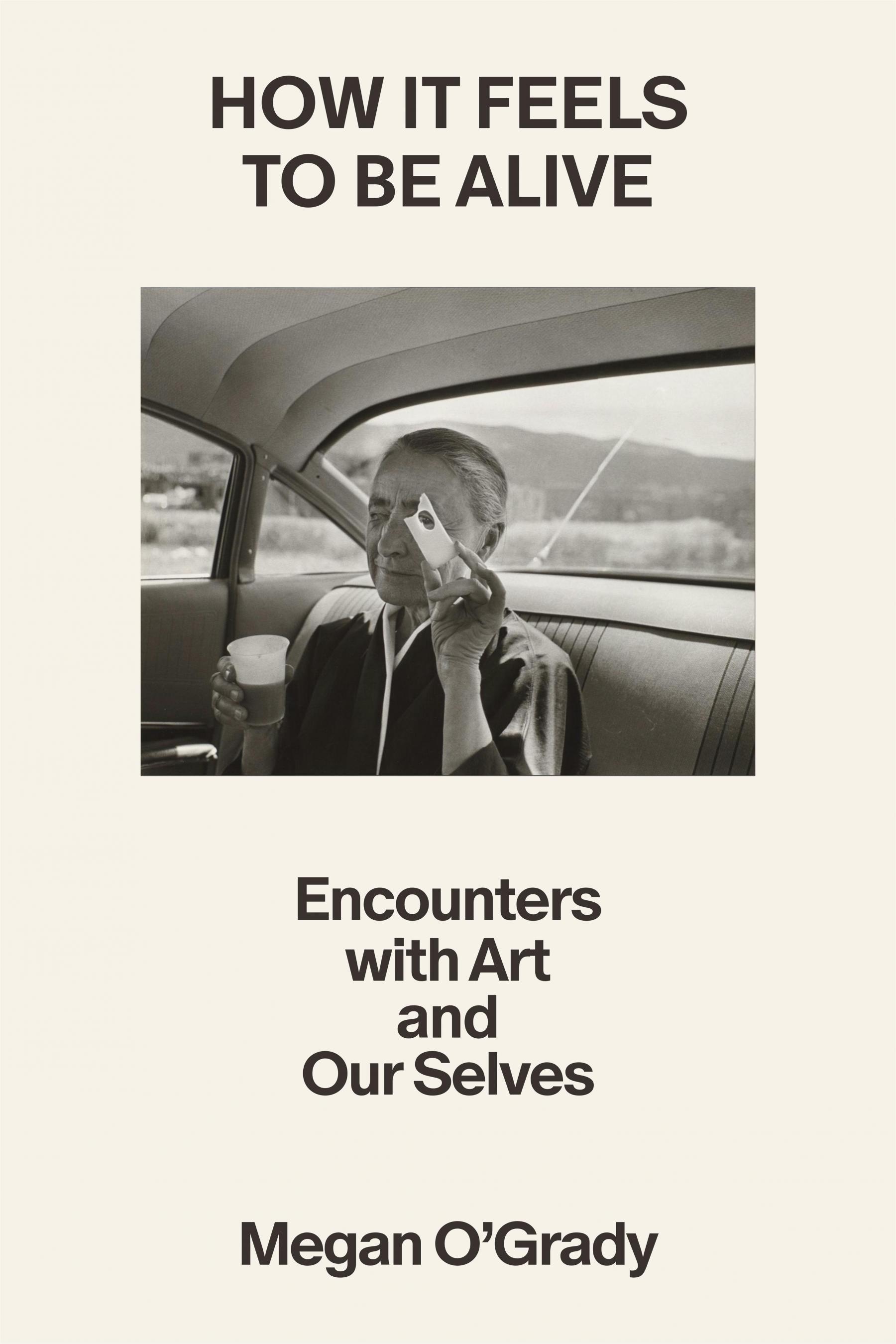
Book cover for How It Feels to Be Alive: Encounters with Art and Our Selves, Farrar, Straus and Giroux (2026)
I'm wondering if you could talk about how these ideas start to fit together in your writing practice.
This book was very much an experiment. It was important to me that the book contain biographical material, criticism, and personal narrative—again, thinking of that movement between one’s inner life and art’s public impacts. So, the work was to get that braid right. When I was in graduate school at NYU, my mentor, the novelist E.L. Doctorow, who was the person who urged me to write criticism, often used the image of driving at night through fog to describe the writing process. You can only see as far as the headlights, but you can make the entire trip that way. This really tracks, in my experience.
Could you speak more directly to this autobiographical strain in your writing?
The craft of the profile, when I was writing for The New York Times, was to try to make it appear as though the person reading it is in intimate conversation with the artist. Eventually, I started to understand the limitations of that as I went on. It felt essential to disclose my positionality with respect to the artist’s work for a number of reasons, and I realized that the only honest way to write about art was to stop hiding, and to try to be very transparent about my particular subjectivity. I think I also wanted to dispel some of the uncoolness of telling personal stories about art.
Yeah. It’s impossible to divorce yourself from your encounters with the work. This is making me think of your chapter on mirrors, which is so much about revelation and the conscious way that women frame their self-portraiture, knowing that they’re being gazed at. I feel like there's some symmetry with how you write about yourself as well. This tension between what you say and what you don't.
Absolutely, there was a great deal of self-discovery in the writing process. And a lot of the things that I find out about myself in the book are not particularly flattering. I was okay with that choice to make myself vulnerable. It felt like part of the necessary risk-taking.
Risk is central to how I think about art now. It's a real risk to choose to devote one’s life to making it. I also teach artists at the graduate level, and I'm in awe of them. Not that they’re necessarily going out and doing things that are technically illegal—though some of them are. There’s the risk inherent to devoting your life to creativity and critique within a culture that doesn't support any of those things, that doesn’t value art’s truths all that much. I want my writing to reflect that level of investment in creativity and critique, things that feel essential to holding on to our humanity.
I was really slow to understand that all criticism is autobiographical, even if we pretend that it isn't. I'm trying to be as open as I can about the limitations of my own Western eyes. At the same time, I'm also very conscious that I don't necessarily always see myself clearly, and that I will inevitably change my mind or get something wrong. Maybe this book is my attempt at self-possession.
What are some books that have really moved you or influenced your writing?
A handful of books influenced How It Feels to Be Alive, most obviously, the sculptor Anne Truitt's memoir, Daybook. It's probably the best book I've ever read about the artist's life, or the process of making art in the context of lived experience and being a mother, spending the evening in the studio after a day of caretaking and bill-paying. Lucy Lippard’s no-nonsense ideas about art deeply informed my ways of thinking as a critic—I love The Lure of the Local—and Mark Doty's Still Life with Oysters and Lemons, a book that I teach often, was probably also an indirect influence. It's a gorgeous work of ekphrastic writing. You can't get more rapturous about art than he does in that book, and it’s liberating.
You’ve mentioned your students several times. Can you speak to how your students have shaped how you see the artworks you're teaching?
As emerging artists, my students are looking to the future. One of the book’s last scenes is in my classroom, the morning after the 2024 election. And even though it’s a dark moment, there's something incredibly hopeful about the direction that art points in.
Also, I wanted to make it clear in the book that I’m not just talking about a handful of major influential artists, I’m talking about what art does, bigger picture, and why we persist in making and looking at it. Many of my students are DACA, foreign, trans, or vulnerable to our current political moment for other reasons. Including them in the book leavens it, a bit, perhaps, but at the same time, gives it stakes.
Can you speak to aesthetic encounters that are disquieting, broadly negative, uncomfortable, or leave you bored or wanting? Early on in the book you talk about Andy Warhol's soup cans, how they left you hungry, and that strikes me as such a funny experience not of appreciation, but something else a bit uncomfortable and embodied.
To be fair to myself, I was probably six when I felt that.
[Laughs] Maybe that's the most direct experience with that particular piece.
I don't shy away from discomfort in the book—certainly the chapter on Pope.L, the performance artist, and how he influenced my sense of home and belonging touches on a number of tough subjects, as does the “Bodies and Battlegrounds” chapter, which includes Heji Shin’s amazing series of photographs of infants crowning and Carolee Schneemann’s “Interior Scroll.” I’m forced to confront my own internalized misogyny, which is pretty unpleasant—and very necessary.
Boredom is another matter. I don’t want to single out a specific artist who has left me cold because I always feel that there's potential there to change one's mind. But it happens all the time—not everything is for everyone, right? In the book I mention some of the art of the early aughts that was very slick and self-referential, and at that particular time and where I was, it was not the art that I needed. And maybe it still isn't, but I always leave the door open.
Art comes to us with baggage; we come to it with baggage. There's no pure encounter. That's why I included that image from Thomas Struth's Museum Photographs in the introduction, where you see the people from the perspective of the art. In one image there's a little girl in red looking quizzically but enraptured at something, trying to puzzle it all out. Then there are all the other people who are just on the phone, taking a picture, thinking about lunch, whatever. I relate to all of them.
It's easy to be intimidated, or to feel like you’re not feeling what you’re supposed to feel. I can't say that I feel a personal connection to the Mona Lisa. But that said, while writing about 21st-century art, I have learned to love the Old Masters. In the first chapter, I include my experiences in Berlin’s Gemäldegalerie. I happened to be passing by when there was a cloudburst, so I went in and found the rooms were entirely empty of people—which makes sense; Berlin is filled with cutting-edge contemporary art, why go see the Old Masters? This meant that I had all the art to myself.
I could sense the emotions of the artists who made these works hundreds of years before. Even in a still life, each object was chosen for a particular reason, representing any number of things the artist wished to telegraph about beauty or desire. I think about what was at hand in the artist’s studio and what they sought to bring into it. I think about what luxury meant to them, or other things that might be coded into these things, from social class to colonialism. A world of human feeling is there. If you can tap into it, I think that's the best you can do.