
Elias Nafaa, Handle With Care, 2026. Installation view at La Chambre Blanche, Manif d’art 12 – The Québec City Biennial.
Cast resin, variable dimensions. Tender Grounds, sound composition by Cynthia Zaven. Image credit: Pedro Barbáchano.Caption
Handle With Care is a familiar instruction to me. It asks that an object be protected from damage as it passes from one place, or one pair of hands, to another, a small courtesy extended to something that can't ask for it itself. But handling also names a different kind of passage: the process by which something is received, examined, sorted, and made manageable, the manner in which a case is handled, or a body of evidence. The phrase holds both meanings without strain for as long as the object in question is something that might be broken. It comes under a different kind of pressure when the object being handled is designed to break something else.
I keep returning to this contradiction that Elias Nafaa’s installation of the same title holds.
My initial encounter with Handle With Care was at La Chambre blanche, an artist-run center in Québec, during Manif d’art 12, the Québec City Biennial. As soon as I entered the gallery, I was blindsided by the sheer presence of three-hundred resin-cast sculptures. Arranged closely alongside one another and sorted into six families, they occupied much of the room, with just enough space to move around them. Only gradually, I began to recognize their forms as those of munitions, objects I had previously known largely through the images of war. Transformed into translucent, almost ghost-like sculptures, their seemingly delicate surfaces stood at odds with the devastation of their real-world counterparts. A sound composition permeated the gallery from the platform the casts rested upon. Distant denotations, the hum of drones, and low-frequency vibrations mingled with less recognizable sounds. While some sounds were identifiable, others were difficult to place, and I could not always distinguish where one ended and another began.
The resin-cast sculptures form the heart of the installation, modelled from munitions linked to Israeli strikes on Lebanon, since 2023. Cynthia Zaven's soundwork Tender Grounds accompanies the sculptures, a piece built through memories of her own experience of being in Lebanon. In contrast, Nafaa’s work developed from a distance, in Montréal, and I want to start with the particular kind of attention that his casts demand.
Ordinarily, a weapon is known through what it does—not through protection, but impact—and through what remains after. Nafaa works from that residue: fragments, photographs, reports, and locations, reconstructing forms of munitions from the traces they leave behind. To handle the traces with care, in his hands, means something closer to the second sense of the phrase. He distinguishes one munition from another, refusing to let three hundred distinct objects dissolve into a single image called war. This refusal seems deliberate to me, and it's what I wanted to ask him about directly.
What receives this precision is still a weapon, already one of the most classified objects there is, with a name, a type, an order, all assigned by systems of taxonomy, and the Military Industrial Complex that put it to use. Nafaa does not remove the munitions from that logic. He turns it around, so that the exactness through which they can be identified becomes a means of holding them still. Hollow, cast in pale, semi-transparent resin, the munitions retain enough specificity in their silhouettes to tell one form from another while losing the density, weight, and solidity associated with their original function. Their arrangement carries this classificatory order into the room, turning the distinctions established by Nafaa's research into spatial relations that the viewer moves through. What appears as taxonomy in the accompanying booklet, Field Notes on an Ecology of Strikes, in the installation, becomes something closer to a sequence the viewer walks through.
Zaven's sound enters this order differently. Conceived as though emanating from the ground, Tender Grounds moves through the platforms on which Nafaa's casts are arranged. But what we hear is not an attempt to reconstruct the strikes that Nafaa has documented. Where Nafaa's research moves from evidence toward identification, Zaven's composition seems to move through a different kind of return, reaching from the recent war toward memories of those she experienced decades earlier in Lebanon. To me, this difference feels important—it suggests that the sound does not simply supply another kind of evidence for what Nafaa has reconstructed. Both practices seem concerned with what remains, but they appear to arrive there through very different kinds of trace.
Nafaa's taxonomy separates the munitions into identifiable forms, and their arrangement carries those distinctions into traversable space, so that each cast can be approached, circled, and distinguished from the next. Tender Grounds cannot be encountered in quite the same way. It is heard without being seen, and its source is not always immediately apparent. It changes how the space around the casts is encountered without becoming another object within it. Nafaa's material architecture and Zaven's sonic one therefore occupy the same room differently, and their coexistence, rather than a simple division between object and sound, interests me. Moving through the installation also means encountering these architectures over time, since sound introduces duration into objects Nafaa has otherwise held still.
Objects that are visually identifiable do not always coincide with that which can be located through listening.
The following conversation with Nafaa and Zaven considers the acts of reconstructing, remembering, and approaching what remains, alongside the possibilities that emerge when these different forms of attention are brought into relation.
So much care is organized around making sure an object designed to destroy reaches its destination intact, while the body, building or landscape that receives it can be treated as expendable.
I’m interested in how the collaboration began, particularly because your practices seem to approach the question of violence from such different directions. Elias, your work begins with the identification and reconstruction of weapons, while Cynthia, your soundwork moves through the space in a way that is much harder to locate or contain. What brought these two approaches together in the first place, and what did you recognize in each other’s practices that made you want to work together on this project?
Cynthia Zaven: I hadn’t collaborated with another artist for a long time when Elias first contacted me. I loved listening to him describe Handle With Care. His project was rooted in reality and research, while being very poetic and powerful at the same time. And it’s an installation that resonated with me. By making art that was in connection to our present, I suppose we were trying to assert control over the chaos around us, to reclaim agency through our work. When Elias first showed me 3D drafts of his casts, I also saw them as ghosts: violence disguised in elegant sculptural forms. The evidence of terror was not in your face, it was beautifully camouflaged within a vulnerable object, so fragile it had to be handled with care. I was drawn to this contrast because his intention was not to aestheticize war. On the other hand, unlike a visual object, sound is intangible and cannot be contained within a fixed frame. It moves through and activates the space, making its boundaries deliberately porous. Sound became the threatening element: unseen but perceptible.
Elias Nafaa: When I approached Cynthia, I already knew that I wanted sound to be part of the installation, but I also knew quite clearly what I didn’t want it to do. I didn’t want to reconstruct the sound of a strike or create something illustrative around the sculptures. There was already so much information in the objects and in the research behind them that adding a kind of soundtrack of war would have felt too literal to me.
What interested me in Cynthia’s practice was her ability to use sound spatially and psychologically without needing it to explain an image. I wanted something that could enter the installation from a different direction.
My own process was very precise. I was working from fragments, photographs, reports, technical information, and locations, trying to distinguish and reconstruct six families of munitions documented in Israeli strikes on Lebanon. It was important to me not to let everything dissolve into one generic image of “war.” These objects have names. They have particular forms and functions, and they belong to larger systems.
Cynthia wasn’t approaching them through that same process of identification, and I think that difference is what made the collaboration interesting. We could occupy the same installation without having to arrive at the same thing.
Cynthia, is there a specific memory or place behind the sounds in Tender Grounds, or did the piece take shape from something less specific, an association and an older work rather than a single source? How did that memory or association first enter the piece, and did it remain the same once you began thinking about the sound in relation to Elias’ sculptures?
CZ: I had been working on similar themes in previous projects, like the Bunker Fairy Tale (2013) and Human Moments in WWIII (2018), inspired by a short story by Don DeLillo. When Elias approached me for his installation, it immediately struck me as a continuation of my work on sound as an abstract sonic terrain of a warscape. Elias’ installation seemed to inhabit this same terrain. Unlike these earlier compositions, which included dialogue in the phonetic alphabet, in Tender Grounds, all traces of human presence have disappeared. Some of the sounds originate from recordings made at night during periods of bombardment, sounds I processed and manipulated digitally: distant detonations, drones, and low-frequency vibrations travelling across the landscape. Elsewhere, subtle textures suggest matter in transformation: something simmering, something burning, something unsettled under the surface. The composition doesn’t try to reproduce the experience of war. Rather, it evokes the enduring presence of menace within a landscape and its psychological and territorial impact. Walking around the resin sculptures, listening becomes a form of witnessing, blurring the boundary between reality and interpretation.
Elias, is there an earlier experience or work of yours that you can trace a line back to from Handle With Care, something that returned in the making of the piece, even in a form you hadn't expected?
EN: The clearest line is probably Conversation with the Strata, a project I developed with Beirut Museum of Art (BeMA) around damaged paintings from the Lebanese Ministry of Culture’s collection.
I was looking at conservation and at the decisions that happen around an object once it has been damaged. What gets examined, what gets stabilized or repaired, what receives attention and what can wait. I think that was the moment when care became more complicated for me. It wasn’t simply a gesture of protection anymore. It was also a system with its own priorities and choices.
That returned in Handle With Care in a form I hadn’t really anticipated. I started noticing that care wasn’t only something extended to an object after it had been damaged. It could also be built into the systems around objects designed to produce damage. That complicated the idea of care for me even further.
I keep thinking about sound as a trace of violence, how immediate it is, and how impossible to hold onto at the same time. It passes as it happens, unlike a photograph, a document, or a material fragment, which remain behind to be collected and examined. And yet sound can persist too, not as something you can return to and find again, but as something that stays in memory, sometimes more insistently than any object does. How do each of you think through that difference—between a trace that can be collected and identified and a trace-like sound, which passes but can remain, unpredictably, in a person?
CZ: In the 1970s, Beirut used to have an alarm siren. It was tested once a month, and to me as a child, it was the loudest sound imaginable that would fill the entire city. I remember running around to shut all the doors and windows, and still being able to hear it very loudly. This was before the civil war began. So, as a child, I already understood the power of sound, how it could infiltrate everything, how nothing could stop it, how it sometimes can remain in your ears for days. Later, during the war, I would carry my stereo into the shelter and listen to music through headphones, initially so that I wouldn’t hear the bombs. But the main reason was not to hear the silence in between the explosions. That was the scariest, most potent, and loudest sound of all. It was when all your senses were most alert. In the 1980s, I was a conservatory student studying music. So music, war, and silence were all part of the cocktail that shaped my fascination with sound—as a medium, but also as a space to inhabit, and that I continue to inhabit to this day.
EN: Sound is also evidence. Some of the recordings Cynthia was working with were made during periods of bombardment, and each of those recordings carries information about a particular moment before anything is done to it.
What became important for us was the decision not to make sound function primarily as evidence in the installation.The six sculptural families were already built through identification and documentation, and the booklet carries that research quite explicitly. If the sound had also been used to reproduce or document the strikes, I think we would have been bringing the violence into the room too directly. I didn’t want the installation to become a simulation of being under attack.
I started thinking of sound almost as a seventh element, but one that shifts the logic of the work. Instead of directing you back again toward the weapon or the explosion, it turns toward the ground, toward what receives the impact and what continues afterwards. The original recordings are still present within Cynthia’s composition, so the evidence hasn’t disappeared. But you’re no longer being asked to listen to it as documentation. You aren’t identifying a particular explosion or drone.
I think that shift was important. The work already asks you to look very closely at violence. The sound didn’t need to make you relive it.
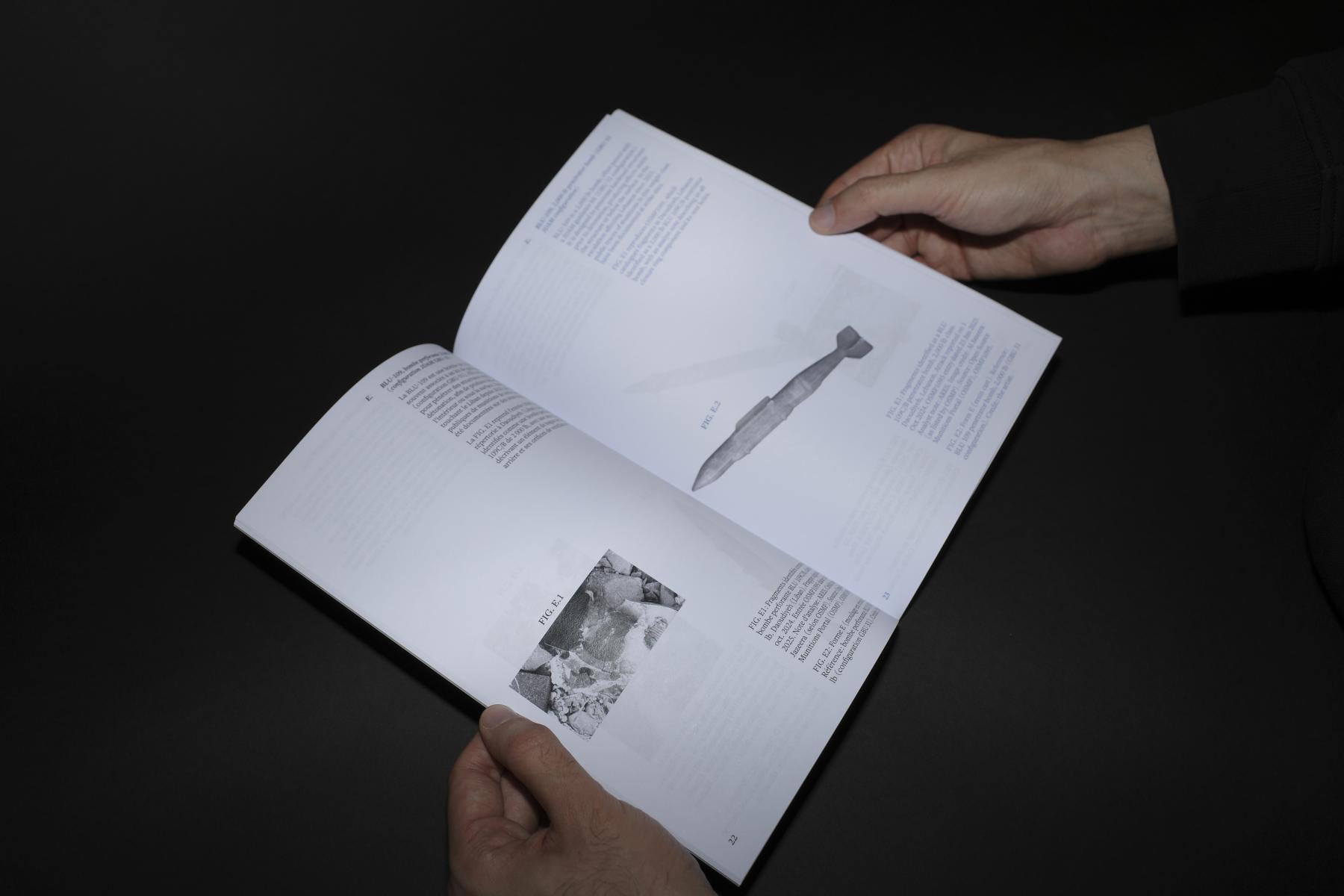
Elias Nafaa, Field Notes on an Ecology of Strikes, 2026. Detail view of the booklet accompanying Handle With Care. Image credit: Tyra Maria Trono.
Elias Nafaa, Handle With Care, 2026. Installation detail at La Chambre Blanche, Manif d’art 12 – The Québec City Biennial. Cast resin, variable dimensions. Tender Grounds, sound composition by Cynthia Zaven. Image credit: Pedro Barbáchano.
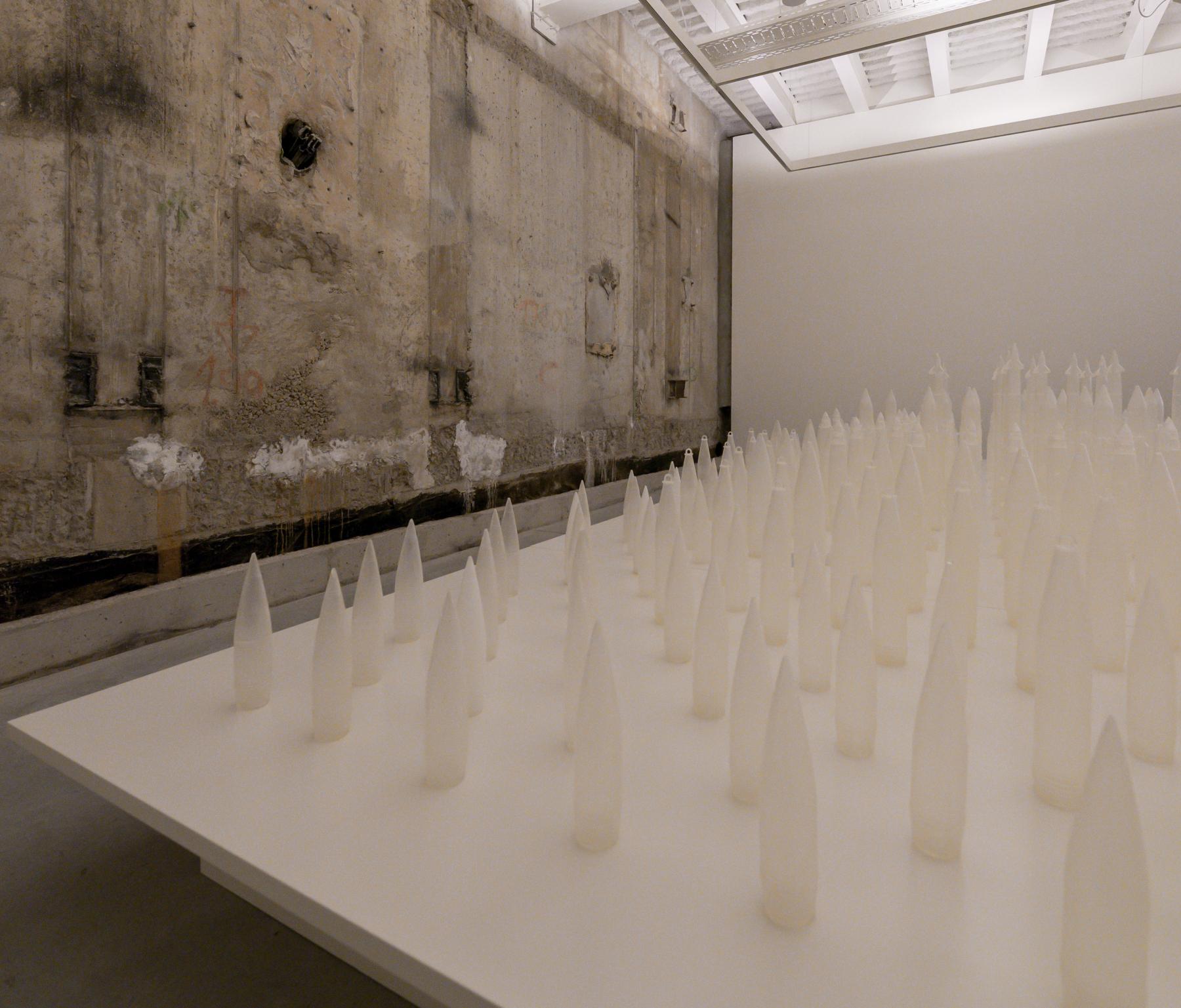
Elias Nafaa, Handle With Care, 2026. Installation view at MUZEU – Pensamento e Arte Contemporâneadst, Braga, Portugal.
Cast resin, variable dimensions. Image credit: Hugo Delgado.
Elias, your background in architecture seems to come through in the way the sculptures construct the space around them. Your research gives material form to distinctions between the munitions, while their arrangement across the platforms produces a kind of built architecture within the installation. Cynthia, Tender Grounds seems to produce another kind of architecture alongside that one, a sonic architecture whose boundaries are not materially built but emerge through the way sound is experienced across the installation. How did these two ways of constructing space shape each other as you were working on the installation?
EN: My architectural background probably comes through less in the individual form of a sculpture than in how I think about relationships between things. With three hundred objects, I was thinking constantly about distance, repetition, scale and circulation. At what point are you looking at one specific object, and at what point does it become part of a larger accumulation? How close can you get? How do you move between the different families?
The taxonomy was important to me, and the booklet makes that structure quite explicit, but I didn’t want it to stay on the page. I wanted those distinctions to become physical. The families occupy different areas across the platforms, so part of the research becomes something you understand through movement.
Once Cynthia’s composition entered the installation, that order became less stable than I had first imagined. Visually, everything is separated and measurable. You can identify where one family stops and another begins, but your attention doesn’t necessarily follow that order while you move through the room. I liked that. The taxonomy is still there, but it is no longer the only way of reading the space.
The installation is grounded in a specific and ongoing violence in Lebanon, yet it seems careful not to let itself be read only as a document of this moment. How do you both think about making work that is historically precise without becoming historically bound, work that could still mean something once this particular war is no longer in the news?
CZ: I was never interested in making a work that would simply illustrate a specific historical moment. Violence has its own repetitions, its own language, and these extend beyond a particular place or date. To me, Handle With Care is all about the past wars, the wars of today, and those in the future. Elias’ starting point is geographically defined, South Lebanon; but to me, this was about what can no longer be confined by time or place. It is a suspended war, like something out of science fiction. It could also be about the new world to come. This is why I wanted the composition to remain somewhat open and unresolved, as sound does not necessarily locate you in one precise moment in the way an image can. It can evoke and suggest many possibilities of interpretation. I am interested in how a specific history can also resonate with other histories, other places and times. I hope the work can continue to exist even when the circumstances that gave rise to it are no longer in the news.
EN: I’m quite cautious about moving away from the specificity too quickly. The work begins with particular munitions used in Israeli strikes on Lebanon. I don’t want the desire for it to speak beyond the period it documents to make that history vague. Sometimes abstraction can reproduce the disappearance that the work is trying to resist.
For me, it is almost the opposite. You stay with the specificity long enough that it starts opening onto larger systems. The booklet is important for that reason too. In the room, the sculptures can become quiet, fragile and somewhat ambiguous. Field Notes on an Ecology of Strikes keeps returning them to the research, to the names and sources, and to the systems around them. The installation can remain open perceptually without losing the history behind the objects.
When you follow one munition closely enough, you quickly move beyond the object itself. You arrive at manufacturing, transportation, storage, targeting and legal language. Then there is everything that happens after impact and what remains in buildings, soil, agriculture, infrastructure, bodies and memory.
I felt this very strongly on the opening day at Manif d’art. The exhibition opened on February 28, 2026, the same day the United States and Israel began striking Iran. More than sixty people came into this small artist-run centre in the middle of winter in Québec City and found themselves standing in front of three hundred munition forms. At the same time, many were following the news from the region. Some were checking updates or checking on family and friends as I was presenting the work. Within days, Israeli strikes had intensified across Lebanon again.
The work was built from documentation gathered before that day, but in that moment it was being encountered through the present. It wasn’t documenting what was unfolding in real time, but suddenly the distance between that research and the present felt very small. I think that is why historical precision matters to me. It gives the work a specific place to speak from, while the present keeps meeting it differently.
Elias, you were working on this from Montréal; Cynthia, you were in Lebanon. Did that difference in proximity shape how you each approached the material, or how you worked together across the distance?
EN: I think the distance partly produced my method.
I was in Montréal while the war was unfolding in Lebanon, and almost everything reached me through photographs, videos, reports, phone calls and messages. Looking closely became a way of working through that distance. If I couldn’t be physically present, I could at least remain with the specificity of what I was seeing rather than letting it collapse into a generalized image of destruction.
But distance also shaped what I could know. I never had these objects in front of me. I was reconstructing them from what became publicly visible after their use. There were always gaps, and I think it was important not to disguise those gaps as certainty.
Research can also create its own strange sense of control. You make folders, compare images, build models, and something that is completely unmanageable in reality begins to look manageable on a screen.
What became interesting in the collaboration is that we were almost moving in opposite directions. I was working from far away and trying to get as close as possible through accuracy and identification. Cynthia was much closer to the ground and to the sounds themselves, but the composition moved away from direct representation. It created distance from the immediate violence rather than trying to reproduce it.
CZ: There’s always the risk of sensationalism, or even desensitization. But the beauty of the objects does not erase the violence they represent, nor the data that has been collected; beauty makes it more disturbing. Like a Haneke film.
In Handle With Care, there is a great deal of research behind the work. So the attention is not only directed towards the experience of the work, but also towards the reality and the facts behind it. This is an installation about an ongoing erasure, a continuing ecological, economic and social catastrophe. If the work is able to make us stop, listen, look, read, and perhaps become curious about what we are seeing and hearing, then that attention is meaningful, because it keeps us from becoming indifferent.
Cynthia, I recently had the chance to watch Ali Cherri's The Watchman, which you scored. It made me think about how different the conditions of listening are between a film and an installation like this one. What changes for you when you're composing for a film, where sound is tied to an unfolding sequence of images, versus a space where the listener is moving through the room itself?
CZ: I loved working on Ali’s The Watchman. In a way, I consider myself lucky to be in a position where I can choose the projects I want to work on. The contrast between the politics of power and the poetics of vulnerability is particularly present in this film as well. I am interested in opposition, in the multidimensionality of a story or a reality, and in the possibility that several readings can coexist. Sound can open up these different possibilities and create other layers of perception.
For me, the main difference between composing for film and sound installations lies in the relationship between sound, time, and the way the audience encounters the work. In film, the moving image and the narrative establish a particular passage of time. The audience is carried through a sequence that unfolds in a predetermined order and duration, and the sound responds to what is happening on screen: either by illustrating or by suggesting a different emotion, destabilizing what we are seeing. I find this tension between what we see and what we hear particularly powerful, because it can shift the meaning of a scene without changing the image itself.
In a sound installation, the relationship to time is much more open. The space itself becomes part of the composition, and the visitor is free to move through it, to stay, to leave and return later. Depending on the work, sound could be the primordial medium, taking the form of a narrative that is meant to be experienced from beginning to end, as in Perpetuum Mobile (12-channel sound installation, 2016) or Octophonic Diary (8-channel sound installation, 2009).
Tender Grounds is a 2-channel composition, but sound is not the primordial medium here. The piece was written for Elias’ installation after he had already begun working on the resin sculptures. My aim was to create movement within that environment, and for the acoustic environment to become an essential part of the installation without taking the experience away from the work itself. I also wanted the sound to feel immersive and emotional, and, in doing so, to transform the perception of time within the installation. When deeply engaged in listening, our sense of duration can shift: a moment can feel extended, compressed, or suspended. The physical work may remain static, but sound creates an experience that is constantly unfolding, allowing time to be felt rather than simply measured.
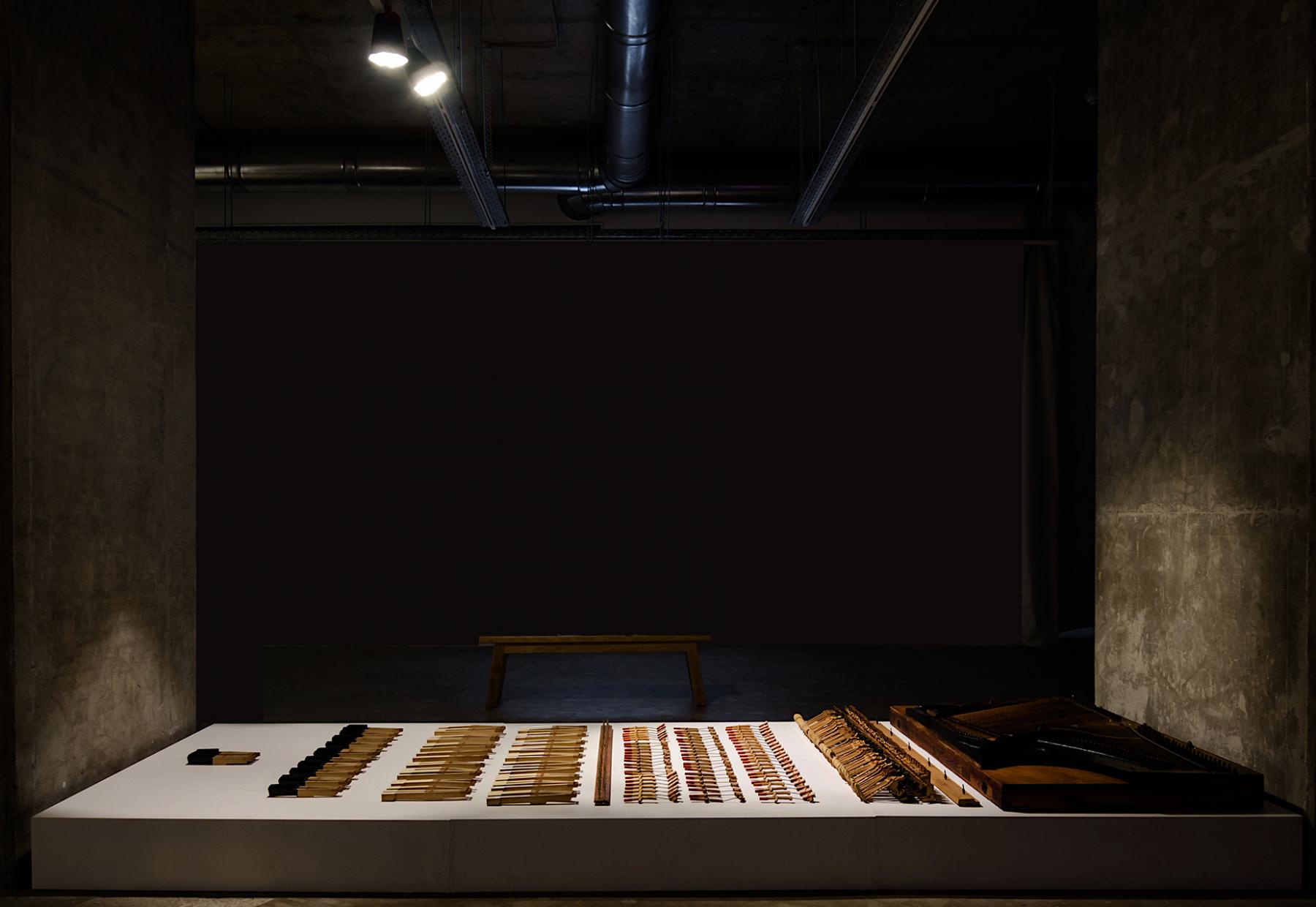
Cynthia Zaven, Arsenal, 2021. Installation view at Galerie Tanit, Beirut, Lebanon.
Courtesy of Galerie Tanit.
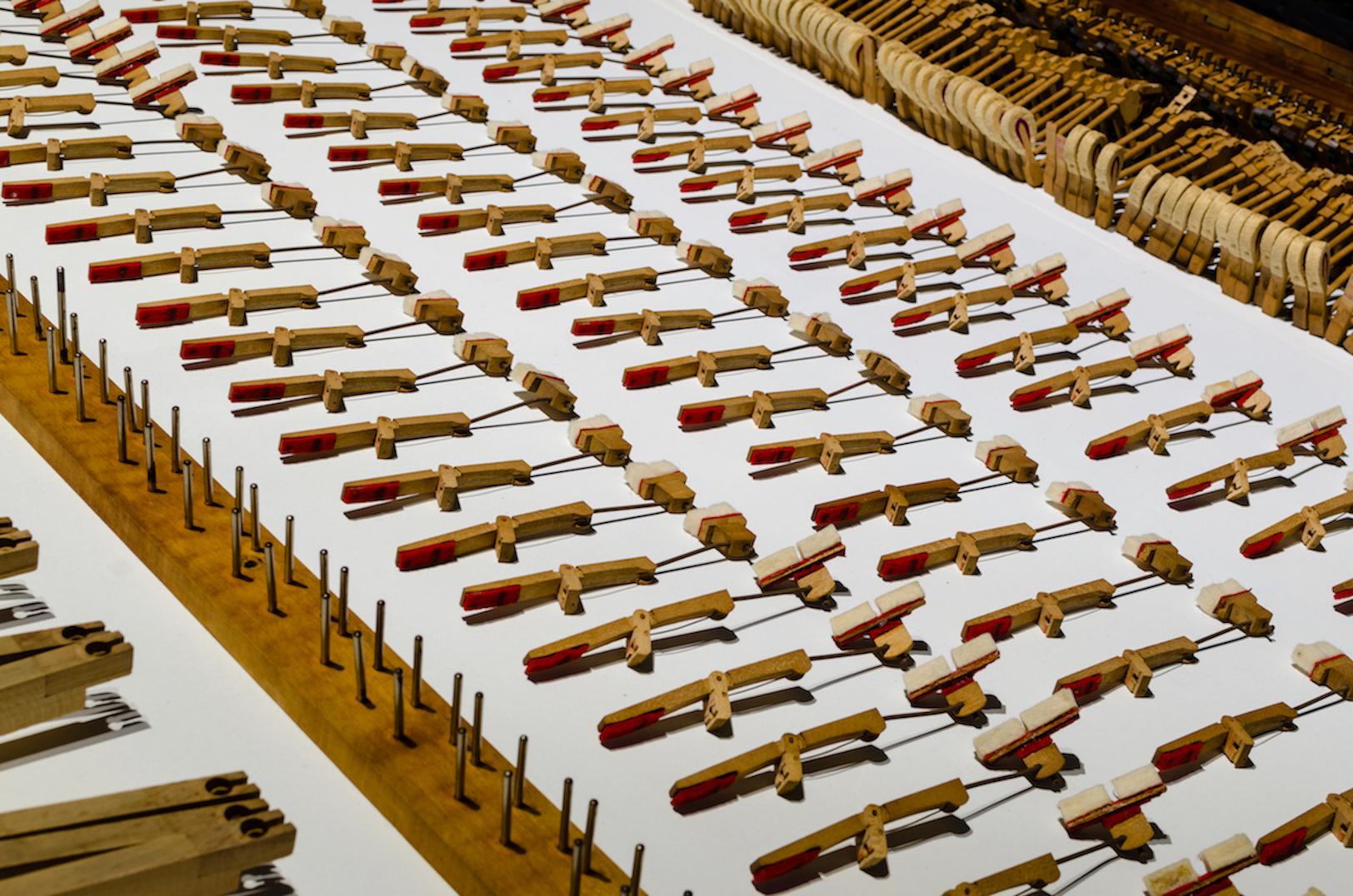
Cynthia Zaven, Arsenal, 2022. Installation detail at Villa Empain, Boghossian Foundation, Brussels, Belgium. Image credit: Thibault De Schepper.
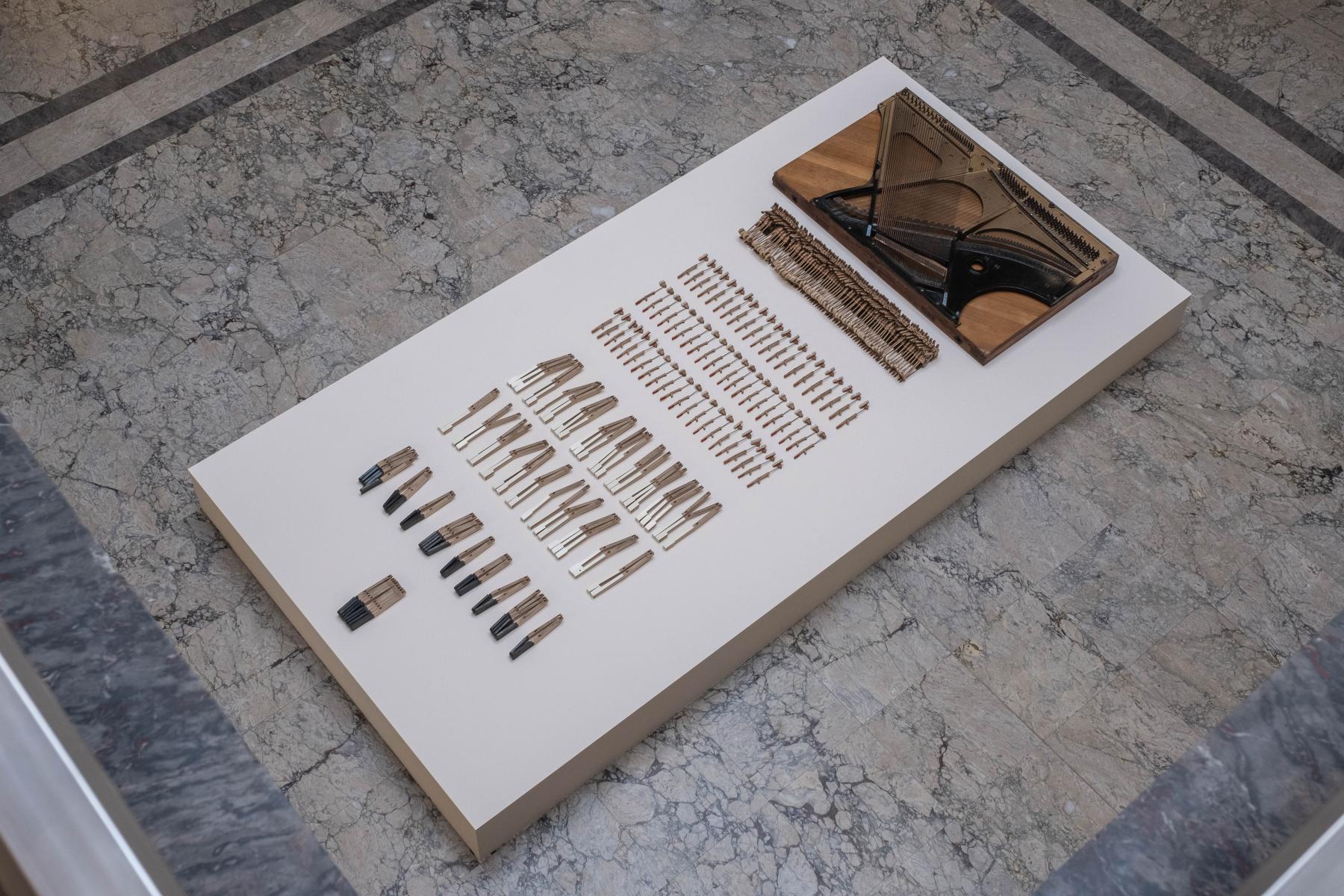
Cynthia Zaven, Arsenal, 2022. Installation view at Villa Empain, Boghossian Foundation, Brussels, Belgium. Image credit: Thibault De Schepper.
I was thinking about Cynthia's work Arsenal (2017) while sitting with Handle With Care, because there's an interesting reversal between the two works here. In Arsenal, something immediately recognizable, a piano, becomes strange through being taken apart. Here, Elias reconstructs objects from fragments until they become recognizable again, and Tender Grounds then introduces something immaterial from within those reconstructed forms. Does that reversal between disassembly and reconstruction reveal how an object's meaning changes with the way it's transformed?
CZ: It's interesting that Arsenal is a deconstructed instrument with no sound, while Handle With Care is an arsenal with sound. But I wasn’t consciously thinking about Arsenal when working on Tender Grounds. In Arsenal, I dissected a recognizable instrument into many fractions, atomized the mechanism, and stripped it of its conventional identity, turning it into something else. What interests me is that recognition does not necessarily bring us back to the original meaning. There is a moment of uncertainty between what we think we recognize and what the object has actually become. The sound in Handle With Care comes from the platform where the sculptures are positioned. It emerges from within a physical environment that is already charged with transformed objects. It does not explain or restore their meaning; it creates another possibility for experiencing them. The platform represents the ground, the soil, the earth that bears the impact of wars. Both Arsenal and Handle With Care are concerned with transformation, but in opposite directions: one moves from recognition towards estrangement, while the other moves from fragments towards recognition, with sound then adding another layer to that recognition.
EN: There was actually a small reversal that Cynthia and I had already talked about while we were working. Arsenal begins with an instrument that has been taken apart, and there is no sound. Here, I’m reconstructing an arsenal, and sound enters it. I like that relationship, even though I don’t think the two works mirror each other.
What interests me more broadly is that reconstruction sounds as though you are restoring something, but that isn’t really what I’m doing. I’m reconstructing from incomplete public traces, never from the complete object itself. Recognition is already being produced through interpretation.
At the same time that I make the form recognizable, I remove almost everything that makes the original object operational. It loses its weight, density, internal mechanisms and function. It becomes hollow and fragile.
So I’m moving toward recognition, but not toward restoration. You know what the object refers to, while its usual relationship between form and function has been interrupted. I think that space between recognition and estrangement is probably where Arsenal and Handle With Care meet.
What thoughts would you want someone to still be sitting with, once they've left the room?
EN: When you enter the installation, you understand very quickly that these objects are fragile. People instinctively move carefully around them. They had to be cast carefully, packed, transported, unpacked and installed with care.
And yet the forms come from objects that already move through extraordinary systems of care. They are carefully designed, classified, stored and delivered.
What I would want to stay with someone is that imbalance. So much care is organized around making sure an object designed to destroy reaches its destination intact, while the body, building or landscape that receives it can be treated as expendable.
CZ: I would like them to leave with something that stays with them, even if they don’t quite know what it is or what to do with it. The information is there, but so is the emotion. Perhaps the work can leave them with a question that does not necessarily have an immediate answer, but that continues to exist beyond the room.
Is there a person, a piece of writing, or a place either of you keeps returning to across different projects, something that seems to shape your work without your fully choosing it?
EN: The land. Not really as landscape or scenery, but as something that receives and keeps traces. Things pass through it, are buried in it, damage it, repair it, and sometimes remain there long after the event itself has moved on.
I don’t think I consciously chose it as a recurring subject. I just keep returning to the sense that the ground is never passive. It holds what has happened to it.
CZ: I don’t think there is one particular person, text, or place. There are many things in literature, music, art and cinema that inspire me, but most of all, I think it is lived experience—the things I have seen, heard, felt, and lived through—that inevitably find their way into my work.