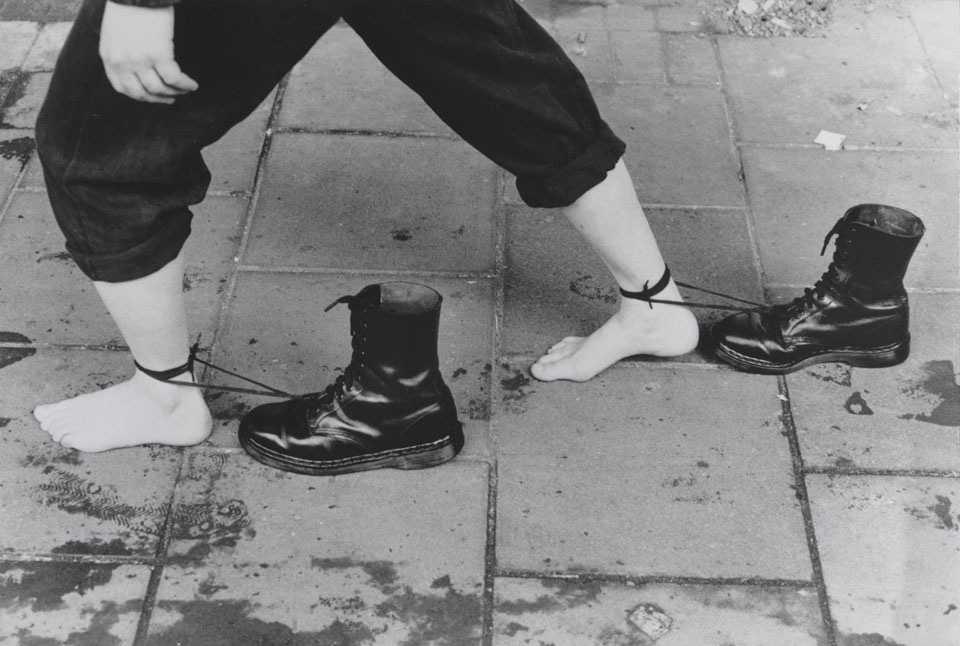
Mona Hatoum, Performance Still (1985-95). Photograph, gelatin silver print on paper, mounted on aluminium. Sourced via.
TORONTO 2024 — At the Dinner Table
“Watch out for your hate, you do not want it to turn into what happened to Jewish people in Europe.”
These words are uttered by a friend after I share that lately I have been carrying a sense of enmity towards Israel. My good friend and I are sharing a meal on the carpet of my overpriced rented studio apartment. We are in Toronto, a city with barely any redeemable qualities, to me, a Montrealer by way of Palestine. After spending close to a decade in the city-state of Istanbul, to me, Toronto is a godforsaken place. But since the violence of genocide surged on October 7, 2023, my loathing for the city has been eclipsed by a bottomless grief, and increasingly, a sense of enmity—rage of seeing my loved ones disappear in a live-streamed genocide. Witnessing the collective annihilation of family and kin seeds something in my insides, and I want to let it out to a friend.
I offer the word enmity, but she keeps defaulting back to “hate.” I tell her that hate is not a term I work with. In the North American vernacular, “hate” is often dealt with in an a-contextual, a-historical fashion. It is this thing that you either hold or do not. She offers advice to focus “on love rather than hate” because there is something ugly about enmity.
I second-guess myself. Am I out of line? I know my friend is not my enemy, but the speed at which she chooses to distance herself from me makes the pendulum swing the other way. Yet, what I’m naming is not reactive. It is a response to absorbing the live-streamed murdering of my kin, my community, our histories wiped out as Israel performs its ceaseless crescendo of violence. It is a response to the ease with which Palestinians are asked to temper their grief, to soften their language, to behave. To be digestible, speak of the violence softly, even as we are being buried.
The sting was not due to her dismissal alone. It was the familiarity of it. The way we are asked to make our grief more palatable. The way our rage must be negotiated before it can be acknowledged. As if our mourning must always come second to someone else's comfort. We are witnessing the Nakba of our generation, and even in our most intimate spaces, we are told to be careful with our words. Equanimity in the face of genocide, my friend suggests, is to be the correct position for someone like me.
Across the tables, classrooms, and corridors, I have watched the same choreography unfold: the softening of grief, the renaming of rage, the disappearance of context. Still, the anger remains—not as rupture, but as remainder.
CANADA 2025 — Third Spaces: The nation-state inside us
Palestinian-Canadians have long had to contend with the reality that their expression of anger is not welcomed. A Palestinian voice is often permitted public circulation only if it falls between a superficial message of peace or a story of hope amidst sadness and despair. Take Dr. Izzeldin Abuelaish. A Palestinian doctor who lost three of his daughters in 2009 when an Israeli bomb obliterated their home during Operation Cast Lead, Israel’s second major military assault on Gaza since the blockade began in 2006. Israeli-born producer Tal Barda made a documentary about him for the CBC, I Shall Not Hate (2023), building on the circulation of his story as a narrative that frames his grief as moral inspiration rather than a demand for justice. The film further elevates him as a model victim—one who is praised precisely because he raises a flag of hope instead of insisting on accountability or reparations.
Rarely are Palestinians given the chance to voice their political anger. An angry Palestinian is an abrasive, difficult person. An individual who cannot hold reason. Someone hard to reach. In fact, even though we are often in the vicinity of university campuses, art communities, business sectors, and otherwise, we are made to feel out of reach. State-sanctioned censorship ends up trickling down to our everyday life, mediating and shaping even the most intimate circles like a dinner table in your home.
This suppression, both institutional and cultural, is not unique to Canada but is a recurring phenomenon in liberal democracies across the "Western World.” Germany represents an extreme case, where pro-Palestine protesters routinely face police brutality, but Palestinians in particular are targeted with a level of violence that exceeds violence directed at other anti-genocide activists. The North American landscape has often been bleak for Palestinians, but it is especially nefarious in Canada. I learned early on that an individual who is politically active against Israel’s genocide is made to be a problem, but a person identified as a Palestinian is made to feel like the elephant in the room, without even having uttered a word.1
OTTAWA 2006-2011 — In the Lecture Halls
As a student in Ottawa and Toronto, I have only felt seen in moments of discreet, timid whispers. Even saying the word Palestine was chronically avoided in classes, like a Voldemort of Social Sciences. The “Conflict in the Middle East” almost always meant the Israeli occupation of Palestine. The settler colonial lens was not on the syllabus in the early 2000s. My professors, practitioners of international relations, would double-check that the door of their office was properly closed before they could share with me how they analyzed Israel’s apartheid state. In Parliament, without fail, members of parliament would apologize the very next day they uttered something true about Israel’s policies.
In undergrad, for example, I am signed up for a degree in conflict studies and human rights. But the program just teaches you how to talk about war and international relations like a liberalist. We are discussing the term terrorism in a three-year seminar about just that: Introduction to Terrorism.
"A key characteristic of terrorism is that the next attack has to be stronger than the one before it," xxxxx xxxxxx tells a class of francophone students.
I raise my hand to ask,
"What about mundane terrorism?”
"What do you mean?"
"I mean like in Palestine, people have to see military checkpoints daily and homes get raided. Is that not a form of terrorism, even if it's consistent and not extraordinary?"
Silence in the seminar room.
"Sabrien, I'll gladly discuss Palestine and Israel with you, but not here. A colleague at Concordia got in trouble, and I am not interested in going that way. You can come to my office and we can talk.”
At least he is honest about why he is shutting up, I thought.
It happens again in grad school. xxxx xxxxxx is a Track Two Diplomacy practitioner for my Master's Program in International Relations and Public Policy. He worked on the Oslo Accords, and in Ottawa he is considered an expert on the "Israeli-Palestinian Conflict." In class, he tells us how both Israelis and Palestinians are impossible to please, makes Israel's settler colonialism sound like a small family dispute between cousins who just cannot get along. But during his office hours, it is different. He closes the doors and shares with me how even his daughter—who teaches English in Palestine—“knows that Israel is an Apartheid State.” It is 2011, and he is whispering the term in his office in case the door or the wall exposes him: I can tell he believes it, he just cannot speak it outside of his office, where it counts.
At the time, it was rare to see a Palestinian academic on Canadian news. CTV loved to host xxxxxxxxx xxxx—another International Relations scholar—to offer comments. In 2012, when Israel was shelling Gaza again, she appeared on CTV News as a "Middle East Expert" and told the audience, "families on the beach are terrified in Tel Aviv, they cannot enjoy the sun peacefully.” She says nothing about Palestinians, about their killings by Israelis.
I had all these encounters long before October 7, 2023. Long before the South African delegation shared the public anger and said an enemy of justice is an enemy for all. These encounters were after 2006, when Gaza was officially put under siege, and the international community rejected Palestinian election results. Gaza would witness full-scale bombing attacks from Israel in 2008-09, 2012, 2014, and 2021. In every one of those operations, families were bombed, and entire neighbourhoods were erased. Long before October 7, Israel had vowed to make Gaza unlivable, but discourse in Canada wants Palestinians to talk about the violence with gentleness, poise, and softness.
That's the thing, our enemies are our enemies because they disrupt the people and the places we love as an objective, as a goal, as their purpose. How can I not carry this enmity if you are committed to destroying the love-making of my people?
BANFF 2024 — At the Writing Residency
On November 18, 2024, members of the literary community gathered outside the Giller Prize ceremony in Toronto to protest Scotiabank over its investment in Elbit Systems, an Israeli weapons manufacturer. A little over 2000 miles west, in the town of Banff, myself and a group of Canadian writers are on day two of a two-week writing residency, “Literary Journalism.” The director of the program introduces the space as a sanctuary for writers. Having lived outside of Canada for the past seven years, returning in January 2024, I decided to take my non-academic writing more seriously, and when a friend suggested I apply to this esteemed residency, I did not consider that I could be walking into a minefield.
One of the faculty members, an Israeli-Canadian, spent the first couple of days telling me how they brought their daughter to Canada to save her from “the bombs coming down on Tel Aviv.” They shared that they were devastated by the violence the daughter was subjected to, but not once did they ask me about my family. I could have reminded her that Gaza is still being bombed, that homes are being demolished in Jenin that week to suppress resistance. Instead, I listened to her lamentations and nodded. On the day of her public reading, she presented an op-ed she was working on that attempted to legitimize the violence against Palestinians in Gaza because the world had to get rid of the evil of Hamas. I want to stand up and scream what the South African delegation at the International Court of Justice kept saying in January 2024, “Nothing justifies Genocide,” but I don’t. No one challenged her in her chagrin that had no place and no time, just one entity to blame and entire people to punish. She was not expected to mention the context leading to October 7; she was not expected to tell us who was bombing Gaza. Her anger—divorced of history and current material conditions—was received as justified by the crowd, who celebrated her sense of disdain. Overwhelming the audience with raw emotion to distract from accountability.
In 2011, Keith Goffe, a Jamaican-born psychiatrist, wrote about his disappointment over one of Derek Walcott’s most famous poems, “A Far Cry.” Written in 1953, the poem is about Walcott’s internal conflict of having mixed African and European heritage, set against the backdrop of the violence of the Mau Mau Uprising in Kenya. The poem explores the complexities of identity, the brutality of colonialism, and the poet's feelings of being "poisoned with the blood of both" cultures, torn between his love for the English language and his ancestral ties to Africa. Goffe highlights how, ultimately, this poem is about genocide, but that Walcott insists on a neutral hostility of both sides, that he chooses to individualize his feelings, reducing “Genocide to a contest between equally bestial men, white and black, both acting without reason.” Goffe cautions from this dangerous play, writing “it is not how we usually think about the crime of genocide, as a danse macabre between victim and perpetrators.” He asks rhetorically, “Why can’t the poem stand more squarely with the victims of a genocide? Why the air of impartiality?”
During the second week of the residency, another faculty member, unprompted, gave me their personal take on the chapter about Palestine in The Messenger by Ta-Nehisi Coates (that he did not read), how he believed that Coates did not know Israeli society, and that he did not know what he was talking about. “A parachute journalist,” he called him, and finished his monologue, telling me, “Israeli people are really hurting right now.”
TORONTO 2024 — At the Book Launch
A couple of weeks after my friend warned me about my public affect over dinner, I found refuge at a book launch for Hanif Abdurraqib’s There is Always This Year: On Basketball and Ascension. The book is about many things, including love and enmity. Hanif opened his book talk with the first page of the book “…You are putting your hand into my palm, and I am resting one free hand atop yours, and I am saying to you that I would like to commiserate, here and now, about our enemies. And you will know, then, that at least for the next few pages, my enemies are your enemies…”
“Grief and Anger are in the same hum," Hanif said to the audience while pausing from reading the page. During the Q&A, a person put that line back at him, and, similar to my friend at dinner who asked me to "focus on love rather than hate,” suggested, "What about the flip side, Hanif? What about hope?" After a delicious pause, Hanif said that "hope" doesn't really propel him to new curiosities the way the responsibility to show up for the people he loves does. That's the thing, our enemies are our enemies because they disrupt the people and the places we love as an objective, as a goal, as their purpose. How can I not carry this enmity if you are committed to destroying the love-making of my people?
NEW YORK 1985 — In a hallway, inside a book
In 1985, Edward Said coauthors After the Last Sky: Palestinian Lives with Jean Mohr. The project comes out of a peculiar geographical puzzle that Said tries to solve. In 1983, while serving as a consultant to the United Nations for its International Conference on the Question of Palestine (ICQP), he suggested that photographs of Palestinians be hung in the entrance hall of the main conference site in Geneva. He was granted permission with one caveat: no captions allowed. The picture can exist, but no context should be given. After a series of back and forth with the higher-ups, they settled to simply put the name of the place the photography came from: Jordan, Lebanon, West Bank, and so on—but “no more than one word.”2
The UN, under pressure from various member states (including the U.S. and Israel), wanted to avoid any display that could be interpreted as “political advocacy” for Palestinians. Palestinians could exist only as images without words, as objects of humanitarian concern but not as speaking subjects. Only considered if context and history are erased, the photographs become mute aesthetic objects rather than political testimony.
While Mohr, who could go to Palestine, took the pictures, Said prepared fragmented texts for the 176 pages, far away from his homeland. Mohr’s photographs are given rich, introspective, sometimes contradictory commentaries by Said. Said's fragmented meditation questioned the very act of seeing and representing Palestinians. Conditionality is imposed on Palestinians if we are to be visible, if we are to be engaged. Palestinians are everywhere, but we are made to feel literally not there, except if we follow certain rules—written and otherwise—about how to behave in the public agora.
TORONTO 2025 — In my Corner
The underlying message in Said’s geographical ordeal is that “centering Palestinian voices” is one thing, but insisting on the accuracy of the violent context—past and present—is always imperative. For the UN agency, he is permitted to show Palestinians, but not permitted to use what would be considered clarifying tools of curation. Telling the stories that hold the photographs. Captions that would admit to the institutional, epistemological, and affective violence.
In the discipline of human geography, much of the field centers on the study of location and spatial relationships. Academic jargon around the “spatial turn” or “relationalities” refers, in the most rudimentary terms, to political placement: where we place people and places in our minds, memories, and physical spaces. Where do we dare place ourselves? The act of placing is dynamic, often earth-shattering, and more importantly, steeped in power. It is constantly produced and reproduced.
In Canada, like in Occupied Palestine, settler colonial political placing is drowning in violence—past and present—moved and molded by a deep-seated desire to see Indigenous people disappear. Palestinians and their anger operate in this constellation of negative life-force: place-making with ideologically weaponized celebratory identity politics and the aestheticization of trauma as a replacement for real political reckoning. A Palestinian may be invited to speak about their worry and sadness for their family in Gaza on the CBC, but we have a hard time inviting a Palestinian who wants to exist beyond this public double bind. The Canadian media is particularly complicit in this, comfortable having an Arab or some Middle Eastern-passing person write an op-ed or a feature about the Palestinian exception in the newsroom, but would never have a Palestinian in those spaces to begin with.
Israel is committed to a dangerous strategy: to utilize this historical moment to eradicate as many Palestinians as possible before the hourglass of liberal imagination runs out. The damage inflicted is irreparable, with and without a ceasefire. And yet, Palestinians in Canada (and beyond) are expected to show up in public with poise and eloquence, wrapped in a kind of gentle sadness—just soft and articulate enough—to feel comforted by a performance of empathy. All without ever being asked to truly reconsider a stance on enmity, violence, and anger—especially in a time of genocide. Across the tables, classrooms, and corridors, I have watched the same choreography unfold: the softening of grief, the renaming of rage, the disappearance of context. Still, the anger remains—not as rupture, but as remainder. It travels across years and geographies, gathering what the world has tried to strip away. Sooner or later, this country will have to stop exiling Palestinian anger and learn to see it for what it is: a legitimate, necessary anchor for political transformation.