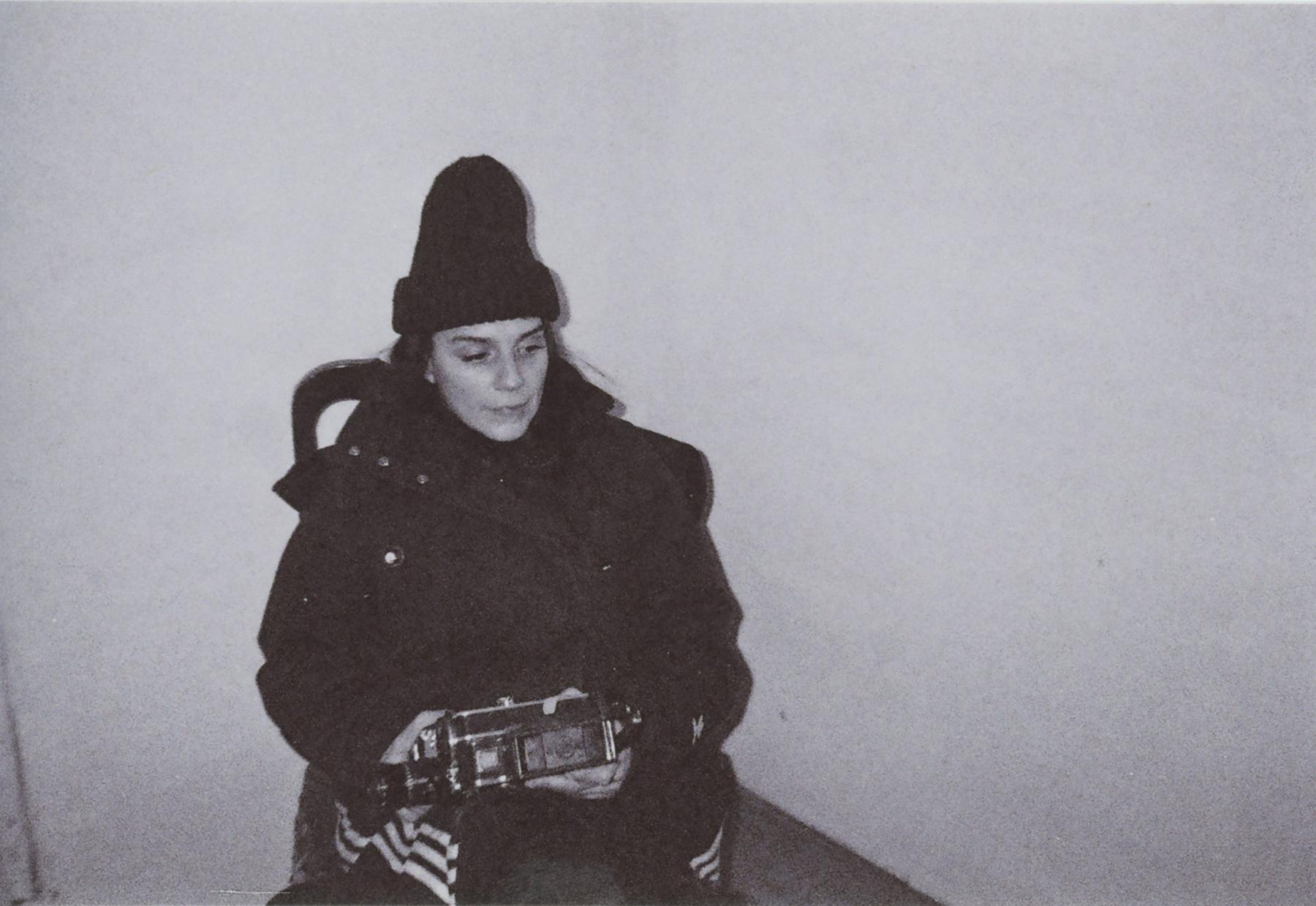
Rhayne Vermette. Photo by Ed Ackerman.
I met Rhayne in the summer of 2020 in Winnipeg, shortly after I moved to Canada for my PhD. She was DJ’ing, already with a visible spark, already operating beyond recognizable structures. There was a sense, even then, that she was not simply participating in a scene but quietly rearranging the conditions of it. Our friendship grew slowly, largely through what we did not exchange: not turning proximity into possession, not forcing disclosure into currency. I’ve come to understand her films in much the same way. They refuse extraction. They withhold resolution. They linger, knowing that true confrontation and disclosure is impossible in the wake of large-scale catastrophes—genocides, cultural genocides, residential schools, ecological extinctions, and their afterlives.
Rhayne Vermette is a Métis filmmaker, visual artist, and animator based in Winnipeg, Manitoba. Her practice spans experimental animation, short films, and feature-length works, often created through small, intimate, and deliberately non-industrial modes of production. Her films are deeply rooted in place, family, and Indigenous presence, while resisting the demands of legibility often imposed by settler and international film circuits. Rather than explaining catastrophe, Vermette treats it as an ongoing and quotidian condition. As she states plainly in our conversation: “We’ve been living inside of it.”
Her debut feature Ste. Anne (2021) marked a breakthrough. Premiering at the Berlinale, the film went on to win the Amplify Voices Award for Best Canadian Feature Film at TIFF and received international acclaim for its allegorical reclamation of Indigenous land, memory, and familial reconnection. Shot in Vermette’s home community and featuring her relatives alongside herself, Ste. Anne established many of the formal and ethical commitments that would come to define her work: non-professional performers, cyclical time, and a refusal to translate Indigenous experience for an external gaze.
Her second feature, Levers (2025), premiered at TIFF Wavelengths and screened at NYFF Currents and other international festivals, further solidifying Vermette as a singular voice in contemporary cinema. Set against a day-long disappearance of the sun, the film unfolds through tarot-structured episodes, dense soundscapes, and dreamlike opacity. Catastrophe is not climactic but procedural, something endured rather than explained. Inspired in part by the endurance of Manitoban winters, Levers also gestures toward the province’s historical and ongoing experience of colonial violence—what Vermette understands as an apocalypse that has already happened, and continues to happen.
“I don’t think about the audience,” she says. “It’s me looking inwards, prodding those places I don’t quite understand.” This inwardness does not result in isolation. Vermette’s films are made through proximity and care: friends, family, cousins, parents, and animals recur across her work not as symbols but as collaborators. Her approach to collaboration extends into material conditions—non-hierarchical wages, shorter workdays, and a deliberate refusal of exploitative production models. The credits, she suggests, function as records rather than acknowledgements: scrolls of who is actively participating in culture at a given moment, and who is usually excluded from it.
Music—particularly experimental jazz, hip-hop production, and looping structures—shapes both her editing practice and her philosophy of time. Influenced by figures like Sun Ra, Madlib, and J Dilla, Vermette treats film as a rhythmic art form, where interruption, drift, and return matter more than narrative clarity. Language, for her, is increasingly insufficient.
Throughout this conversation, Vermette returns to unknowing as both method and ethic. Her films do not protect themselves from misreading, nor do they attempt to resolve contradictions. What remains instead is an invitation: to sit with opacity, to endure without resolution, and to recognize that some images—once chased—may begin to reorganize your life in return.
I was really trying to create a beautiful mirror to hold up to the very messy, contradictory and deranged world we are experiencing today.
I’d love to start with a classic from the Proust Questionnaire: What is your current state of mind?
My current state of mind is deranged and unstable. I’m thinking of rebranding my life, and likely too open to public suggestion and opinion. Got any thoughts for me?
[Laughs] I’m definitely not the right person to give advice but that sounds less like a crisis and more like a mind in motion. I don’t have guidance so much as curiosity: do you experience that openness as disorienting, or as a condition that makes new forms possible?
It’s more like I’ve been putting the brakes on my mind. Seems like all artful thoughts are dead thoughts so why bother. I’m trying to take a break from my abstract headspace by focusing on the body in preparation for the end of the world. Trying to both soften (in terms of my capacity for love, honesty and compassion) and harden (muscle, strength, and endurance).
Speaking of the end of the world…In Levers, the sun’s disappearance evokes responses that feel deeply procedural—people simply performing their roles, while, in the background, televisions quietly register the fear of a possible apocalypse. Rather than explaining the event, the film sustains an almost-end-times tension. How did you approach working with that atmosphere as something to be held rather than resolved, and what kind of attention did you want it to draw from the viewer?
I was really trying to create a beautiful mirror to hold up to the very messy, contradictory and deranged world we are experiencing today. It’s a crisis film, but sets a stage where ideas of survival collide with the idleness or pettiness of the contemporary every day. A large universal crime occurs, but is eventually clouded by the individual, or personal events: some more trivial (a fight over cribbage rules), some more consequential (the loss of a friend).
At first, I was also really inspired by how Manitobans endure the winter. The central idea to the story was: it’s the end of the world, a literal ice age has taken over, but in Manitoba, life goes on as usual. And the more I developed this idea I recognized it both as a prosaic suggestion in regards to our winters; but also as a catastrophic ongoing reality in terms of the province’s historical and ongoing relationship to the Indigenous nations on this land. Collectively, the end of the world has been experienced here many times over, it's an ongoing organization of happenings, always precariously near, occurring at both micro and macro scales.
Do you see apocalypse less as an ending than as a condition people learn to live inside?
We’ve been living inside of it.
I see how your thinking about catastrophe, endurance, and eternal return shapes the film. Levers doesn’t follow a strict linear story, and the sun feels like the central pivot around which everything orbits. The chapters marked by tarot cards seem to invite the audience to inhabit or interpret the film in their own way. In that context, whose eyes are we seeing the world through, and who or what guides the perspective of the movie?
It’s my eyes. I don’t think about the audience. It’s me looking inwards, prodding those places I don’t quite understand, or ideas which I am curious about. Levers is a collage of lived and dreamed images. It’s also a set of contradictions playing against each other. The film making is just me, trying to make sense of it all. I think a Manitoban audience may get the most of it due to the symbols used, the metaphors, the acutely regional sense of place, so I guess it's for them.
I think of prophecy a lot, and the power of prophecy and manifestation which presents itself in image making. Thinking of prophecy urges me to meditate on Louis Riel—a central metaphor for Levers.
I don’t know where a lot of these images come from, they just come to me through some channel. It takes me years to understand what I make and why I make it. Sometimes I think it’s like my future self talking to me in the process of filmmaking, flagging things, premonitions, highlighting information…
You mentioned not thinking about the audience and seeing the film as your inward collage, with images arriving through channels like prophecy or future self. Does that mean the tarot cards and fragmented images are more for your own sense-making—or do they leave space for viewers (especially Manitobans) to find their own connections or stories?
Yeah it’s my own sense-making. Each film I make is an exercise in thought. But, I think, as someone who is living in this world, it’s absolutely relevant to others, whether people think that or not. It’s open for audiences to jump into and derive their own reading from it. What I generally notice with my films is that, when someone alludes to what a film is about, it gives me an insight into their life, things they’ve experienced or witnessed. It’s more interesting to me to center unknowing, rather than a western-logic of knowing, it's more like interpreting a dream or something, but just as relevant.
My interest in the tarot cards came out of a desire to subvert the bureaucratic approaches of scriptwriting, it became a new model to think about approaching a story, outside of a 3 point narrative. Instead of introducing a problem and solving it, the writing was motivated by thinking of how one chapter can oppose or mirror another, or be the sum of two other chapters, these sorts of ideas. I really just kept with the cards in the film as a means to keep time, for anyone who could pay attention.
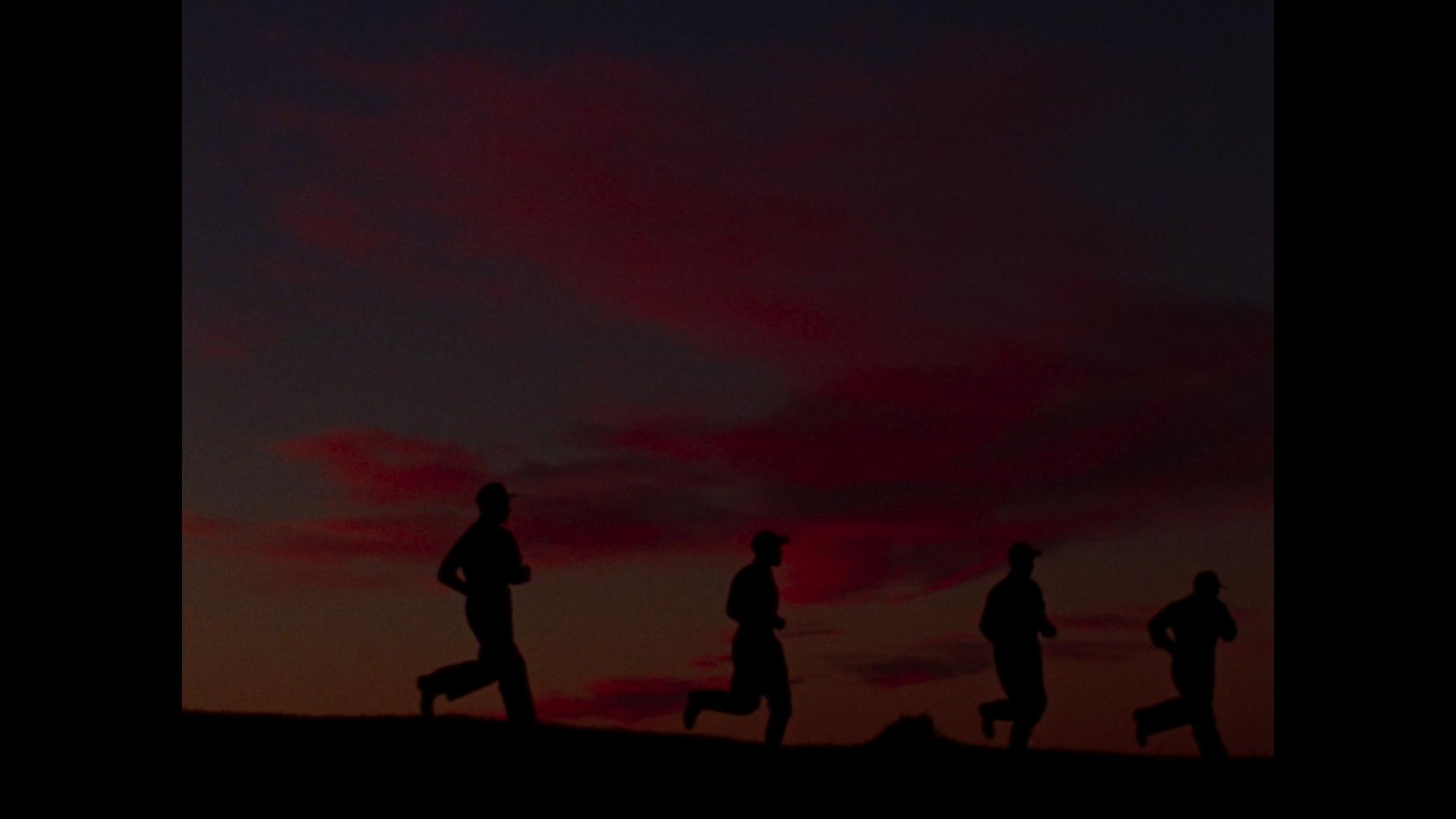
Still from Levers (2025). 89 minutes.
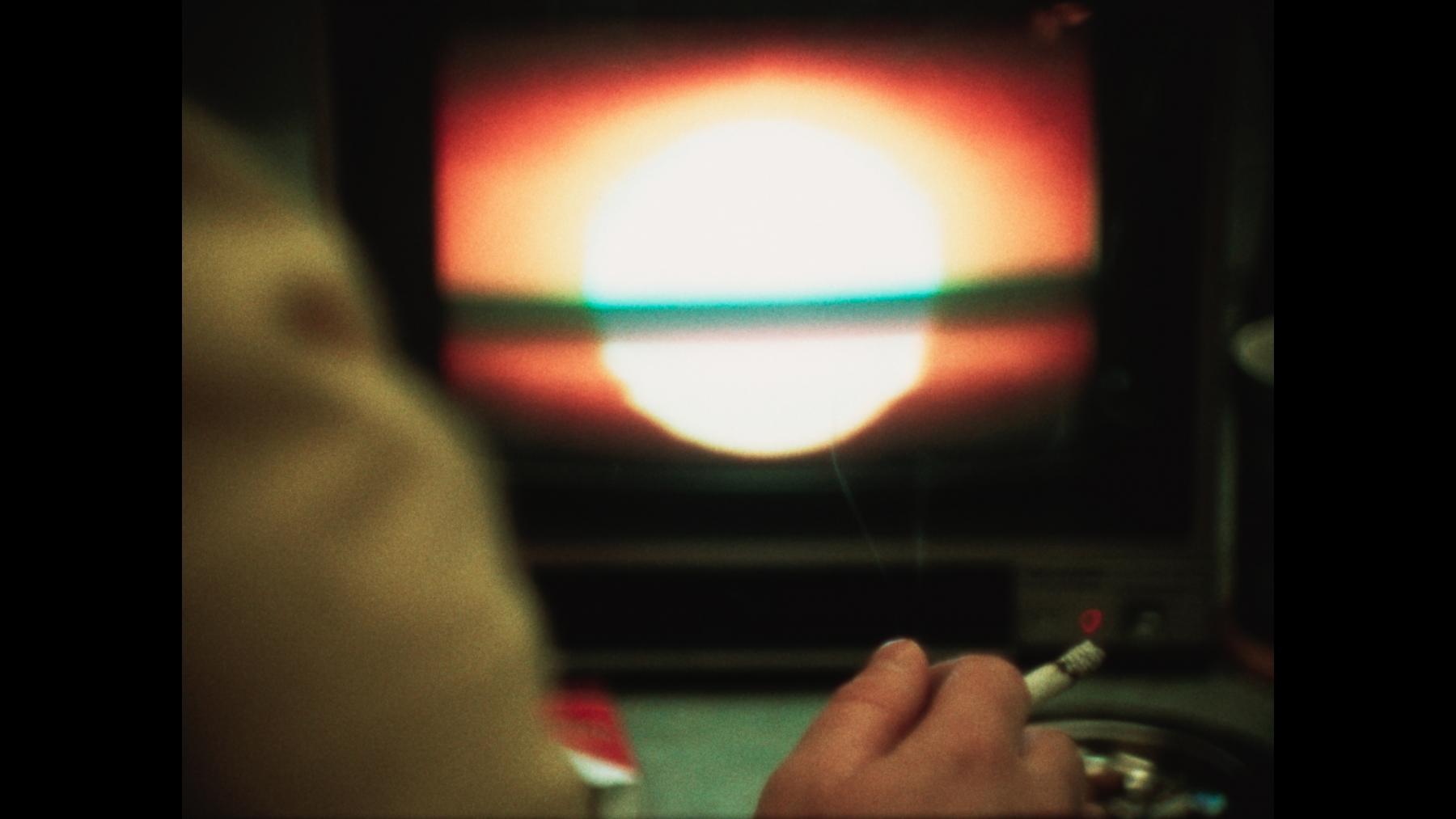
Still from Levers (2025). 89 minutes.
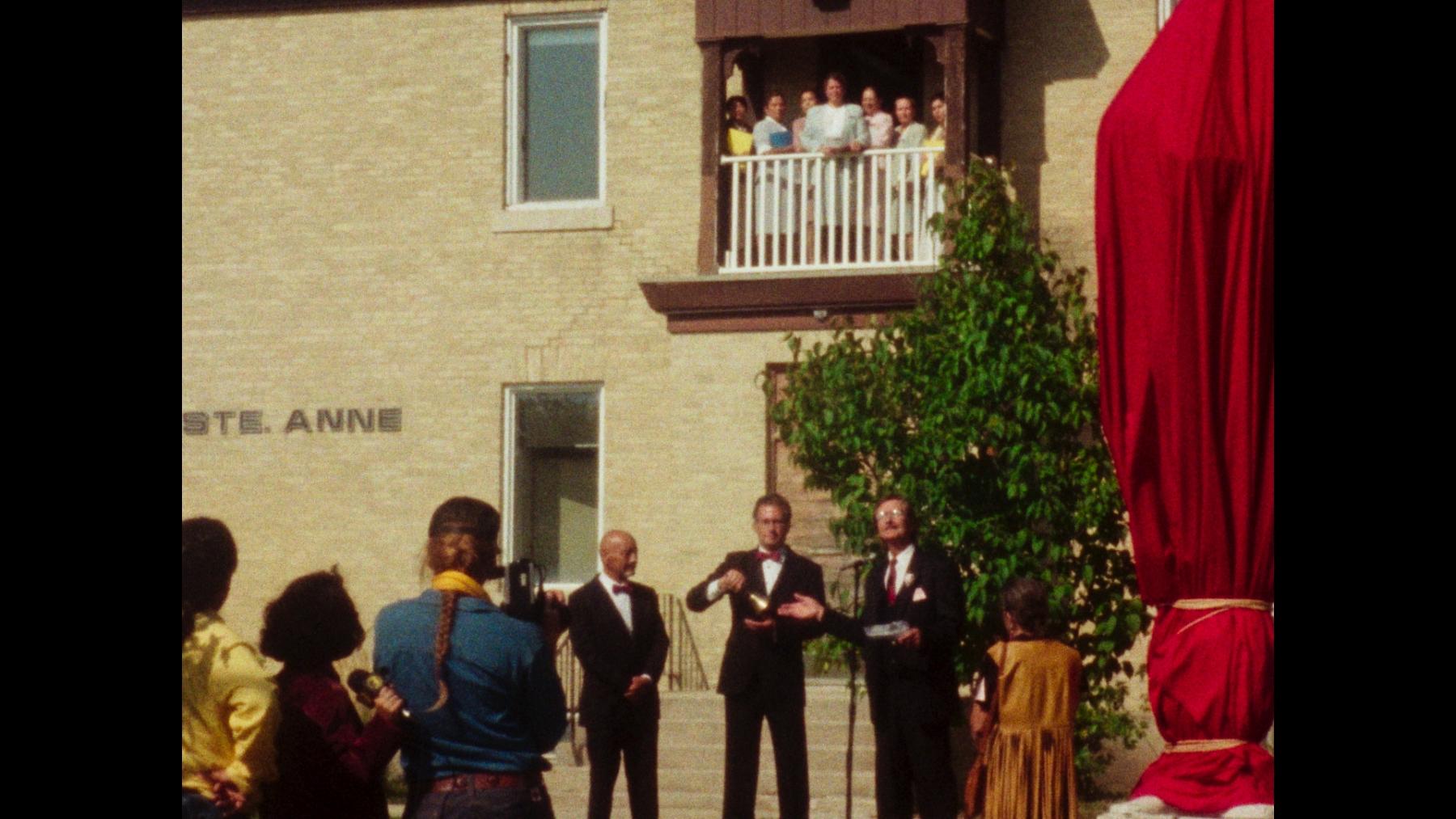
Still from Levers (2025). 89 minutes.
Your films are so closely tied to where you come from—your Métis roots and deep connection to Manitoba—yet they don’t feel confined by identity or place only. You often appear alongside friends and family, bringing people who might otherwise remain unseen into a shared public frame. How do you think about the responsibility of presence, exposure, and care when working so intimately with people and places that are part of your life?
I follow what comes naturally. My first animations came from a natural impulse to destroy other filmmaker’s films (likely some subconscious instinct driven by the patriarchal space which surrounded me at the time), and that compelling moment to deconstruct and reconstruct with other filmmakers’ 16mm film prints in many ways naturally embodied who I am, where I come from, my state of mind, and in turn a sense of Indigenous innovation—yet these works still remain far beyond the reach of the somewhat stiff conception of Indigenous cinema.
Collaboration is approached as a natural process as well. Working with friends and family was not really something I actively set out to do, it just occurred through proximity to my very small orbit, as someone who likes to remain fairly isolated, comes off as standoffish in public, and has zero interest in networking. My dad is likely my most faithful collaborator. He’s helped me on many short films and appears as concept and image throughout many of the works, as well. There is a lot of love there, he is always around to help me and I trust him the most. He also was the one who taught me how to conceive of an image (using his 35mm camera when I was a teenager). My mom is also very supportive but behind the scenes most times. She’s the one who listens to me cry about the films, the tribulations of making them, etc… And there’s also Manners, my cat, who is in many ways the hero of each film I make. His fur is also found on every frame of my animations, as he loyally sits next to me whenever I work. The presence of all of my cousins, my godfather, and extensions of my family in Ste. Anne happened naturally: we were all at a funeral, and I was talking about the film project, expressing that I needed to find actors and didn’t know how to go about it, and everyone just said “We’ll be your actors.” So I just wrote everyone into the script, and that was it.
There are some deliberate choices when it comes to certain ways I think of whom I will collaborate with…Ste. Anne was an all female crew, mostly Indigenous women, peers and friends who I met over the years or who were part of the Indigenous Filmmakers Collective in Winnipeg. Levers was a natural progression from the network built in Ste. Anne, with a lot of family members also lending a hand. I try to care for the cast and crew through the line production: the money. Providing non-hierarchical wages which are higher than the exploitative industrial wages from American and other Canadian films taking advantage of our Manitoba tax credit. We also run shorter days, we try to keep it around 8-10 hours. And the films sort of get formed around this decision. We prioritize labour so that means there’s less money for expensive gear, rental trucks, etc—so we just use 3 lights and some broken cameras.
I consider the credits at the end of a film as a record. It’s a scroll of who is actively participating in the culture of Winnipeg or Manitoba at a specific time. You look at other Winnipeg films, and there are a lot of recurrent names, which, to me, points to a glaring omission—folks who are here, but don’t have the privilege, the network, or “on-paper” skill set to participate. This is also why I like to work with super emerging people, non actors, and artists from different backgrounds to transform the scroll. It’s so much richer than a handful of seasoned union guys.
In terms of the feature films, I’ve been portraying what lies beyond the patriarchal lens of a particular “Winnipeg,” which has been propagated by more internationally recognized films. I actively focus on feminine experience, Indigenous presence, and Manitoba ie: the land beyond Winnipeg, as someone who grew up in rural Manitoba, and who works often in the North. I try to showcase the beauty of the province and capture its spirit as a means to balance the more deprecatory and whitewashed images which audiences are used to seeing. I’m not interested in making jokes about this place. Instead, I try to make space for all the contradictions that we as Manitobans endure, to converge. Things like the hardships of 7ish month long winters, the innate tensions which arise in a city densely populated by Indigenous people and immigrants, the difficult paradox of our province’s Indigenous leadership and the myriad of ways they’re selling off the land and their Nations, the persistence of colonization, the fact that the North burns every summer, the ongoing crisis of missing and murdered Indigenous women, girls and two-spirit people…All of this is swirling in my films, I don’t feel the need to explain it, or dumb it down for a European audience. Either you get it or you don’t. But, the energy of dissension is real here, it’s always present, everything is happening though it feels like nothing happens at the same time.
You said you’re not interested in explaining or translating your work for an external gaze—“either you get it or you don’t.” How do you protect that refusal in a film world that often rewards legibility and simplification?
These days, I don’t think it can be protected, honestly.
I only make films to fulfill some desire to chase the unknown. I keep myself interested in the work through titillation and unknowing. I’m not interested in making something that looks like what was written on the paper, but interested in what occurs off the page...
The film opens with a Sun Ra quote, and music is clearly central to how you work. You’ve said producers like Madlib and J Dilla taught you the most about editing. Sun Ra’s experimentalism often disrupts time, structure, and causality, while beatmakers rely on looping, sampling, and fracture. How do those musical approaches translate into concrete editing choices in Levers—particularly in moments where rhythm feels interrupted, delayed, or allowed to drift?
Music is the ultimate art form, it’s the most universal language. The more films I make, the more I want to take the words out, reach for some universality that’s not really grounded in this rotten Earth. I think films are losing touch with the fact that they are moving images, there are too many words, too many explanations, too much dialogue, too much voice over—it’s exhausting.
The moment I begin thinking of a story through the word (a script), the idea of a loop is innately part of my creative process. In large part due to my fascination with producers like Madlib and Dilla—but also since I started making films as an animator—the loop is really how I start thinking of building a film. In writing for Ste. Anne, I really thought I was sampling Paris, Texas—taking the shiniest bits from that film and remixing them to appease my own narrative interests. The idea of the sample also instructed a lot of the moments in that film, yet I was approaching the written sample through revisiting these spatial details, the window or the dining table, but each time you see them, they’re evolved, they’ve changed.
This is also how the script of Levers came together, it was all poetry, constructed through this idea of looping images, reoccurring symbols presented in a new way each time, etc. So any notion of time is written into the project under these influences.
Even in production, music is always playing on set. It’s always wafting in the air, influencing my mood and the mood of my collaborators. Part of my choice to use Bolex cameras for Levers was to remove the ability to have synched sound, so we could even play music while we were shooting. I also have a deep, deep natural hatred for slating. It’s like once I’m ready behind the camera: let’s go. I remember reading Ahmed Abdullah saying that when Sun Ra would count down he’d be like “Ready one!” and start. He never got to “two,” you just had to be ready. I feel a deep likeness to this avidity when on set.
I keep thinking of when we saw the Arkestra perform in Winnipeg, that one night in June on the equinox. Industrial film sets are so constrained, and this oppression is heavy throughout most of the process. But it was enlightening to watch the Arkestra, see how rigid and tight they performed (required for the complexity of the musical compositions), but there was always space for them to drift away and improvise. Then, when they needed to hit that specific note, they’d all converge, together, precisely at the right moment. My ideal film set runs this way, the chaos that comes on my sets comes from this desire—it’s not a working machine yet, but maybe one day it could exist.
The edit is sort of forcedly intoxicated under these written and collaborative impulses. But, I can also accredit my editing approaches to my interest in djs, and always listening to dj mixes at home. I’m very interested in transition, always listening for how a dj transitions from one song to another. My favourite mixes are built from transitions between vastly different sonic rhythms or beats. So in the edit, I’m thinking of the dance floor, bringing people up, bringing them down, surprising them, giving a moment to take a breath…
Building on how you described the script for Levers as poetry, looping images and recurring symbols that evolve each time, and your desire to strip away words for something more universal—I had the chance to read it, and it felt visceral and visual rather than literary. How does starting with poetry help you arrive at those images and rhythms that can ultimately stand on their own, without needing words at all?
The choice of poetry was to gather on set at the crossroads of individual interpretation versus some bureaucratic outline of events. With Levers, it really felt like the crew, the cast and I were finding our way in the dark while making it, but I was holding onto the flashlight, centering the logic.
I only make films to fulfill some desire to chase the unknown. I keep myself interested in the work through titillation and unknowing. I’m not interested in making something that looks like what was written on the paper, but interested in what occurs off the page, as well as the evolution of an idea and especially this sense of eroticism, disrobing the filmic figure to see what it's really about, or looks like. In some ways, it’s about chasing the shadow self, prodding into questions of my relation to the material and the immaterial planes. And ultimately the ways in which the seams of the imaginary (the film) cross over in my life, sometimes it's a blessing (Ste. Anne), other times it’s a curse (Levers). It’s an invitation. Images can really fuck with your life when you start chasing them.
Can you say more about that eroticism or danger in prodding the shadow self through filmmaking?
It comes back to centering the unknown versus the known, writing an obscured figure in the script, and then chiseling away the matter to find the true form of what is at the core of the project. During production the eroticism plays out often, behind the camera, witnessing the words come off the page for the first time. There’s also a sense of titillation in the ways the frame reveals or hides the intentions of the script. On set, we played around with this a lot, trying to find ways to skew the images, frame events so they don’t necessarily give us what we expect from an image. The thrill for a project is then reignited when the rushes come in—it’s another moment of revelation. Revelation is what keeps me interested during the edit. Sorting out the mystery of the work, and also the drive of the work—that outside hand which helped me form it. Figuring out the metaphysical plan onto which it exists, that’s what keeps me interested in the work. It’s like, while editing Levers, there was something pointing to an inner-knowing, this inner logic which held the whole together, which I wasn’t necessarily aware of—but it came to light in the ways certain images cut together, you know. For instance, the first moment I saw the image of the sun on the tv screen followed by a cut to the beam of a film projector. These small moments point to something much larger at play.