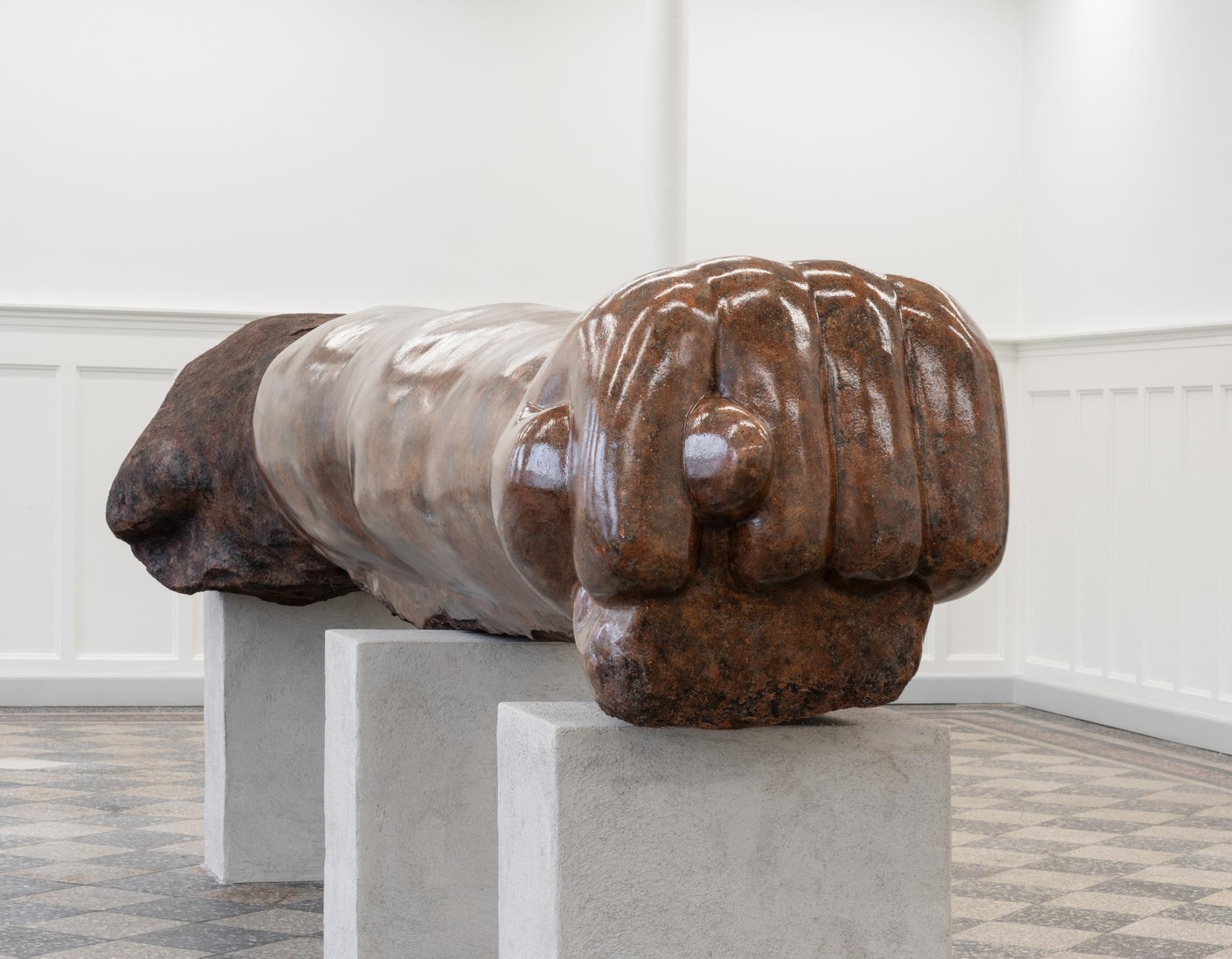
‘TH8 BJIBK’ exhibition by Ihsan Saad Ihsan Tahir. Installation view at Overgaden, Copenhagen, DK. Photo Taken by David Stjernholm
Ihsan Saad Ihsan Tahir is a Kurdish-Iraqi visual artist living and working in Denmark. His work grows out of displacement, inheritance, and the strange, almost choreographed logic of state paperwork, moving through sculpture as a way to think about the body—the place where official history and lived memory tug in opposite directions. His research often begins in museum holdings and in the language of archaeological reconstruction, then pushes back, prying open what colonial vitrines and administrative files have pressed into “artefacts.” Across an interdisciplinary body of work, he shows how citation, humor, and a well-timed gesture can reopen the question of who gets sovereignty over an image, and under what terms.
Monuments, in Tahir’s hands, never sit still. Their authority wobbles, and the absurdity hiding inside that authority comes to the surface. He works through the politics of looking, and of being turned into something to be looked at, in pieces like his reconstruction of the colossal granite arm of Pharaoh Amenhotep III in the British Museum’s collection. Once the imperial weight is made literally hollow, what remains reads less like a relic and more like an act, a posture closer to protest than to preservation. That shift brought him early attention, partly because he can translate institutional harm into objects that manage to be funny and gentle while still landing their point.
This past spring he opened a solo exhibition, TH8 BJIBK, at Overgaden in Copenhagen. There, reliefs that quote Assyrian friezes from northern Iraq appeared alongside his own family photographs and found images of Arab men, a thread that runs through much of his practice, including his sustained attention to archaeological display and to the quieter question underneath it: who is allowed to assign value, and to whom. We met after the opening to talk about the turning points that shaped his path, what is at stake in remaking imperial objects with inexpensive materials, and how sculpture can become a practical tool for pushing back against inherited stories of trauma.
In our conversation we spoke about the pressure on Arab artists to make suffering readable on demand, and about what it means to retrieve a gesture like the clenched fist, or the manus fica, a sign that has drifted between protection, insult, play, and revolt. What follows moves through the archaeological impulse, the heft and the lightness of granite and foam, the family photograph as a counter-archive, and the way Tahir’s work circles the monument again and again, only to let the air out of it.
There is something interesting in creating these almost sacred, or sacrilegious, objects that have nothing to do with what they supposedly represent. They create mythology in another way.
You trained simultaneously at the Royal Danish Academy and Goldsmiths: two institutions with quite different orientations, one embedded in a Scandinavian arts infrastructure, the other shaped by a certain legacy of British conceptualism and critical theory. How did those two formations sit alongside each other, and what did each ask of you that the other didn't?
It is a bit of a crazy story, because I initially did not want to go to the UK at all. That was not my dream. I had done a residency there a few years earlier in L.A., I think around five years ago and I became completely in love with a certain idea of Americanism: the West Coast, the sun, all of that. It was probably also a kind of Stockholm syndrome situation.
So, for a while, I really wanted to go to the States to do my MFA. I applied there and almost had one foot in. I did not get into any schools on the West Coast, but I was going to start at Yale. Then I could not get the visa. It was a technical issue: they needed to see a certain amount of money in my bank account, and for different reasons it did not work out. I had spent almost an entire year trying to get myself onto American soil, and then suddenly it was not possible.
At the same time, I was already doing the MFA in Copenhagen, because the systems do not really speak to each other. I thought, while I was applying elsewhere, I might as well keep studying. In Copenhagen, the full education is six years: three years for the BFA and three years for the MFA. By then, I was already five years in and about to enter my degree year. That was when I started looking into other universities, and I saw that Goldsmiths allowed me to apply directly into the second year of the MFA. I think the term is “advanced standing,” or something similar. It meant I could do one year there instead of two, which made sense to me, because I had already studied for five years. I was not going to do another two years. I felt done.
But there was also a financial question. In Copenhagen, you receive a study allowance, and there was no way I could have afforded to live in the UK without it. So I had to remain connected to the Danish institution in order to keep receiving that support. I had already made a large work the year before, so I thought I could save it for a group show, maybe add a few things to it, and use that as my degree piece in Copenhagen, while spending the year in the UK actually studying and making work there.
So, practically, I was moving back and forth between the two institutions every month and a half or so, flying between Copenhagen and London and trying to keep up with both schedules. But conceptually, the difference between the two places was also very clear.
The institution in Copenhagen was incredibly rich in terms of space, resources, and material support. It is located at one of the most expensive addresses in the city, literally inside an old castle, and the studios are huge: twenty or thirty square meters, and you get one for yourself. There is a real possibility there to dive deeply into material, technique, and making. It allows you to become highly skilled, almost like an artisan as much as an artist. But there was very little theory. Of course, there was some, but it was not the center of education. There seemed to be an idea that artists do not necessarily have to be constantly engaged in critical discourse. The emphasis was much more on material practice, on developing a strong technical relationship to what you make.
Goldsmiths was almost the opposite. It was much more shaped by critical theory, British conceptualism, and the expectation that you could articulate the conceptual and political stakes of your work. So the two institutions asked very different things of me. Copenhagen gave me space, time, and material confidence, while Goldsmiths pushed me to think through language, discourse, and context. Working between them was exhausting, but it also created a productive tension: one place allowed me to make, and the other forced me to explain why and how the work mattered.
Yes, which I also recognize from my own experience. I am in a similar program, within a European model, and I find that it is quite similar: there are massive studios and a lot of material support, but not much interest in critical theory, necessarily.
I am interested in how our work doesn't offer the kind of autobiographical legibility that tends to satisfy that appetite of European institutions, because it is too historically layered and unwilling to position Iraq as a wound for a European audience to receive. I'm curious whether that refusal is conscious, or if you can speak about the relationship between where you are geographically and institutionally located, and what the work is allowed to be?
As an Arab artist, one of the main issues, in my opinion, is that diasporic art often stops at representation. It becomes: “Representation is important,” and then representation becomes an end in itself. But representation for representation’s sake does not do anything.
With some of the works I make, I almost think of it as a civilizing mission, or a humanizing mission. I want to reposition who is teaching whom. In that sense, I think the work is unwilling to position Iraq as a wound as I am not speaking about Iraq in that way. There is history there, of course, and there are specific archaeological and historical references, but I am mostly talking about the informativity of power and aesthetics. It depends on the work, of course, but the reason it feels unwilling to position Iraq as a wound is because I use aesthetics that do not necessarily have anything to do with Iraq.
The stained glass is a good example of that: it is a form that does not exist, or did not exist, in that context. It comes from the West, or from this part of the world. So there is already a displacement in the form itself.
Institutionally, I also wonder about the gap between where the work is made, where it is shown, and what it is expected to explain. I do not necessarily want to say “when you make work about where you are from,” but there is a geographical and conceptual distance between the places the work refers to and the institutions that exhibit it.
I am curious about how you think through that distance. Do you think about the audience as something you need to cater to, or not at all?
I get asked that question all the time: how do I make work for a Western audience? And I always feel like I do not really think about it that way, because otherwise I would just be catering to that audience. My work always has some kind of aesthetic pleasure to it. You can read it aesthetically; you can simply enjoy it without digging further. I think: enjoy the visual, enjoy the technique, enjoy the symmetry, enjoy the form. After that, everything else is not necessarily made for a Western audience. It is not only for a Western audience. That is simply where I stop catering. I love aesthetically pleasing objects. I love looking at something beautiful just for myself. So once I have made that, I feel like I have pleased the general audience. Then I can make jokes with myself, make jokes with my people, and include internal references that critique something very specific.
A good example is the title of the show I just did. It was very difficult to convince the curator to use that title. They kept asking, “How am I going to read it?” And I said, “Well, you do not read it. Exactly—you do not read it.” After she agreed, the director of the institution gave a speech at the opening and had learned how to pronounce it, which was good. I enjoyed that. I had a lot of fun with it.
I want to hear about your own definition of masculinity and how you think this definition is explored in the show.
I think trying to arrive at a definition of masculinity is almost impossible, but that is also why I find it interesting. From my perspective, I grew up in a place where there was no space for a larger framework of masculinity. It existed within very strict boundaries. Without getting too much into it, that had something to do with the social class of where I grew up, and with the gang-related places I frequented and took part in when I was younger. Something I noticed there was how much unsaid care and love existed: how many unspoken infrastructures of care there were. There was so much that could not be said, because once it was verbalized, it would fall outside the framework of what masculinity was supposed to be.
One example, which also comes into the show, is that it was always our role—as boys or men—to get the prepaid SIM cards so that our parents could call home. That is such a loving gesture: walking all the way down to the corner shop, buying that prepaid SIM card, and bringing it back home to your mother so she could call her sister. Everyone I hung out with did that. And everyone knew that when you bought the prepaid SIM card, it would probably already be missing some minutes, because the guy who sold it to you had already used part of it. There was so much knowledge contained within that act, but we could not really speak about it among ourselves, because that would not have been seen as a “masculine” thing to do. It is a small thing, but those tiny markers mattered. Masculinity, in that context, meant not mentioning the caring things that all of us were doing. Even within the infrastructure of a gang, there are so many family dynamics. Of course, it has to do with love and care as well, but you mask it in a way that leaves no space for those words.
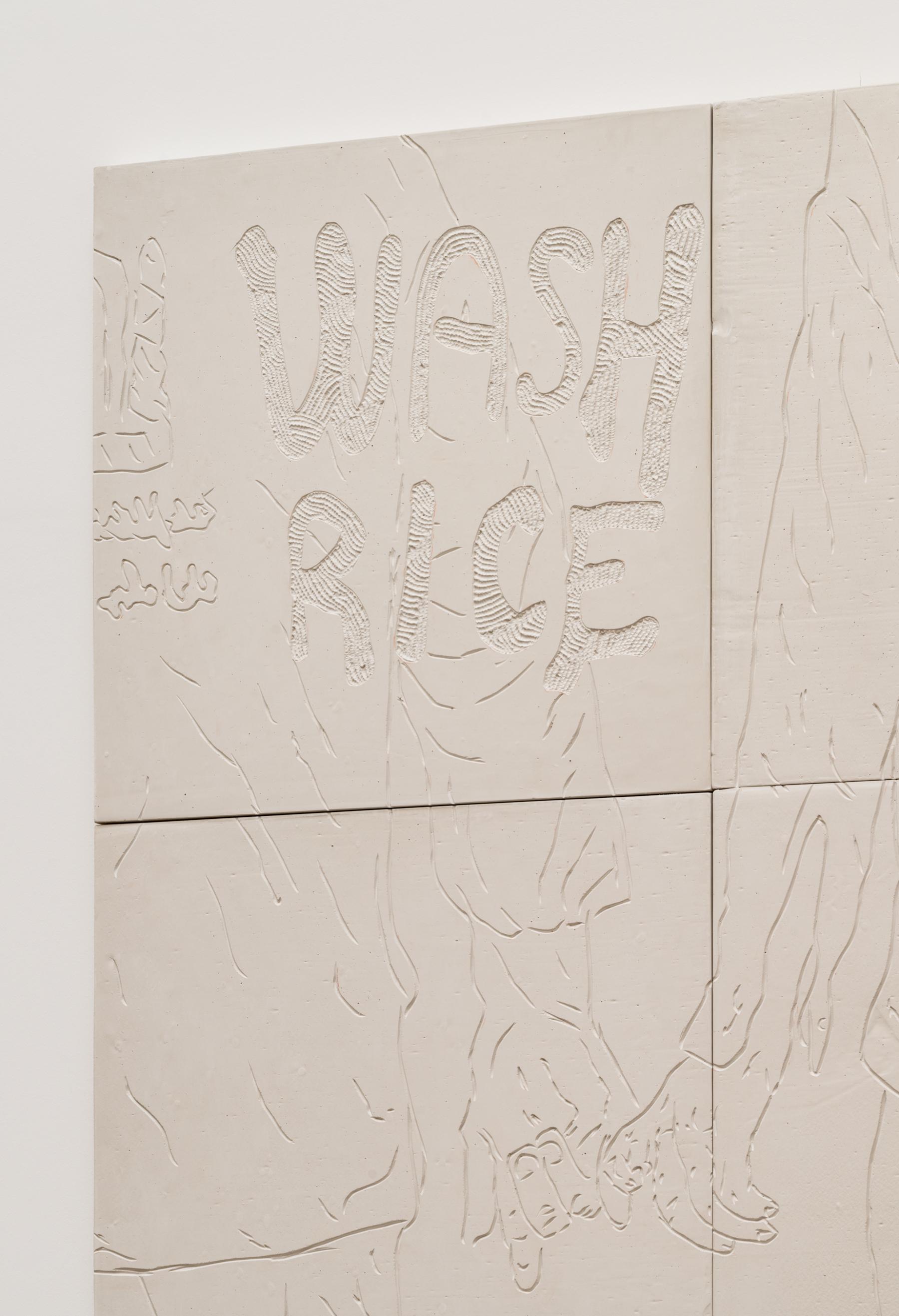
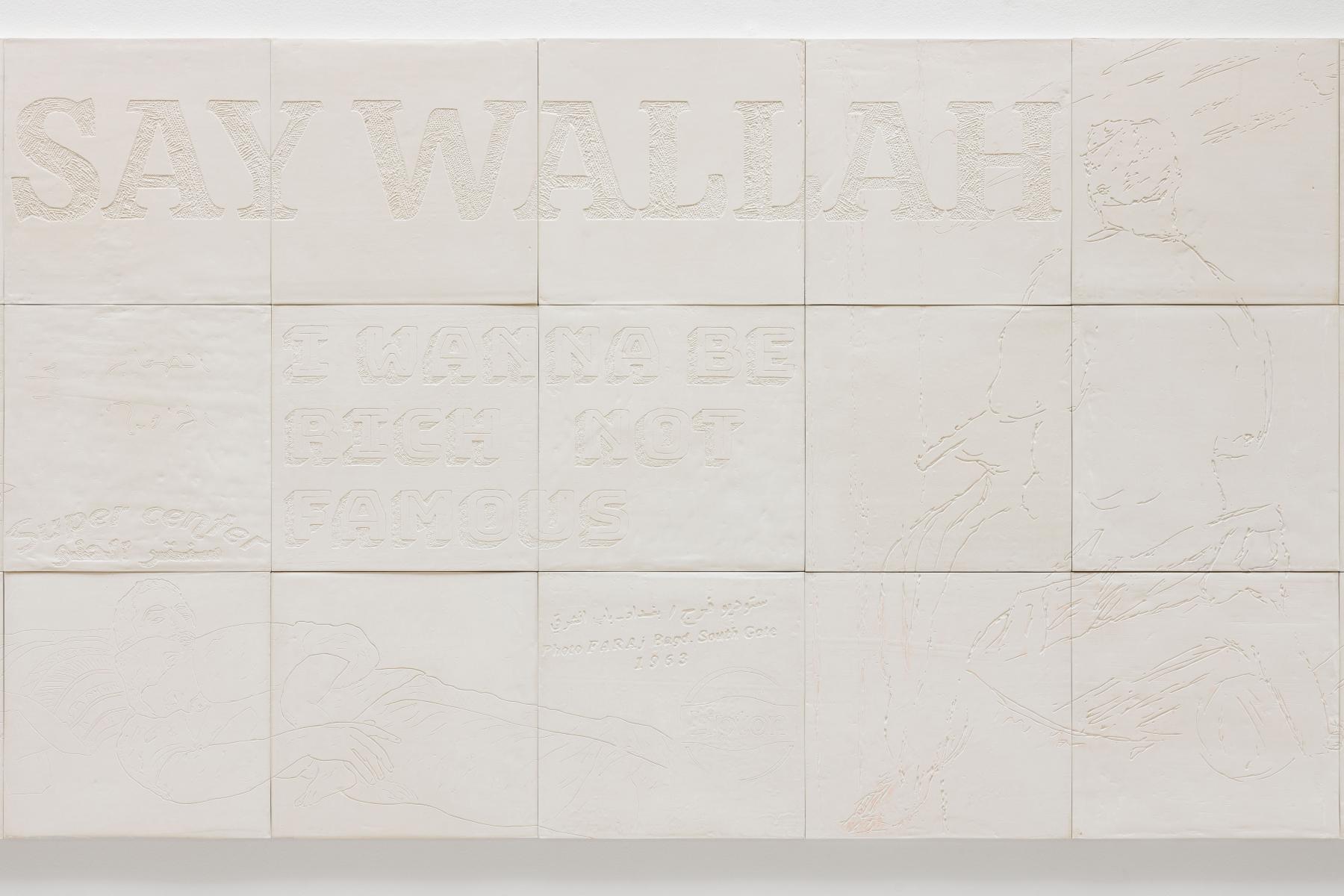
That is also what some of the pieces in the show are about. All of the reliefs are titled the same thing: Lebara. That title brings them together and creates a red thread between them, because they all touch on ideas of care, calling home, and also other uses of those prepaid SIM cards including using them for burner phones. It made sense to gather all of those reliefs under one title, as one piece.
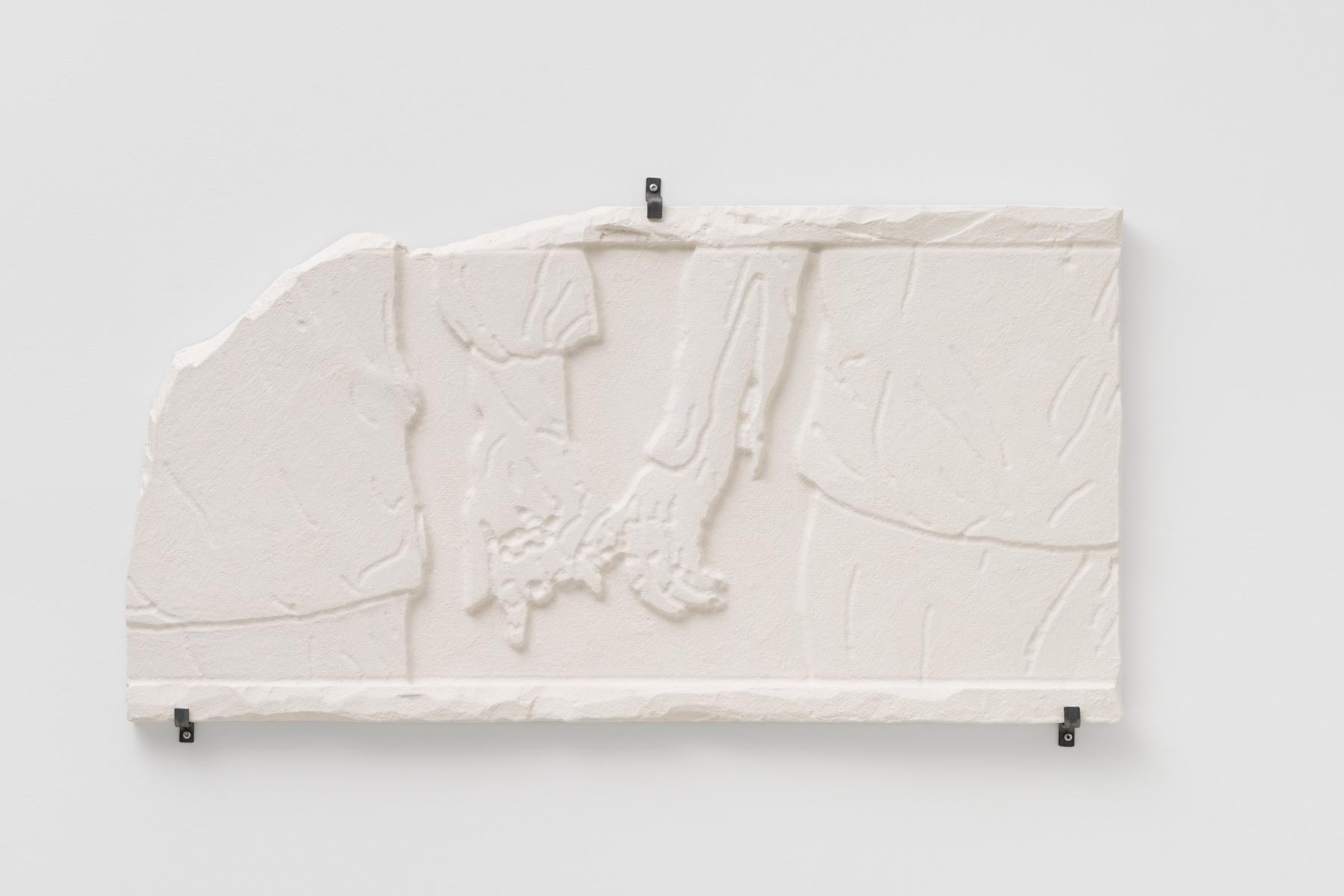
‘TH8 BJIBK’ exhibition by Ihsan Saad Ihsan Tahir. Installation view at Overgaden, Copenhagen, DK. Photo Taken by David Stjernholm
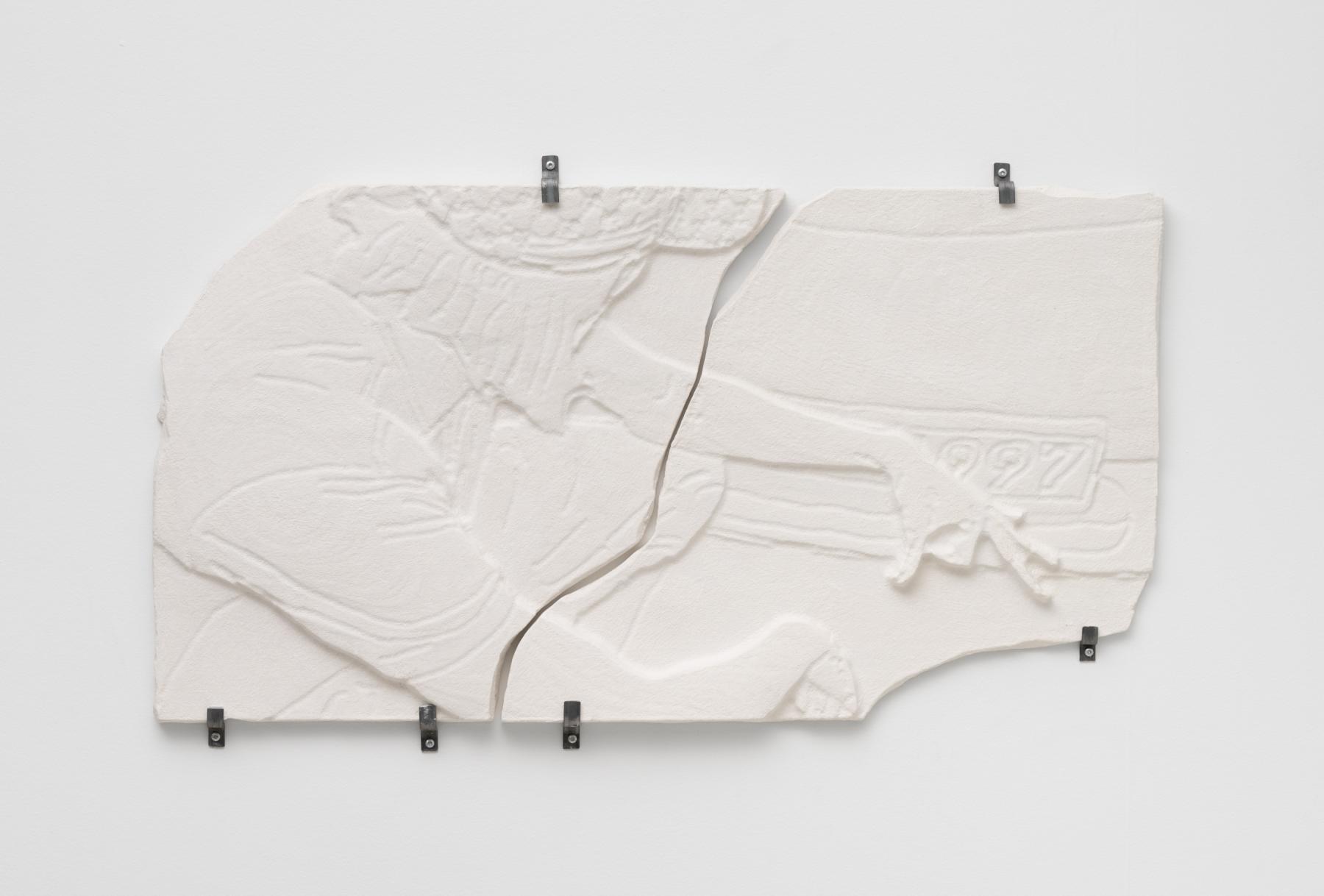
‘TH8 BJIBK’ exhibition by Ihsan Saad Ihsan Tahir. Installation view at Overgaden, Copenhagen, DK. Photo Taken by David Stjernholm
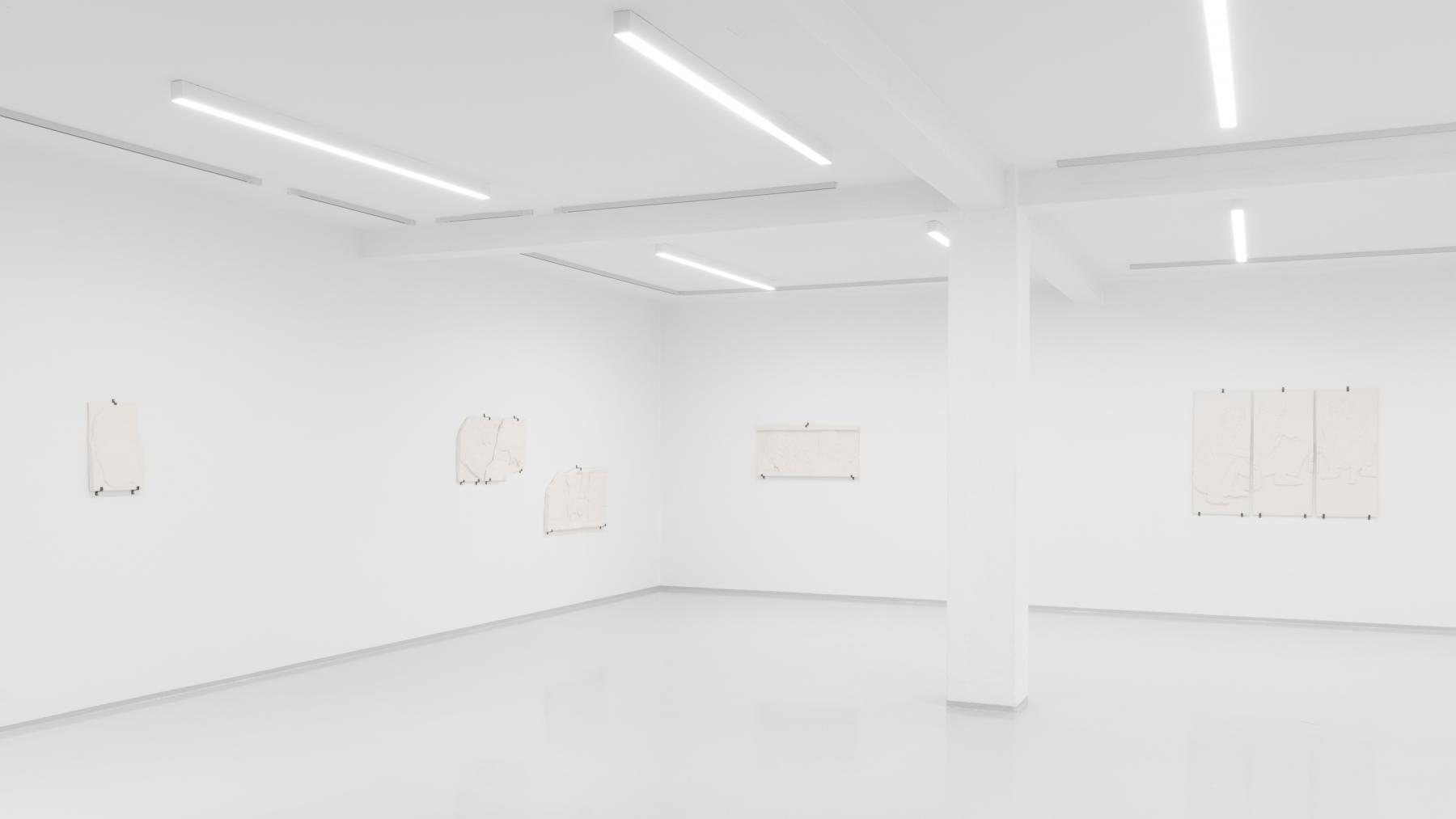
‘TH8 BJIBK’ exhibition by Ihsan Saad Ihsan Tahir. Installation view at Overgaden, Copenhagen, DK. Photo Taken by David Stjernholm
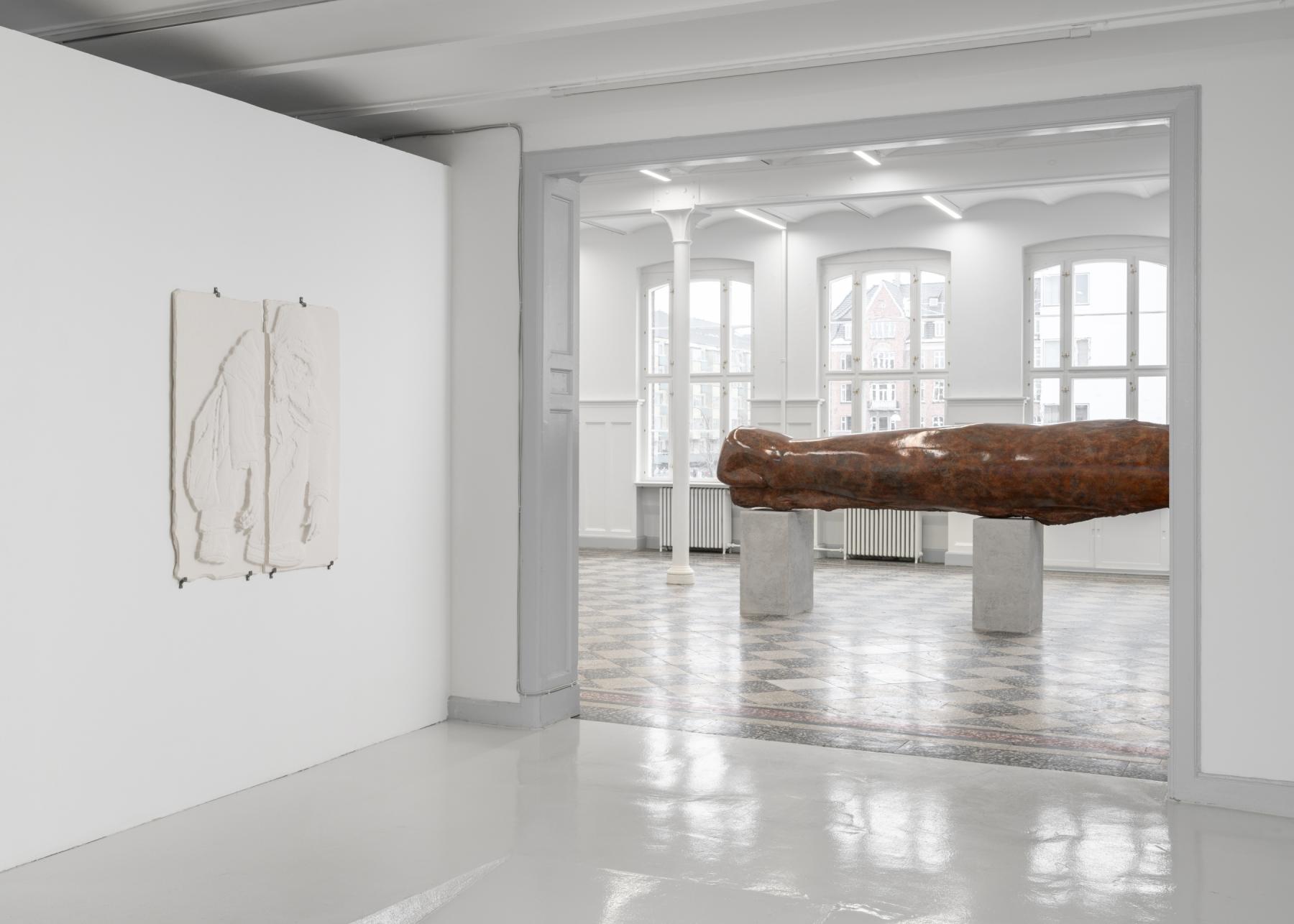
‘TH8 BJIBK’ exhibition by Ihsan Saad Ihsan Tahir. Installation view at Overgaden, Copenhagen, DK. Photo Taken by David Stjernholm
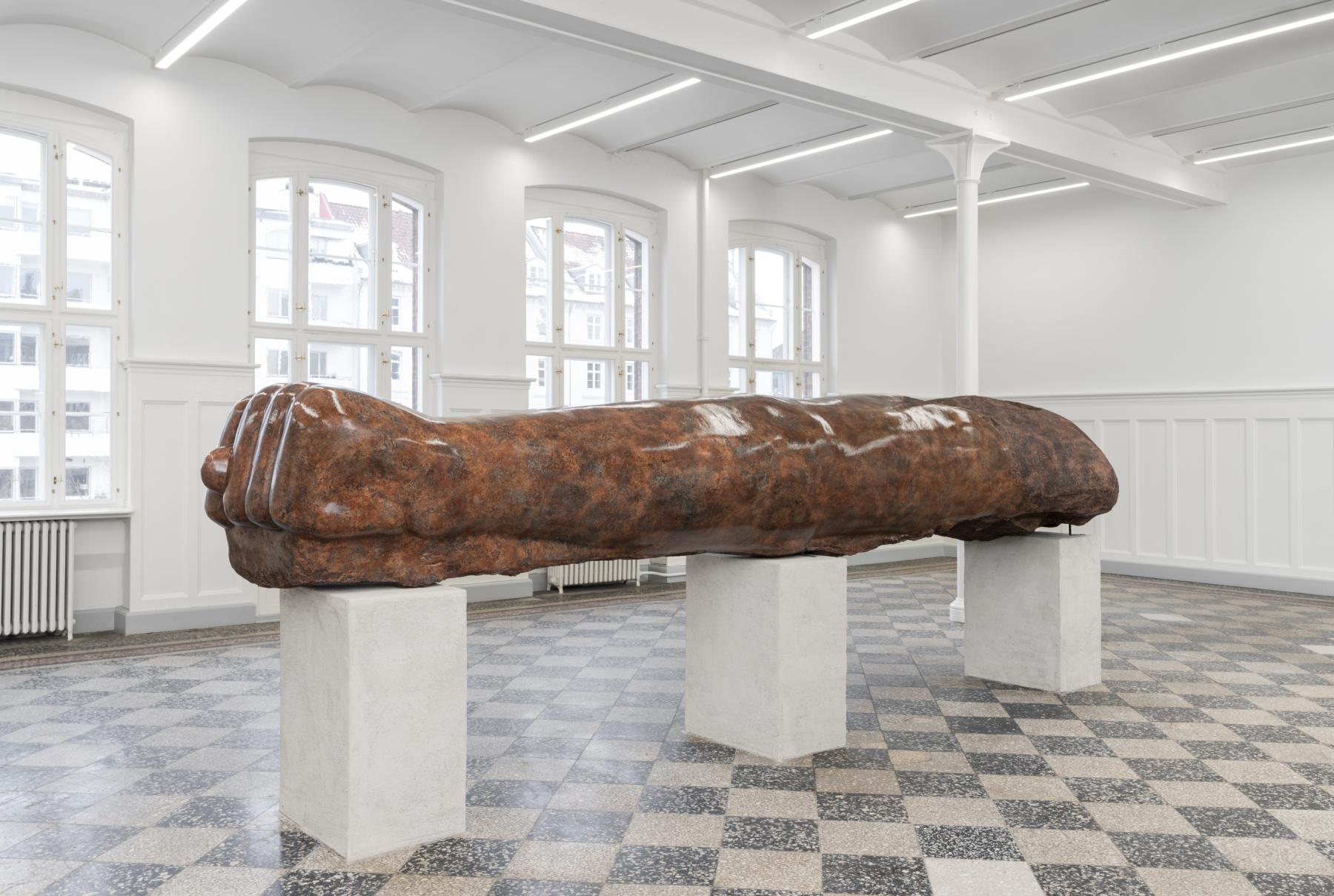
‘TH8 BJIBK’ exhibition by Ihsan Saad Ihsan Tahir. Installation view at Overgaden, Copenhagen, DK. Photo Taken by David Stjernholm
There is a long tradition of thinking about the photograph as a document and the relief as a monument but your practice seems to complicate both. The relief format carries an archival function in the Assyrian context from which you're drawing, but the imagery inside your panels comes from a personal photo archive, from found images, from things that could have been photographs. What does the relief as form make possible that a photograph does not?
Because you are talking about legibility in relation to Arab men as a specific figure, or as a specific kind of person, I think it is important to say that I did something with this show that was very different for me—technically, formally, and methodologically. When I think about abstraction, legibility, imagery, and also photography, the way I usually work is that I begin with an image. It might be an image I have taken, or one I have found somewhere. Then I sketch out only the outlines and I remove the depth. I think outlines are such an interesting concept, because nothing in the world actually has an outline. Nothing in reality has a line around it. And yet, when you see an outline, you recognize what it is instantly. In that sense, the outline becomes the perfect representation of an object without being the object itself. It loses its depth, its shadow, and its context.
Usually, I find that very interesting to work with: taking that outline and placing it next to something else, distorting the hierarchy between two things that have nothing to do with one another, and playing with legibility in that way. I think that becomes especially interesting when thinking about Arab culture, or Arab men, and placing those figures next to something else that has undergone the same process: something that has also lost its context and depth.
But with this show, I think I did the opposite. I did not want to remove the meaning or the depth. I wanted to highlight it. So I took images that I had used before in other works, and instead of only using their outlines, I wanted to give them form, shape, depth, materiality, and stone. I wanted to almost sacralize them, not in a religious sense, but in the sense of giving them value. I was not trying to make them illegible, even though the work still obviously plays with legibility. The idea of contours, or “vanishing contours,” was also connected to this—to the outlines I mentioned earlier, and to the way an image can remain recognizable even as it loses or gains context.
The exhibition moves across styrofoam, jesmonite and polyurethane foam, all materials associated with industrial production and packaging. Can you speak to that choice in what it does conceptually to locate ancient sculptural formats inside materials that are, in some sense, disposable? Is there something in the impermanence or the industrial quality of these materials that speaks to how you understand the objects being reconstructed?
A while ago, I applied for state funding for a show I was doing, and I received around five and a half thousand euros to make these coins. They were made of actual silver, which was insane to me. I remember taking that money and going to my friend’s father, who is a goldsmith, and saying: “I have this thing I want to make, and I can pay you this amount of money.” What interested me was that I took money from the state or money that usually goes into making something that has no fixed material value, like the reliefs, and I gave it to someone who then returned something to me that had value in relation to the market. That was the first time I had made something and thought: okay, this has actual value in the world.
Usually, the artworks I make are made out of materials that have very little value on their own like styrofoam, for example. We inscribe value onto them because they are artworks. But with the silver coins, there was already a market that had inscribed value onto the material. I made sixty of them, so it was a significant amount of silver.
I think this also connects to the question of form, and to how I use copying and repetition. A lot of the imagery I work with is archival, or taken from the internet as images that could theoretically be printed millions of times. But then I stop that circulation by turning the image into something that cannot be copied in the same way anymore, because it becomes stone, silver, or another material form. At the same time, the process of making them is still connected to copying and pasting. I take the image into Rhino, turn it into a 3D shape, and then CNC-cut it out of foam. So the work reverses the logic of the endlessly reproducible image. It begins with something that can circulate infinitely, but then becomes something fixed, material, and much harder to reproduce. That is basically why I do it. I would not say there is one singular deeper meaning, but it does play with questions around imagery, photography, value, and reproduction.
My old professor used to always ask me: “Why is it not a photograph?” And I think part of the answer is that I went to sculpture school.
The British Museum holds somewhere between 164,000 and 172,000 artifacts from Iraq which is the largest such collection outside of Iraq itself. Amenhotep III's arm is among tens of thousands of objects whose presence in London is the direct result of extraction under imperial conditions.
The manus fica added to the Pharaoh's clenched fist is interesting to me because it operates outside of a polished political statement. It is rude since in some contexts, it is a street insult, a ward against the evil eye, and, in certain northern European contexts, something you'd do to a child to steal their nose. I read in it a kind of ethical equivalence: that the appropriate response to colonial theft is something closer to the same register of vulgarity which is to take back, or at least to insult. Is that a reading you'd stand by? And does the work want to be read as demanding repatriation?
There are definitely a few things happening there. One of them is that the work splits the audience a little bit. I was also wondering whether you are trying to make a comment on repatriation through this work, but maybe first you can speak about that split in the audience.
It is impossible not to comment on repatriation. Once you start dealing with stolen artifacts, it becomes very difficult not to speak about it. During the preview, they wanted me to speak about the work, and I found myself asking: who has the right to cultural heritage? Who has the right to their own cultural heritage? Who has the right to culture? We were all there, in a preview, having the luxury of looking at art. So the question became: who has the right to look at their own things?
So yes, of course there is a comment on repatriation. But I also found it funny because the work really did split the audience. Some people who grew up where I did only read the insults. They did not even stop to think about the stolen nose. Meanwhile, the Danish audience did not even know there was a gesture of insult there. I loved that split, because it felt like exactly what I was trying to do. The intervention had this multi-layered context: it could be read as an insult, but it could also be read as something completely different, depending on who was looking and from where.
At the same time, it almost feels futile to speak about repatriation. Even when artists make work about it—like Michael Rakowitz’s project for the Fourth Plinth in Trafalgar Square, where he reproduced an object connected to what is held inside the museum—it still does not necessarily change anything. The work can enter the city, it can make the issue visible, but that does not mean the museum is suddenly going to respond. I can speak about repatriation, but it is not as if I imagined the British Museum saying, “We saw what you did.”
And how do you conceptually locate ancient sculptural formats inside materials that are, in some sense, disposable? Is there something in the impermanence or the industrial quality of these materials that speaks to how you understand the objects being reconstructed?
I think, as I said, it definitely has to do with inverting ideas of value. That is what I am trying to work with. But I am also definitely a hypocrite, because if someone gave me the budget, I would make it out of stone one hundred percent. So yes, I do think it is a tactic. For artists like us, who are not yet blue-chip artists, it becomes a way to work through ideas within the budgets that are available.
When we speak about construction materials, I also think they are closely related to prop-making. These are materials that prop makers use as well—I worked with professional prop makers to make the arm, for example. There is something interesting in that: the whole idea of setting a scene that is not real.
That also opens up another question around props and museums: A prop is an object that serves a certain function within a constructed context. But when you think about artifacts in museums, they also become props in some ways. They are staged, displayed, and made to serve a particular narrative. So the line between the prop, the artifact, and the artwork becomes very unstable.
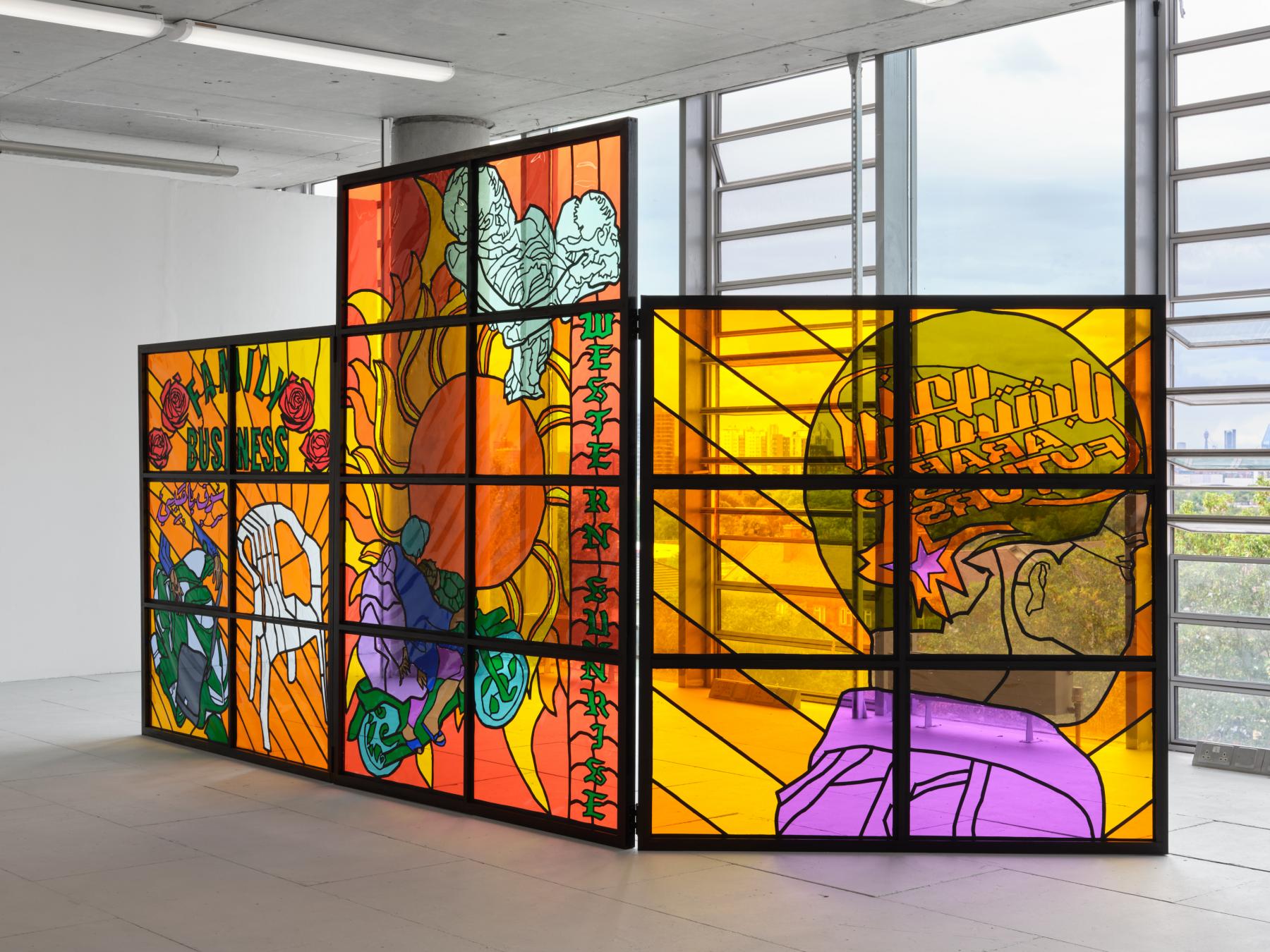
'WESTERN SUNRISE (The Fifth Column)', 2025, Goldsmiths, London, UK
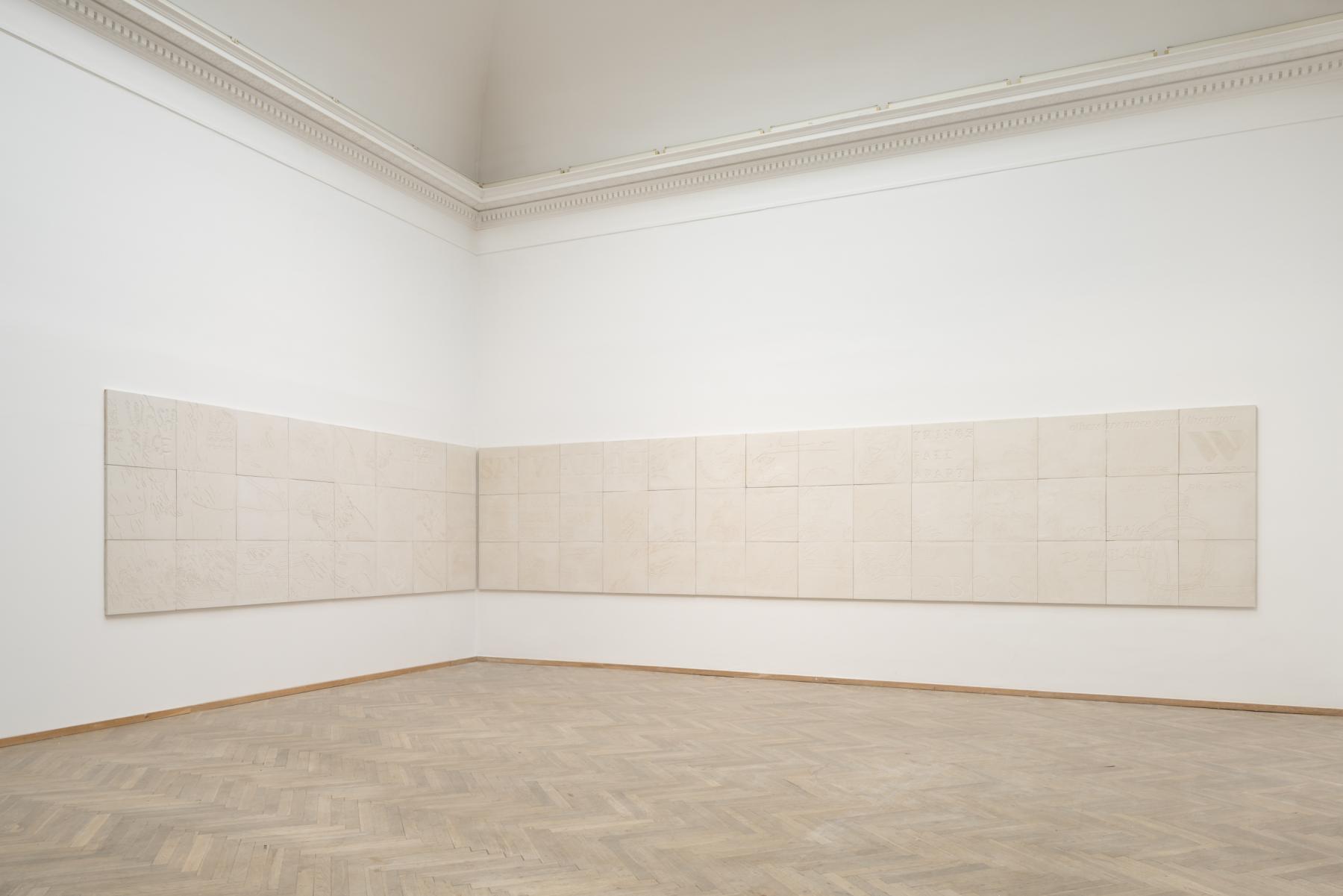
'THINGS FALL APART', 2025, Kunstall Charlottenborg, Copenhagen, DK
'THINGS FALL APART', 2025 (detail)
'THINGS FALL APART', 2025 (detail)
TH8 BJIBK is not a show about the Iraq War, nor about contemporary Arab diaspora in any conventional sense. You seem to be insisting that Iraq is one of the oldest continuous civilizations in human history, and therefore that the current condition of that civilization has to be understood against a much longer arc than the one Western media is willing to hold. How do you work across those temporal scales? And what does it mean to put Assyrian friezes and a gangster posing in front of a car inside the same formal logic?
I think the way I connect these things is actually quite simple. For me, the question is: what is Arab culture? What is brown culture? What is it, and where does one encounter it?
In museums, you encounter it at a distance: it is framed as something historical, old, and disconnected from contemporary life. It is often presented as having no value in modern society, except as an artifact. There is a sense that these cultures are associated with backwardness, or with backward thinking.
But then, in a contemporary Scandinavian context, Arab culture or brown culture is represented mostly through gang culture and that is where it becomes visible. It is also understood through rap music, because rap becomes, in a way, the popular voice of that culture, or the pop voice of gang culture.
So, in my head, there are these two dominant ways of understanding people from the Middle East: one is archaic, historical, and backward-looking; the other is connected to gang culture and social fear. I think those two things have a lot to do with each other.
The way brown bodies are represented in the media, especially in Scandinavia, is insane. You have musicians who receive national awards for their music because they are among the most listened-to artists in the country. People want to look like them, sound like them, and appropriate every aspect of how they live aesthetically. And yet, at the same time, people are afraid of them. Policies are created around that fear: evicting people from their homes, deporting them, and criminalizing entire communities. So you have this strange situation where they are among the most celebrated cultural figures, while also being treated as a threat.
There is also something in the work about sacralizing, or perhaps mythologizing. I used the word “sacralizing” earlier, but mythology might be closer. There is something interesting in creating these almost sacred, or sacrilegious, objects that have nothing to do with what they supposedly represent. They create mythology in another way.
It is more like creating contemporary monuments, or objects that are perceived as monuments, even though they belong to a very different set of references.
There is a script that Western institutions often want from Arab and Iraqi artists which reads: testimony, trauma, loss, the war as wound. How do you think about the "post" in post-Iraq War as a structural condition of what it means to make work now, in these institutions, in front of these audiences?
I think I started by saying that I am trying to look at how power structures present themselves aesthetically: through architecture, ornament, archaeology. But within that, I am also thinking about how these things are shown in the West. I think that is where the “post” is for me.
It is not only about the post-Iraq War. It is older than that, of course. It has to do with Orientalism, with the way Mesopotamia has been presented through literature, museums, and collections. I have this image of myself as a child walking through the Louvre with my parents. It was very normal for my mother and father to take us through these national collections when we were kids. Thinking back on it now, I understand it differently: it was also a way of showing us how our culture is understood and perceived here.
So, in a way, I am talking about colonization. But I think what interests me more is how power is aestheticized. How do you create aesthetics around power? I think this is also what I am trying to deflate, and maybe this comes back to material choices. Making a granite arm out of Styrofoam is not granite. It deflates the authority of the object. The next work I want to make, just to explain this mode of thinking, could be a pillar made out of the material used to make balloons. The idea is to take something that has a powerful aesthetic and deflate it.
For me, that is the “post” in a way. The post is not only the post-Iraq War. It is difficult for me to talk about the post-Iraq War without talking about the very thing we are trying not to talk about, which is the expectation of trauma. But I think there are ways of talking about war without talking about war.
One of the most interesting phrases I have ever heard is “civilizing mission.” I think that phrase is incredibly interesting. I think of my work as a civilizing mission as if to say: I am going to civilize you a little bit.
Post-war, post-Iraq War, post-9/11, all of that changed the way we were perceived here. I grew up in Europe and the day after 9/11, in school, you were supposed to raise your hand if you were Muslim. So the question becomes: how am I perceived, and how am I going to perceive you back? How do I want to speak? That is one way for me to talk about war without talking about war. I don’t know if the Iraq War affected me personally in a direct way, because I was not there. But of course, it affected me indirectly, socially. That is the landscape I want to create work from. There is a way that I am being perceived that is extremely hypocritical, and also kind of dumb. Highlighting those hypocrisies, or the places where people take certain things for granted, is where I find humor. That became an accessible way for me to work in relation to the post-Iraq War.
I think I make jokes around some of these things because they actually are funny. With the armless piece, for example, I burst out laughing every time I went to the studio. I would look at it and think: this is so ridiculous. I was literally laughing every day. For me, humor can sit inside the political sphere. The questions may be extremely serious, but they do not always have to appear serious in order to carry that weight.
What are you working on at the moment?
Without going too much into the details of the work, one of the things that occupies me right now is tragedy. I am just beginning to read some of the classics, but there is something in tragedy that I find very interesting: the sense of inevitable despair, inevitable loss, inevitable death. I think this connects to the way I have used skeletons and skeletal imagery in previous works. For me, skeletons are maybe the most humorous way of talking about tragedy. There is something playful about them. They resemble the human body, but they have already lost everything. They carry death, but they also become almost absurd, almost funny. So I am interested in that tension: between inevitable loss and humor, between tragedy and playfulness, between the human figure and what remains of it.